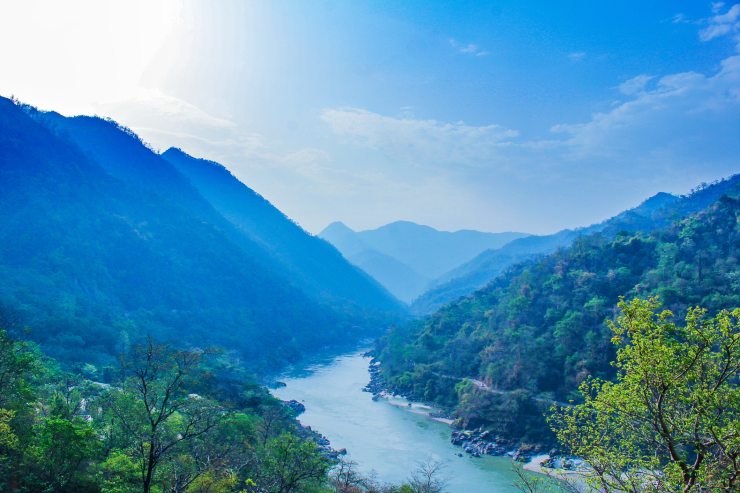
“…the Ganga is more than a river. She is the Holy Mother. She is Ganga Ma.”
Ronald Barrett
“River Ganga” by Snatam Kaur, Todd Boston and Ramesh Kannan, performed by various world-renowned musicians, which premiered at the River Ganga celebration today, the sacred day of Dev Diwali when divine beings come and bathe in the waters of Mother Ganga (courtesy of Snatam Kaur):
“If Ganges is the mother, Himalayas is the father.
One nurtures and nourishes, the other provides and protects.”
Vinita Kinra
The story behind the creation of this tribute (courtesy of Snatam Kaur):
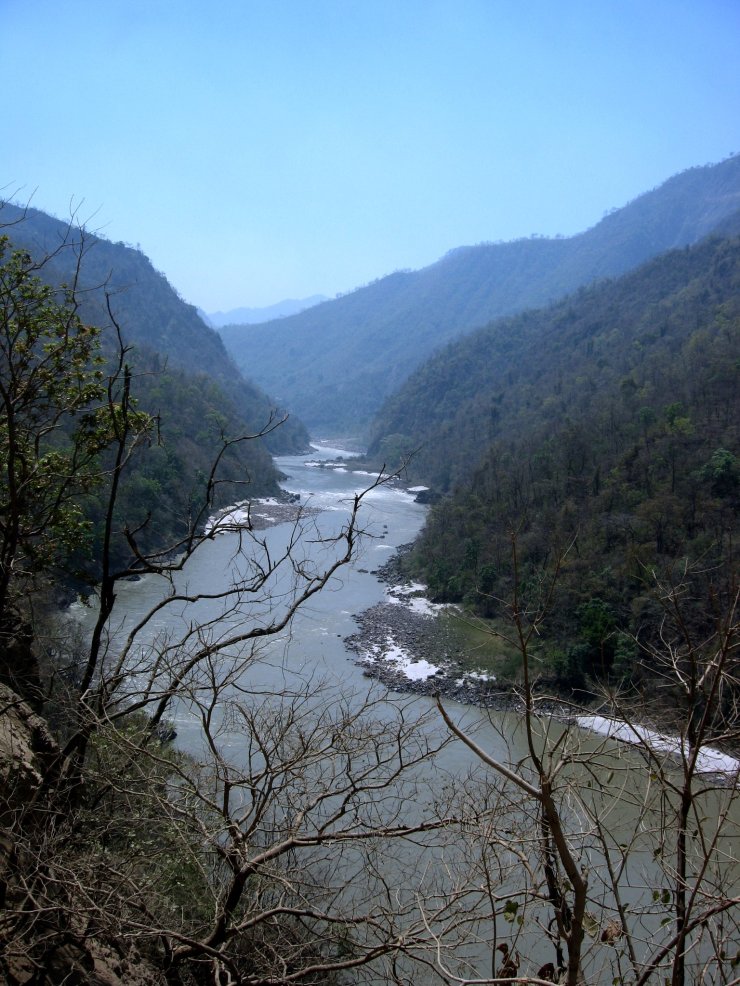
“Ganga” by Ricky Kej featuring Shankar Mahadevan (courtesy of Zee Music Company):
The River Ganges has held a powerful grip on ancient and modern generations from the Hindu faithful to celebrated writers and poets such as Virgil, Ovid, and Dante. Alexander the Great thought of her as a boundary of the universe. When Columbus reached Panama, he believed it to be a day’s march from her banks. With the exception of the monsoon, the Ganges is not one of the mightiest rivers, for there are twenty-eight rivers longer than this, with the Amazon, the Nile, and the Mississippi-Missouri each running more than twice as far. Even on Indian subcontinent reckoning, both the Brahmaputra and the Indus come off better for sheer size. What makes the Ganges unique in her run of 1,678 miles from the source to the sea is the intensity of devotion and the scale of devout humanity to be found.
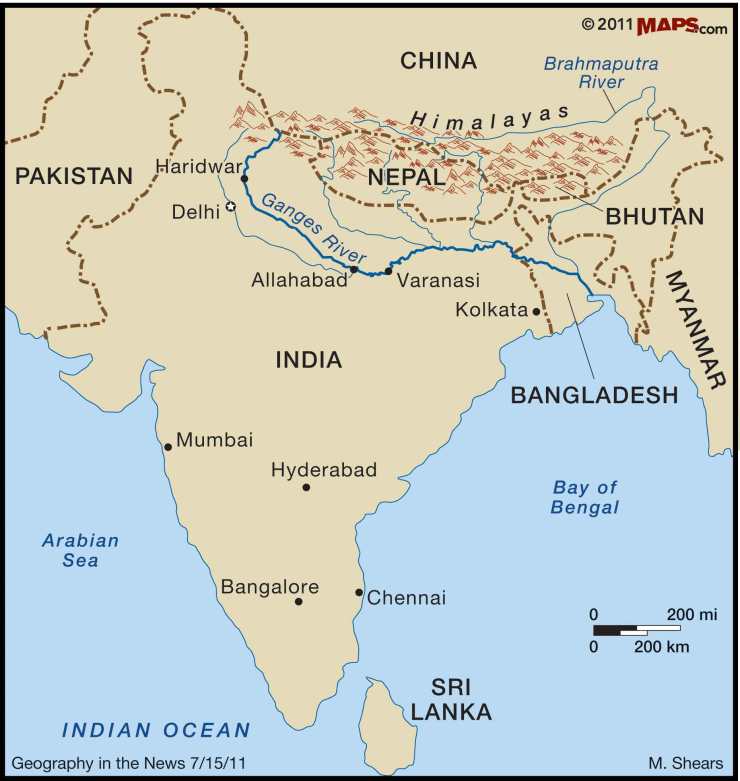
A mini explanation of the River Ganges (courtesy of FactSpark):
From Snow to Sea (courtesy of National Geographic):
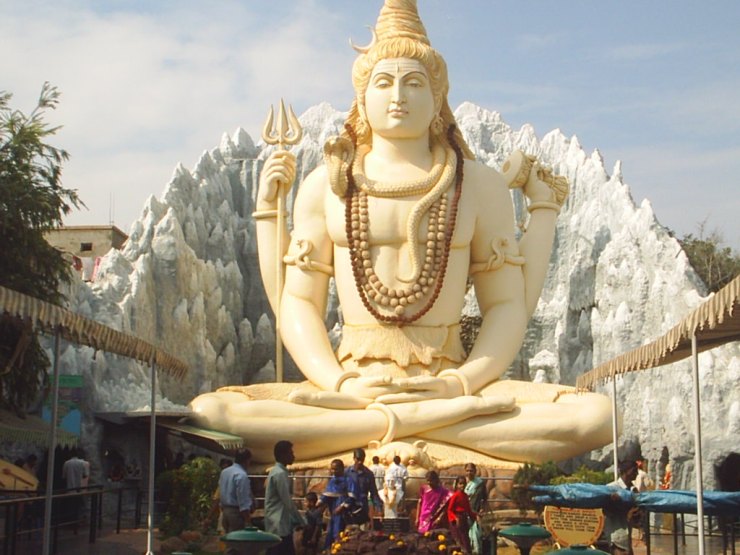
The use of the feminine is not just a sentimental fad. According to the myth, the female Ganga was brought down from heaven with the connivance of Lord Shiva in order to purify the ashes of King Sagara’s 60,000 sons who had been incinerated by the wrath of a sage for overweening pride. A subsequent king, Bhagirathi, did penance for their offence high in the mountains. When his propitiation was complete, and he began to descend, Lord Shiva caught the falling Ganga in his matted hair, releasing her gently to follow Bhagirathi out of the Himalayas, through its foothills, across the northern plains, into the jungles of the east. Eventually, at the delta on the Bay of Bengal, the ashes of Sagara’s sons were cleansed and those 60,000 souls attained paradise at last.
The source of the Ganges (courtesy of BBC Studios):
Below is a statue of Lord Shiva at Shiva Temple in Bangalore
This story is the one constant that makes the Ganges second only to that which propels a Muslim to Mecca before he dies. The Ganges is the place where people come, who have great veneration of Kali, who was a murderous lady, while others are frantic in their submission to Durga, who is Kali’s benevolent other self. They bring a personal addiction to Lord Vishnu the Preserver, to Hanuman the monkey god, to jolly Ganesh in his guise of elephant, and to hundreds more deities besides.
Below are shown carvings of the Hindu goddesses Durga, Chamunda, and Kali in the Kailasa Temple in the Ellora Caves near Aurangabad.

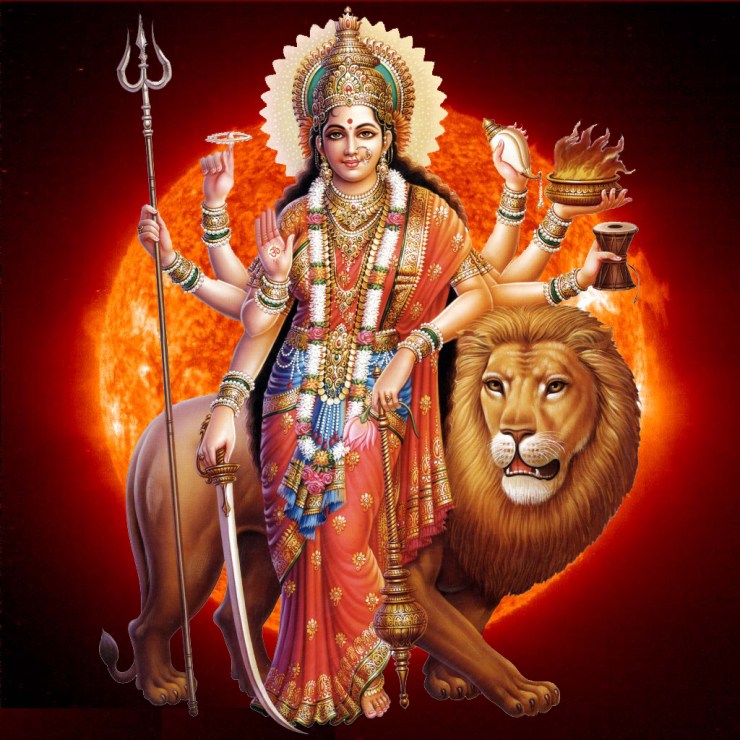
The modern day depictions of Kali and Durga are much more colourful. Below is Durga:
“Rishikesh” (courtesy of Jaime Armengol):
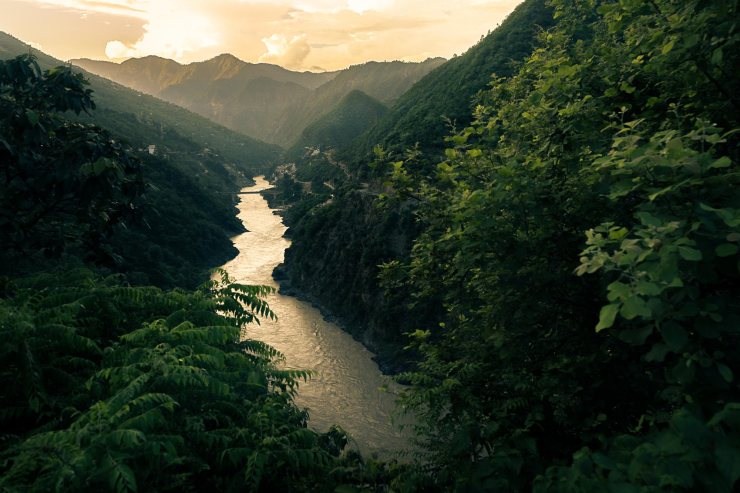
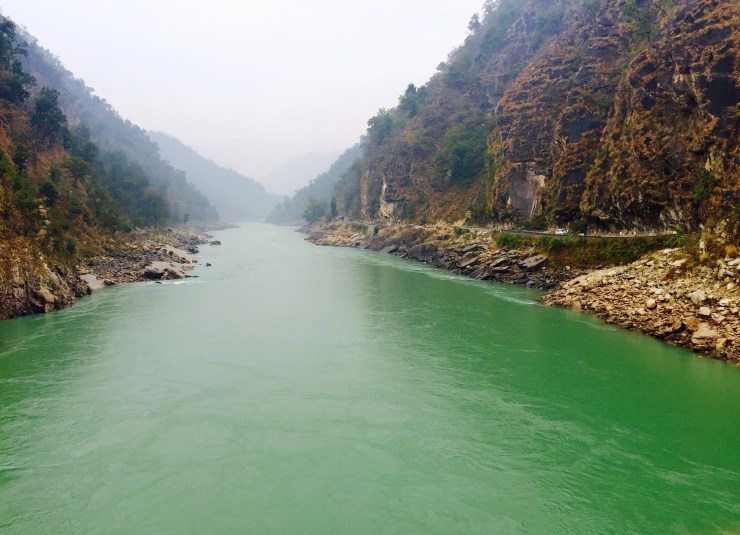
At the source, the young Ganges tumbles boisterously down a ravine, whose sides are littered with boulders that from the mountain track above look deceptively small, but which are as huge as the Albert Hall’s dome. The alpine peaks in the background are quite breathtaking. The pines are enlivened by flaring masses of scarlet rhododendrons, growing from the trunks of full-sized trees. The first villages appear where the ravine-bearing Ganges broadens enough to sustain terraces on which wheat is grown in strips no more than a few feet wide, held in place on the steep hills by drystone walls.
The Valley of Flowers (courtesy of BBC Studios):

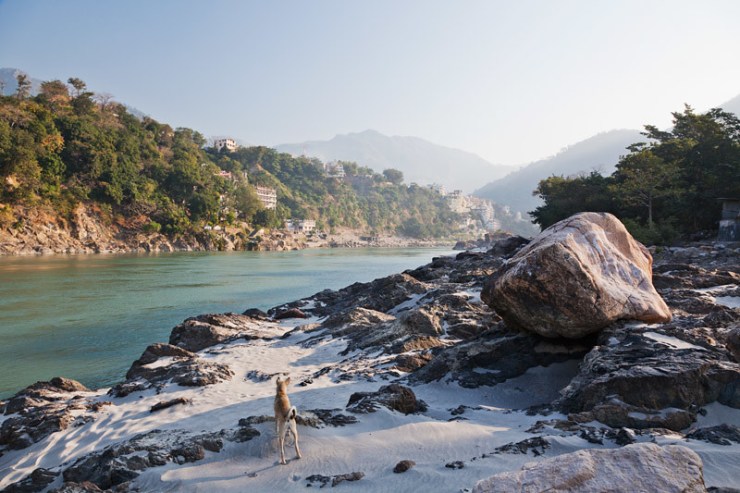

“Placid Ganges” by Mihir Chandan:
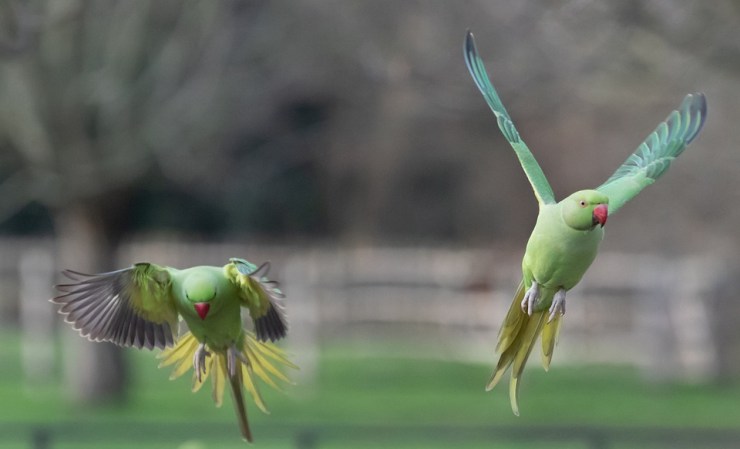
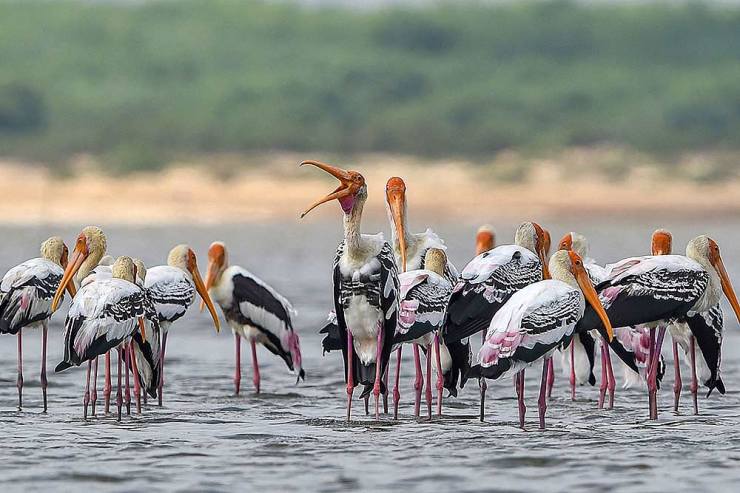
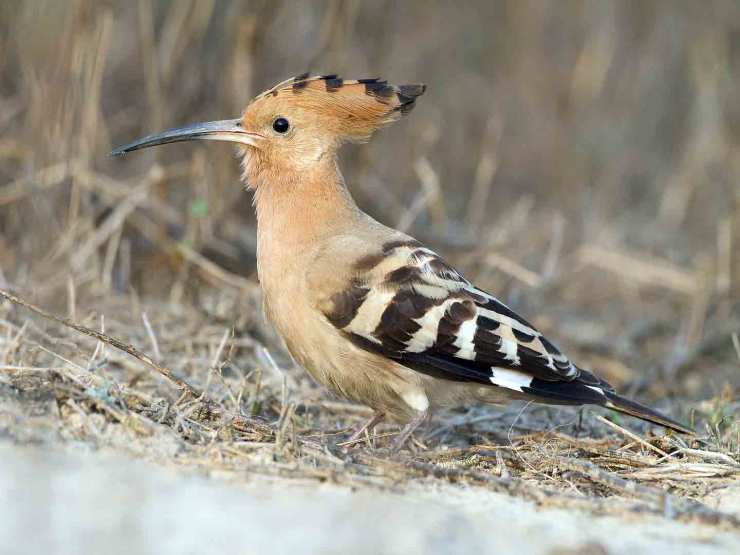
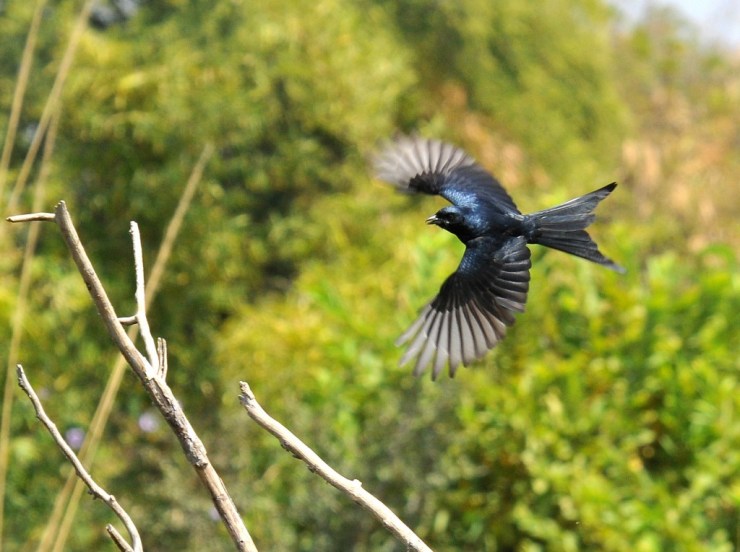
An immense variety of birds flourishes down the whole length of Ganges. Apart from vultures, green parakeets flash by, and storks stand watching the jumping fish before taking their pick. Hoopoes potter for grubs, tern dive, and drongos somersault everywhere.
Below are Green Parakeets.
Below are Painted Storks.
Below is a Hoopoe.
Below are migratory birds.

Below is a Black Drongo.
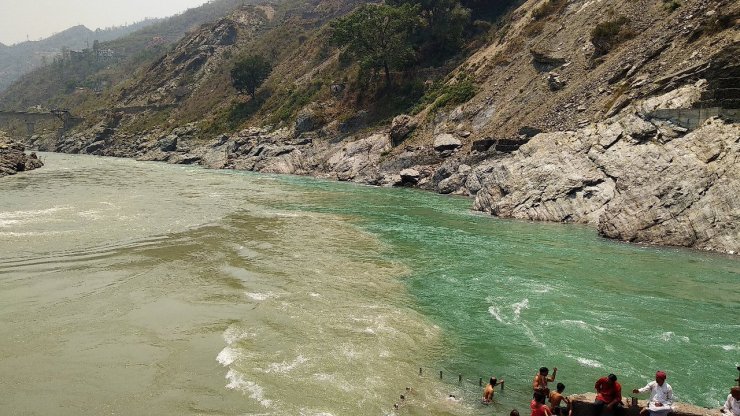
The Ganges is idyllic high up in those Garhwal hills. At Devprayag, where the Bhagirathi and Alaknanda rivers join to form the Ganges proper, monkeys patrol the cliffs and heavy chains hang from the riverside ghats for bathers to cling to. The racing current might otherwise sweep them away.
The bathing ghat at Devprayag

The confluence of the Alaknanda and Bhagirathi rivers at Devprayag
Monkeys patrolling the cliffs at Devprayag

“Down to the River to Pray” (courtesy of The Hound + The Fox):
At Allahabad, the Ganges briefly meets and merges with the Jumna, another holy river. A little lower down there are two miles of ghats, or steps, lining the Varanasi waterfront. Each day thousands come here to bathe and pray. Buddha preached his first sermon on the town’s outskirts. The dhobi wallahs, or laundrymen, are a commonplace sight along the river. The authorities have provided in some places wooden platforms against which to beat their clothes.
Dhobi Wallahs at work below.

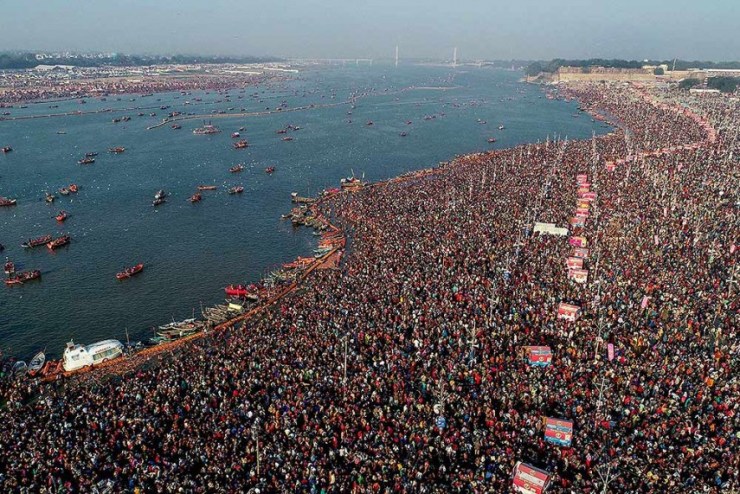
For the best part of a thousand miles now, the Ganges makes her way across ground that is nearly pancake flat and in summer suffocatingly hot which long ago caused some of those not native to flee to the hills every year before May came round. It is here, too, that the Ganges begins to succour and endow the most attractive, repellent, exciting, and always marvellous conglomeration of people that is India. Anyone who visits Haridwar, Allahabad, and Varanasi, can see this phenomenon of contradictions, this extraordinary dependence on the river. Haridwar is where legend places Vishnu’s footprint on the bank, which has drawn millions of people at a time into a town with a relatively small population. That is on the occasion of a Kumbh Mela, an event which is astrologically scheduled for every twelfth year, but annually an event called the Ganga Dussehra occurs when more than one hundred thousand also turn up to celebrate Ganga’s birth in spring. The pilgrims creep down the ghats and launch upon the water small boats made of leaves, bearing marigold petals, which are saturated with ghee and then lit. Long after nightfall, these little craft are still despatched, their tiny flames bobbing and swaying down the Ganges, on towards rougher water, where the last twinkling is doused. Then the pilgrims return to the railway station and on to the Express train with their plastic stoppered bottles or containers that will take some of the sacred water to the extremities of the country.
The sea of people at the Kumbh Mela.

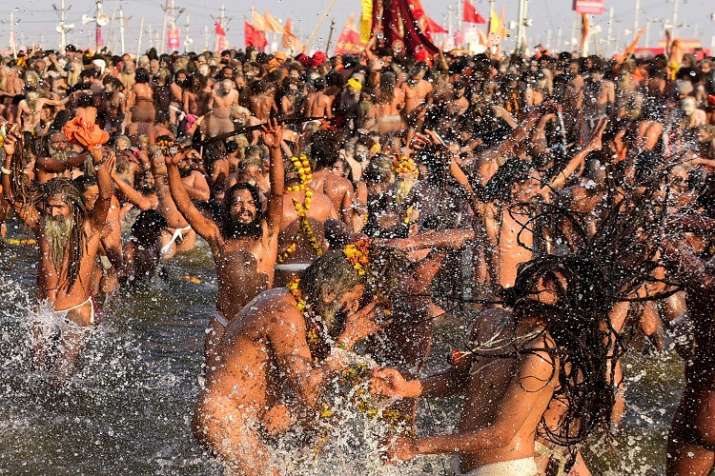
Below are leaf boats launched during the Ganga Dussehra, the annual celebration of Ganga’s birth.

Below are crowds lining the river during Ganga Dussehra.

At Haridwar there is fervour, but Allahabad can offer religious hysteria to defeat the imagination. Many hold this to be the most holy of all places along the Ganges, where it merges with the Jumna before they part and go their separate ways. People are regularly killed here by the sheer weight of numbers when a Mela is celebrated, and in 1954 there was a disaster that shook even this country, which has always accepted human casualty as the luck of the draw. Five million people turned up on the sand-banks at the confluence of the rivers for the famous procession of sadhus down to the water’s edge. These holy men normally flaunt the austerities of their vocation by walking naked, their bodies smeared with mud and ash, but when they advance en masse at a Kumbh Mela they transform themselves into a column the like of which nowhere else has seen for centuries. They are mounted on elephants and camels and horse-drawn chariots, each animal richly decorated with feathers, cloth, and metal. Buglers and pipers march with them in bands, while the sadhus- who are truculent as well as holy – brandish tridents and swords in the air.
Below are images from the sadhus procession at a Kumbh Mela.
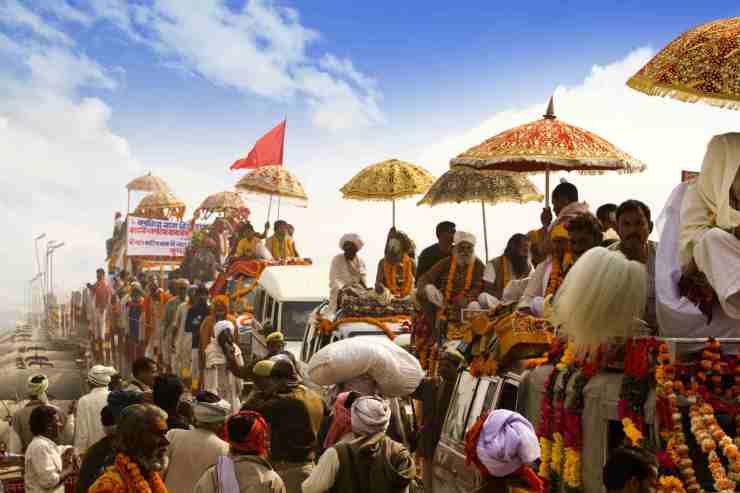
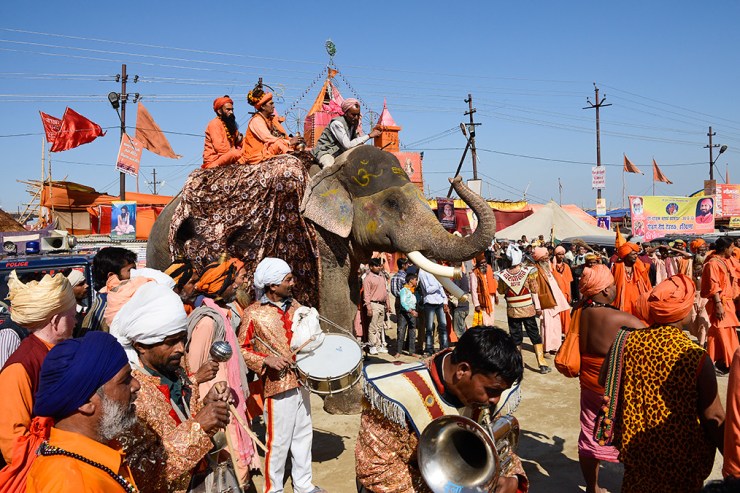
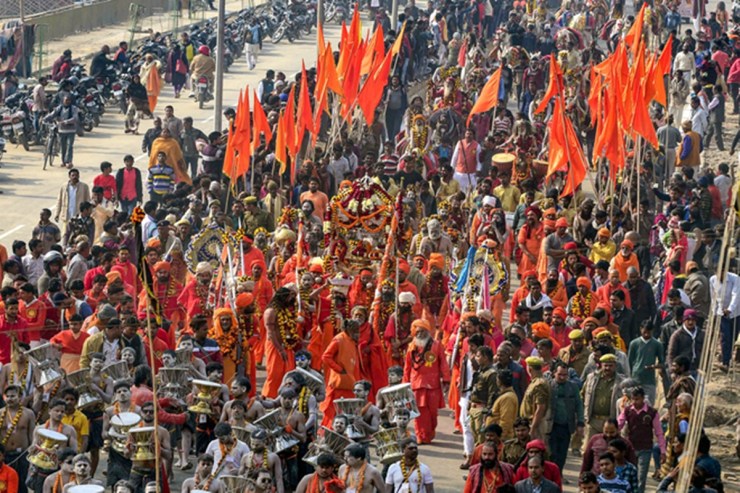
It was this habit that started the 1954 catastrophe, when the procession found its way blocked by the congestion of the pilgrim crowds. The holy sadhus laid about them viciously with their ironwork, people panicked, animals began to run amok, and anyone who fell that day was a dead man. When the horror had subsided, the sand-banks were littered with trampled bodies and more corpses were floating in the two rivers. An official inquiry later estimated 800 dead and 2,000 hurt – no one believed those figures told a quarter of the truth. What the Ganges really means, above all else, is best described in the words of a witness during the inquiry into the disaster at Allahabad. ‘People said beforehand,”If we are killed we shall attain salvation. If we escape death, we shall be gainers in any case. Those who die at such a sacred spot, at such an auspicious moment, would be very lucky. We wish to have good fortune.” Perhaps for that reason, stampedes are very common here.
The Ganges at Varanasi (courtesy of prsw100):
The seething piety of Varanasi has a longer history than that of anywhere else; indeed, there is some evidence for the claim that this is the oldest city in the world, where faith flourished at least two thousand years before Christ. Buddha preached his first sermon here, Islam still has a careful foothold here, but it is the myriad deities of the Hindus that make Varanasi feel like the most jam-packed city in India outside Kolkata, formerly Calcutta.
“Varanasi” (courtesy of Ben Mikha):
Courtesy of BBC:
“Varanasi” (courtesy of Kalki):
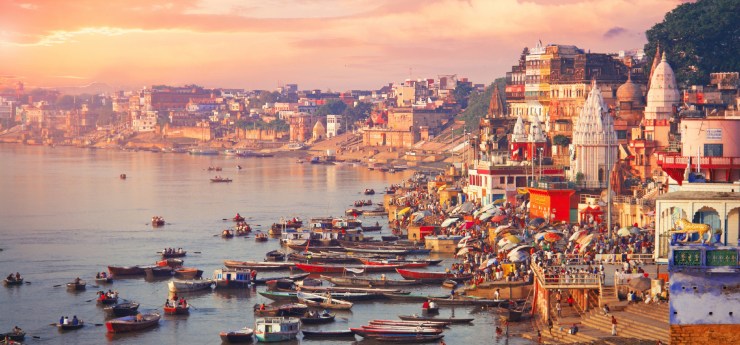
The waterfront at Varanasi is one of the most romantic of all apart from those at Venice and Istanbul. The Ganges runs here in a long crescent curve and Varanasi descends to the river down fifty-two separate ghats, each of which is a full cascade of steps. At the head of every ghat is a temple or a crumbling old palace, or some access to the city behind, where beggars stay. The most important aspect of the ritual bath in the Ganges is the belief of each of the pilgrims that all their sins are instantly wiped away; and if only death can happen here, with cremation on the banks and ashes cast upon the water, it will be the most blessed gift of all, the absolute assurance of entry into heaven. Around the Manikarnika burning ghat, relatives pray around stretchers bearing swaddled corpses awaiting their turn. A neat pile of logs stands crisscrossed ready for use. Workmen are splitting tree trunks with axes – sandalwood for the rich, neem for the poor, 440 kilograms for large people, 360 kilograms for smaller ones, and three hours for anyone to burn. The men who run the burning ghat belong to the distinctive caste of Doams, whose chief has enriched himself enough to live in the grandest building along the river.
Varanasi and the bank of the Ganges
Death along the Ganges River (courtesy of National Geographic):
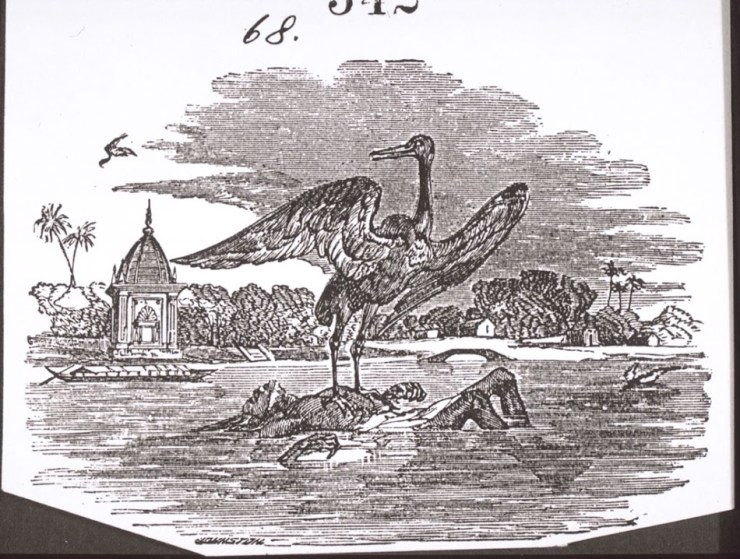
Some potential clients are too poor to pay for the wood, in which case the body is simply placed in the river, weighted with stones. It does not always decompose on the bottom: a long cloth-bound object floats in midstream, two vultures trying not to overbalance on top, while they peck through the bindings to get at the flesh. Rather a lot of disgusting things bob about in the river within inches of bathers who will assure you that some chemical property in this holy water does not allow germs to survive. And it is a fact that although all the great cholera epidemics of India have started in Bengal and have been borne up the Ganges by pilgrims, no form of sickness has yet been known to travel any distance downstream.
Below is a depiction “Vulture on a corpse in the Ganges”, creator unknown, taken from Basel Mission Archives in Switzerland.
Magical sunrise of Varanasi (courtesy of Ethereal):
It is possible to rationalize the veneration of this river and conclude that anything might be regarded with awe that is as much a matter of life and death to so many people as is the Ganges. In flowing through the three states of Uttar Pradesh, Bihar, and Bengal, the Ganges has a material bearing on one-third of India’s entire population, many of whom would perish inside twelve months were it not for the moisture it provides. Those northern plains may be dreadful during the summer but at least they are greatly important because of the rich crops they provide in spring, over thousands of square miles that would be desert without the irrigation ditches and canals.
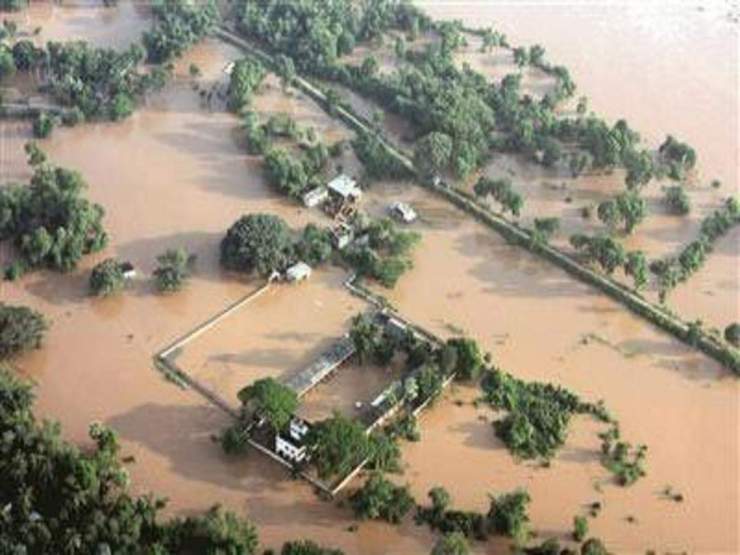
Captain Proby Cautley, of the Bengal Engineers, began to cut the main Ganges canal at Haridwar in 1842 and within half a century it had reached Allahabad, over 400 miles away. An unmitigated blessing in every sense, it had nonetheless an effect on the Ganges’ natural course by drawing off the water for controlled use. The monsoon breaks about the beginning of June, and four months after, the Cow That Gives Much Milk is transformed into a raging monster that sweeps everything out of its way. Villages are smashed in the tumult of brown water, crops are destroyed, and the loss of life and animals is often very high. The Ganges is turned into gigantic inland seas several miles wide. The rise in water-level during the rains is as devastating as the torrential flow. At Varanasi, the watermark that the Ganges had reached in 1978 was fifty feet above the norm, submerged ghats and temples and flowing into the city itself, at a point where for several weeks she had become some ten miles wide.
Courtesy of Vishal Gendle Flute:
The Ganges has an excellent claim that over most of her journey from the source to the sea she is the least navigable river of all. Not long afterward, the Ganges moves to the south at last, as she passes into Bengal close to India’s border with Bangladesh. The flatness of her surroundings doesn’t alter much, but now the growth becomes lusher, palms screening the villages.
A beautiful village in West Bengal (courtesy of Prabal Bhaumik):
The Ganges has been all things to all men since she came of Himalaya – highway and sewer, irrigator and drinking fountain, burial ground and source of food, washtub, and bath. But never for one moment has she been anything less than an inspiration to millions pouring her sacred waters over themselves; a promise of better things to come.
A classic song where a river is viewed as a symbol for the dreams of the future is “The River” by Bruce Springsteen (courtesy of The Late Show with Stephen Colbert). Coincidentally, a film of his “The Legendary 1979 No Nukes Concerts” was also released for the first time today.
Some thoughts from His Holiness Radhanath Swami:
Save Our Planet Earth (courtesy of Ankit Bhatia):
“Water of Your Love” by Snatam Kaur:


This varied waterway, never disappoints. Loved the videos., Joanna.
LikeLiked by 1 person
Thank you, Pat, for the wonderful comments, which are greatly appreciated!
Joanna
LikeLiked by 1 person
Wow! Joanna love your compilation of facts, myths, photos, videos and songs. A mesmerizing write on a venerated river!
LikeLiked by 2 people
Thank you so much, Punam, for the wonderful comments, which are greatly appreciated!
Joanna
LikeLiked by 2 people
My pleasure, Joanna.
LikeLike
The leaf boats must be a sight to see, but such a vast gathering of humanity would be terrifying to me. It is understandable how a river can become so revered since it gives life to so many and if it also happens to be beautiful, it would inspire story-telling. People need something to believe in and they need to have hope, so religion is born. I am not religious myself, but as you know I deeply respect the natural world. Many years ago I read Eric Newby’s book “Slowly Down the Ganges” which was the story of the journey he took with his wife, very long ago. It was a great introduction to that wonderful river and your presentation is brilliant too, such a collection of lovely music and video as well as photos and interesting facts. Many thanks!
LikeLiked by 1 person
Rivers are so special! i live near the Hudson River in New York, a river which has played such a big role in US history. When I walk along it I am in a different place. Beautiful, inspiring post Joanna!
LikeLiked by 1 person
Thank you so much, Carolyn, for the thoughtful comments, which I love and appreciate!
Joanna
LikeLiked by 1 person
Thank you, Phil, for the beautiful comments, which I greatly appreciate!
Joanna
LikeLiked by 2 people
My pleasure, Joanna m
LikeLike
Some great videos and a very detailed description Joanna. Not sure there is another river anywhere, held in such reverence. I do know I would never go near Varanasi, let alone bathe in the water there. Have a wonderful evening. Allan
LikeLiked by 1 person
Thank you for such a detailed story of the River Ganges. The photos were also beautiful. Waterways, of all kinds, are beautiful and essential to life itself. So, it is easy to understand why this river holds a special meaning for so many.
LikeLiked by 2 people
Your articles always are well-researched and well-thought-out. This one is no exception. You’ve described the Ganges and its importance beautifully.
LikeLiked by 2 people
My pleasure!
LikeLiked by 1 person
Thank you, Diana, for the thoughtful comments, which I very much appreciate!
Joanna
LikeLiked by 2 people
Thank you, Neil, for the wonderful comments, which I greatly appreciate!
Joanna
LikeLiked by 2 people
Joanna ji, your article is not merely a description of the river it feels like a profound journey into the soul of human faith and consciousness. The way you have portrayed the Ganges River with such depth, sensitivity, and expansiveness is truly moving.
Your writing beautifully flows through the serene purity of Rishikesh, the divine confluence at Devprayag, the devotion of Haridwar, and most vividly, the living spirituality of Varanasi making the reader feel as though they are part of this sacred journey.
As I read your piece, it awakened something deeply personal within me…
I was born in Varanasi, and the golden years of my life were spent there. Our home was in Chetganj, just about two kilometers from the Ganges. In childhood, every Sunday felt like a celebration, as we would go for a holy dip in the river sometimes with our parents, and often with friends. There were even moments of innocent mischief when we would swim across parts of the river, full of fearless joy.
Those pure, carefree days and that intimate connection with the Ganges still live within me. Even today, I step into her waters but now with quiet reverence rather than childhood mischief.
With time, much has changed…
That Varanasi, once a living symbol of spirituality and the beautiful Ganga-Jamuni culture, no longer feels the same. Perhaps the city has changed, perhaps we have or perhaps both.
In search of peace, I eventually made a new home near Haridwar, where the Ganges meets you again like a calm, nurturing mother.
And yet, my bond with Varanasi has never faded. I still visit once or twice a year.
However, our old haveli in Chetganj now feels silent and empty… my parents are no longer there.
What remains are memories living quietly in the walls, in the narrow lanes, and in the eternal flow of the Ganges.
Your article revived all those memories so vividly. It felt as if the Ganges does not just flow through the land but also through our inner being.
My heartfelt appreciation for this deeply moving, insightful, and beautifully crafted piece. 🙏
LikeLiked by 1 person
Thank you, dear Vijay, for the wonderfully analytical and thoughtful comments, which I love and deeply appreciate!
Joanna
LikeLiked by 2 people
Excellent description of The Holy Ganges, supported by images and videos! Fantastic work, Joanna!
LikeLiked by 1 person
Thank you, Indira, for the wonderful comments, which are greatly appreciated!
Joanna x
LikeLiked by 2 people
Thank you, Joanna, for dedicating such a heartfelt post to Ma Ganga; a subject that resides deeply within me. While every river in India, be it Yamuna, Saraswati, or Narmada, is revered as a mother, the Ganga holds a uniquely sacred space in my life, having nurtured me during my formative years.
I fondly recall a time when Ganges water flowed continuously through municipal taps, pure and life-giving. We would drink it directly, without a second thought or the need for storage. Those were simpler, blessed days. There was also a tradition of preserving Ganga jal for years for religious rituals, and remarkably, it would remain unspoiled. Scientific studies later revealed the presence of bacteriophages in its waters, nature’s own guardians, silently keeping harmful bacteria at bay. Your reference to the cholera epidemic fits meaningfully into this context.
Over time, however, impurities began to creep in, altering its pristine nature. Today, significant clean-up efforts are underway, and encouragingly, visible improvements can be seen. With Prime Minister Modi, also the MP of Varanasi, personally monitoring these initiatives, there is renewed hope for restoration.
Your mention of Manikarnika Ghat, the eternal cremation ground where flames never cease, is both powerful and evocative. The reference to the Dom Raja adds further depth. Whenever I visit Varanasi, I find solace in simply sitting by the banks of Ma Ganga, absorbing a profound sense of peace. To me, she reflects the many phases of a woman’s journey, graceful, enduring, and ever-evolving from her place of origin.
Prayagraj, too, holds immense spiritual significance as the sacred Triveni Sangam, the confluence of Ganga, Yamuna, and Saraswati, where the Kumbh Mela takes place every twelve years. The sheer scale of human gathering is awe-inspiring, and while past incidents like that of 1954 are often cited, they no longer define the present. Just last year, over 500 million devotees participated in the holy dip, and I was fortunate to be among them. It is truly an experience beyond words.
There is so much more I could share about Ma Ganga and Varanasi, but your post has beautifully captured even the subtlest nuances. Your thoughtful selection of images and videos, especially the one by Satnam Kaur Khalsa, adds a soulful dimension to the narrative. I feel a deep sense of pride that you chose to immerse yourself in this rich heritage and bring forth such precious insights.
Thank you once again, Joanna, for this exquisite tribute to Ma Ganga, a true gem. Har Har Gange!
LikeLiked by 2 people
Thank you so much, Kaushal, for the wonderfully thoughtful comments, which I love and deeply appreciate! Your kind words made my day!
Joanna
LikeLiked by 2 people
It’s truly a delight, Joanna, to revisit cherished memories through this post. You’re always most welcome. Namaste!
LikeLike
Thank you so much, Kaushal! Namaste.
Joanna
LikeLiked by 1 person
Joanna ,your post has beautifully captured even the subtlest details on the Holy River Ganga. Your thoughtful selection of images and videos, especially the one by Satnam Kaur Khalsa, adds a soulful dimension to the narrative. While every river in India, namely Yamuna, Saraswati, or Narmada, is revered as a mother, the Ganga holds a uniquely sacred space in my life! In 1986, on the auspicious day of Akshay Tritiya, the Almighty blessed me with an opportuinity to pay a visit to Gangotri & Gaumukh (the point of origin of Maa Ganga)!I was blessed with Gangotri mandir darshan on the day when Char Dham Yatra commences each year !Secondly I got an opportunity to bathe in the Ganga regularly during my 15-year posting at Narora Atomic Power Project which is located on the banks of the Holi river !Thank you so much, Joanna, for this 0verwhelming tribute to Maa Ganga!Jai Ganga mai ki! Namaskar!
LikeLiked by 1 person
Thank you so much, Dhirendra, for the wonderfully thoughtful comments, which I love and deeply appreciate! Your kind words made my day! Namaste!
Joanna
LikeLiked by 1 person
Namaste , Joanna
LikeLiked by 1 person
I really loved the section on the birds.
LikeLiked by 1 person
Thank you, LuAnne, for your beautiful comments, which are greatly appreciated!
Joanna
LikeLiked by 1 person
I’ve been slowly perusing your beautiful post of the Ganges Joanna and it’s breathtakingly beautiful. You outdid yourself with the stories, myths, history with photos and music. I will savor this. I can’t believe how many people are so close in proximity at one time. Thank you so much for your gifts in history and sharing❣️❌❤️
LikeLiked by 1 person
Thank you so much, Cindy, for the wonderful comments, which I love and greatly appreciate!
Joanna
LikeLiked by 2 people
Pleasure!!❣️
LikeLike
Thank you, Cindy!
Joanna
LikeLiked by 1 person
❌❤️
LikeLike
XXX!
LikeLiked by 1 person
This was amazing!
I really loved how you captured the beauty of the Ganges.
The music and visuals were just perfect.
LikeLike
Thank you, dear Luisa, for the wonderful comments, which I appreciate greatly!
Joanna
LikeLike
What an interesting and historically rich text! The Ganges is not just a river, but a symbol of life, faith, and tradition for millions of people. Everything it conveys is beautiful and profound.
Best regards, Joanna.
LikeLike