
Courtesy of Reid Gower:
“Curiosity is the essence of our existence.”
Gene Cernan
Courtesy of Nigel John Stanford:
This final post in my Great Scientific Discoveries is about the discoveries that are born of chance, but then they seem to take on an impetus of their own and become established, whatever the real needs of the community. The most famous example is that of the motor car, the usefulness of which is becoming geometrically inverse to the numbers on the road, but which continues to feature in public opinion as a necessity of life. In the United States, for example, airlines have created such congestion that sometimes, taking into account the delays and the transport time from the airport to the city centres, they take three times the theoretical time of the journey to get from one town to the other. Meanwhile, a train, which would carry at least five times more passengers on each journey, would be on time and would take travellers from city centre to city centre with less risk. But the aeroplane has the image of speed and so is preferred.

The history of inventions in the 20th century includes a lesson in philosophy, whilst that of the preceding centuries includes one in psychology. In considering the past, one can only marvel at the precocity of technical inventiveness, and also at the strange slowness with which some of the major inventions have come to light. In recent decades it is surprising what modest beginnings some inventions have had, and the tremendous, even excessive, influence which they have exercised over time. A new branch of study has developed lately reflecting the destiny of the human race: the philosophy of science.

TIM BERNERS-LEE
Born 8 June 1955
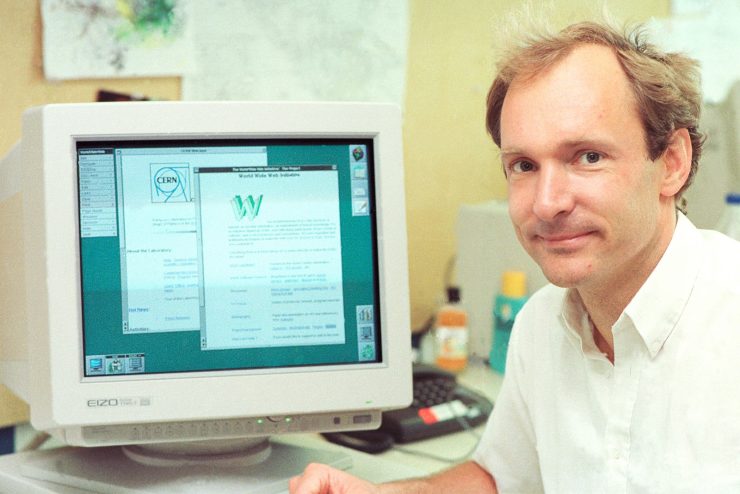
In modern life, it seems incredibly hard for an individual to invent something that truly changes the world; however, one person who did just that is an English physicist and computer scientist Tim Berners-Lee. In 1990, he invented the World Wide Web.
Courtesy of DW Shift:
A plaque at CERN commemorating the invention of the Web:

Timothy Berners-Lee was born in London. His parents were both computer scientists. As a boy, Tim became interested in electronics after building circuits to control his model train set. He studied at The Queen’s College, Oxford University; while he was there, he built his first computer. After graduating in 1976, he worked as a computer systems engineer at various companies.
“A Kaleidoscope of Mathematics” by James Horner, from “A Beautiful Mind” (courtesy of Elliot Walsh):
The Queen’s College, Oxford University

In 1980, Berners-Lee spent six months at the European Organization for Nuclear Research, a particle physics facility on the outskirts of Geneva, on the border between France and Switzerland. It is better known by the acronym CERN, which derives from the facility’s original name, Conseil European pour la Recherche Nucleaire. While at CERN, Berners-Lee devised a computer system, for his own use, to store and retrieve information. Named ENQUIRE, this was a forerunner of the Web. It was based upon hyperlinks, cross-references in one document that enables a computer to call up another, related document.
From “Cern – The Sense of Beauty” (courtesy of First Hand Films):
Geneva, Switzerland

Courtesy of Drone Snap:
In 1984, Berners-Lee was back at CERN, on a computing fellowship programme. He became frustrated by the lack of compatibility between different computer systems, and between documents written using different software applications. In a memo, which he sent to his manager in 1989, Berners-Lee set out his vision of a ‘universal linked information system’ with which to organise the huge amounts of information produced at CERN. He proposed that a ‘web of links’ would be more useful than the ‘fixed, hierarchical system’ that existed. Documents available on computers within CERN’s network would contain hyperlinks to other documents, including those on different computers. In 1990, Berners-Lee’s manager encouraged him to spend some time – as a side project – on developing his idea.
Part of the Large Hadron Collider at CERN

From “Symmetry”, a CERN dance-opera film (courtesy of truth.io):
During the autumn of 1990, Berners-Lee, along with his colleague, a Belgian computer scientist Robert Cailliau (born 1947), created all of the now-familiar fundamental components of the World Wide Web. The universal language he invented for writing linked documents (web pages) is ‘html’ – hypertext markup language. The software that responds to ‘requests’ from hyperlinks is called a ‘web server’, a term that also refers to the hardware that hosts the web pages. And the language, or protocol, computers use to communicate the hyperlink requests is ‘http’ – hypertext transfer protocol. Berners-Lee had to write the first web browser, the application used to view the documents hosted on web servers. He called his browser ‘World Wide Web’. Berners-Lee also wrote the first web pages, which he published on his server in December 1990. It was on 25th of that month that Berners-Lee first ‘surfed’ from one web page to another, via http, by clicking a hyperlink in his browser.
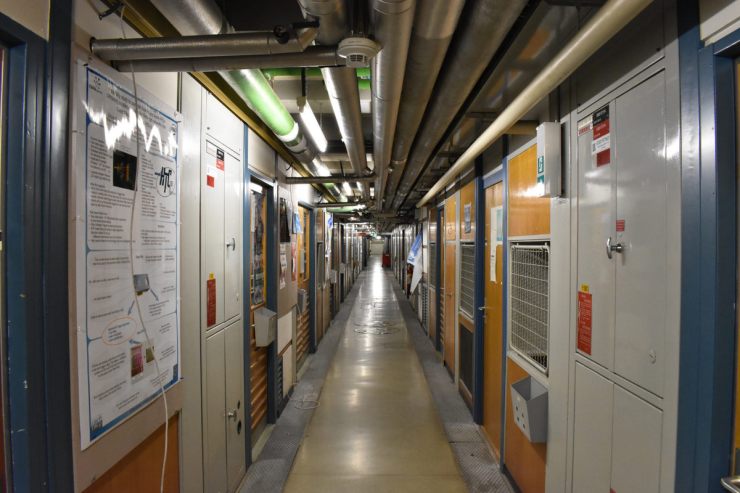
The corridor at CERN where the Web was born:
“A Sense of Symmetry (Day 1)” by Ludovico Einaudi:
The following year, Berners-Lee made available his software to people outside CERN, and the idea quickly caught on. By 1994, the Web had grown so much that each ‘resource’ – a document or image, for example – needed a unique ‘address’ on the Internet. In consultation with the Web community, Berners-Lee created the format for web addresses, called the ‘uniform resource locater’ (URL). After 1994, the Web spread rapidly beyond academic and military circles. Within a few short years, most people in the world had been affected directly by its existence, and millions were already regularly ‘surfing’ from documents to documents online.
Below is the Nataraj statue at CERN, a depiction of a Hindu cosmic dancer which is a metaphor for modern physics

Courtesy of The British Museum:
Tim Berners-Lee has received a huge number of accolades for his invention, which he gave free to the world without patent or rights. In 1994, he founded the World Wide Web Consortium, which helps keep the Web working smoothly and aims to foster its future growth. He also campaigns to keep the Internet ‘neutral’ – free of restrictions on content and what kinds of computers may be connected.

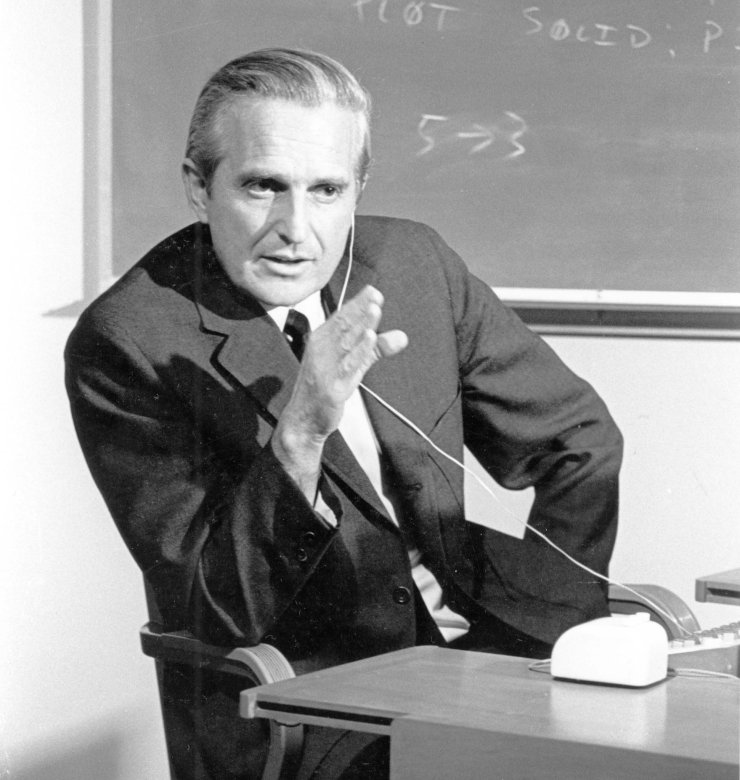
Doug Engelbart (30 January 1925 – 2 July 2013)
Two very important technologies underpinned Tim Berners-Lee’s invention of the World Wide Web: hyperlinks and the computer mouse. An American computer scientist Douglas Engelbart invented the mouse in 1967, and he was also heavily involved in the development of hyperlinks.
Courtesy of Silveira Brothers:
In the 1960s Engelbart headed a team at the Augmentation Research Centre at the Stanford Research Institute, California. Engelbart’s team devised an online ‘collaboration system’ called NLS (oN-Line Systems). This included the first use of hyperlinks and the mouse. In 1968, Englebart demonstrated NLS to a large audience of computer scientists. In addition to hyperlinks and the mouse, the 90-minute session referred to as ‘The Mother of All Demos’, introduced such ideas as e-mail, video-conferencing, and real-time collaboration between computer users far apart.
Courtesy of Stanford:
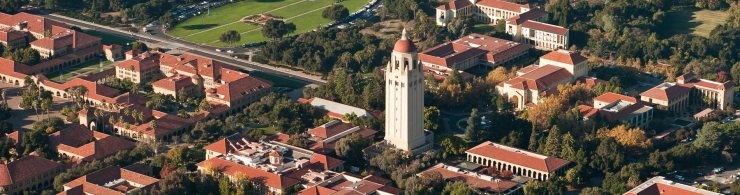
Stanford University, California
Courtesy of Stanford:
“California Dreamin'” by The Mamas and The Papas (courtesy of Wudood Omran):
KARL BENZ
25 November 1844 – 4 April 1929
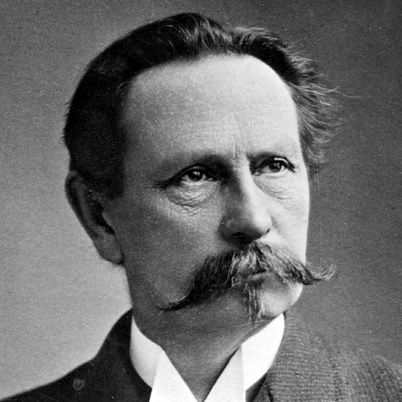
The person responsible for designing the first true motor car, a German engineer Karl Benz, had no idea what effect his invention would have on the world. By increasing mobility, less than 100 years after the rise of the railways, the motor car once again revolutionised patterns of work and play and the distribution of goods and its rapid uptake in the twentieth-century changed the landscape quickly and dramatically.
Karlsruhe, Baden
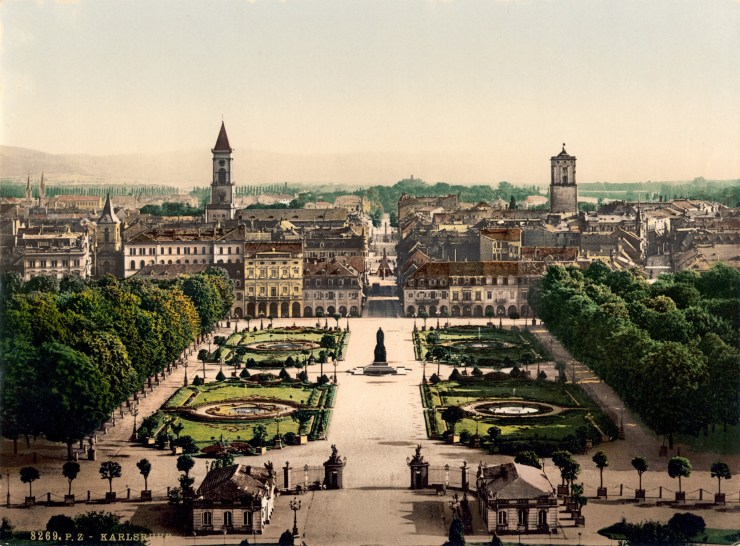
Karl Benz was born in Karlsruhe, Baden, Germany. His father died when Karl was just two years old, but his mother encouraged him greatly, working hard to put him through grammar school and the Karlsruhe Institute of Technology. It was his dream from early to invent a form of transport that would run without horses and off rails.
Karlsruhe Institute of Technology

Courtesy of Colossal Cranium:
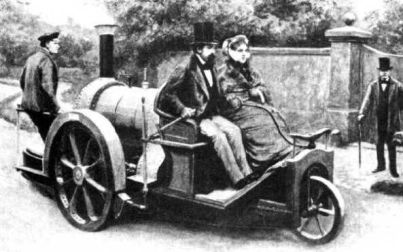
The idea of self-propelled road vehicles was already popular before Benz was born. Some engineers had made ‘cars’ – mostly steam carriages and electric vehicles; all of them were adaptations of horse-drawn carts and none was particularly effective. The most crucial invention in the development of the motor car was the internal combustion engine. In a steam engine, the combustion – the fire that heats the steam – is produced outside the cylinder. The first practical engines in which combustion took place inside the cylinder, and drove a piston directly, appeared in the 1850s. The most important was invented in 1859 by Belgian engineer Etienne Lenoir (1822 – 1900).
Below are shown Etienne Lenoir and one of his automobiles

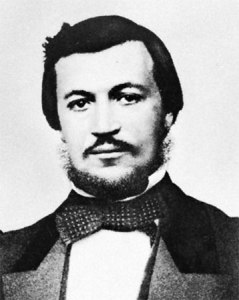
The next step towards the motor car was the ‘four-stroke’ engine designed by German inventor Nikolaus Otto (1832-1891) in 1876. The four-strokes – intake of the fuel-air mixture; ignition, and exhaust – still form the basis of petrol engines today. Otto’s engine was the first alternative to the steam engine.
Below are shown Nikolaus Otto and one of his engines
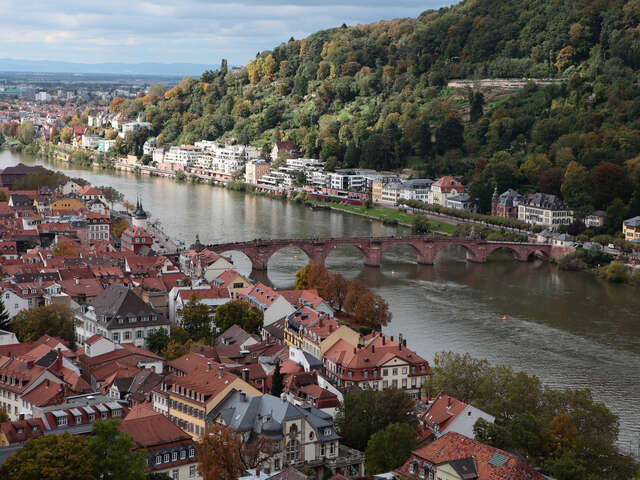
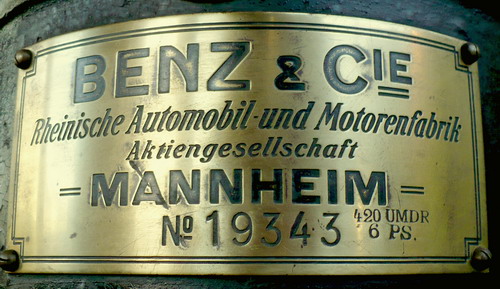
Karl Benz closely followed developments in engine design after leaving college, and worked towards his dream of building a motor car. He had been employed on various mechanical engineering projects, and in 1871 had moved to the nearby city of Mannheim. In the 1870s, Benz designed a reliable, two-stroke petrol engine, in which the four operations of the four-stroke engine are combined into one upward and one downward stroke , for which he was granted a patent in 1879. Four years later, he formed a company with two other people: Benz & Company Rheinische Gasmotoren – Fabric. The company began as a bicycle repair shop, and quickly grew when it began making machines and engines.
Mannheim, Germany

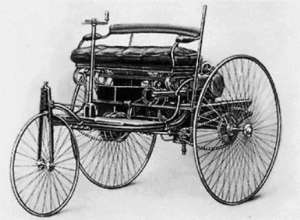
Benz & Company did well, giving Benz the time and the confidence he needed to pursue his dream. By the end of 1885, Benz’s car was ready. It was a three-wheeled carriage powered by a single-cylinder four-stroke engine, which he had created specially. Benz’s motor car incorporated several important innovations of his own design. These included an electric starter coil, differential gears, a basic clutch, and a water-cooling system for the engine. Despite his hard work and obvious brilliance, Benz had not quite worked out how to achieve steering with four wheels. He took the easy option and had three wheels, the single front wheel is turned by a ’tiller’ – type handle.
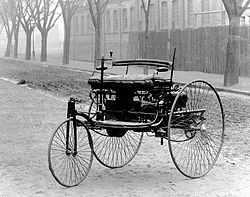
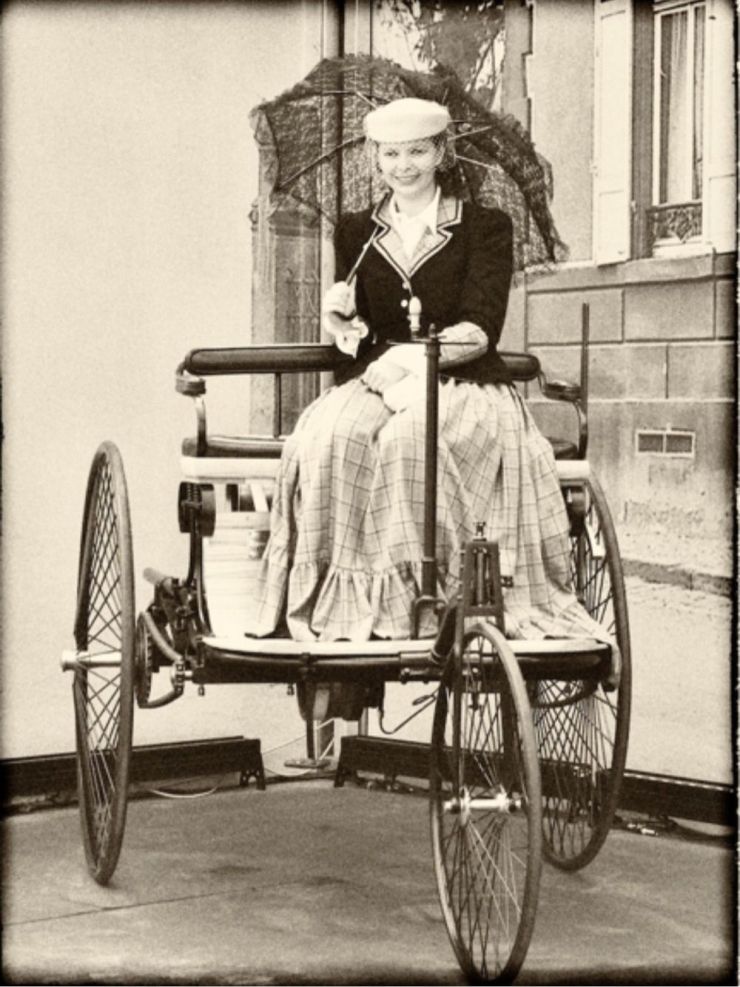
Benz applied for a patent in January 1886, and it was granted in November of that year. His application was successful because his motor car had been designed from the start as a self-powered vehicle. and not simply as a cart with an engine attached. After a few improvements, including the world’s first carburettor, the first Benz Patent Motorwagen was sold in 1887. Benz began production of the car and advertised it for sale in 1888; it was the first commercially available production car in history. Uptake was very slow, however, so Benz’s wife Bertha (1849-1944) decided to try to raise awareness. In August 1888, she drove with her two sons from Mannheim to her home town of Pforzheim and back – a total distance of nearly 200 kilometers (120 miles). The stunt generated a great deal of publicity – and thanks at least in part to that publicity, Benz’s Motorwagen became a great success. The age of motoring had begun.
Bertha Benz
Courtesy of Mercedes-Benz USA:
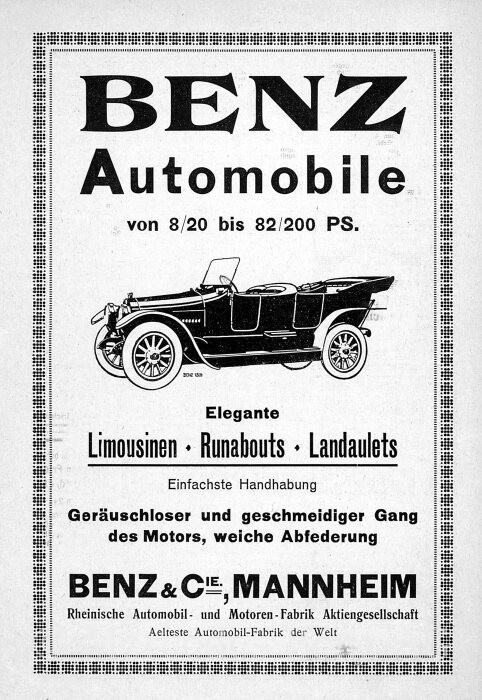
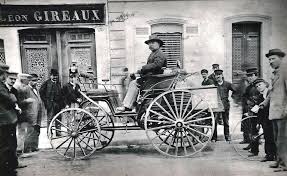
By 1888, Benz had improved his design and began producing cars in greater numbers. A French engineer and entrepreneur Emile Roger, in Paris, held the sole rights to sell Benz’s cars outside Germany and helped to popularise the vehicle.
“Mercedes-Benz” performed by Horst Gössl:
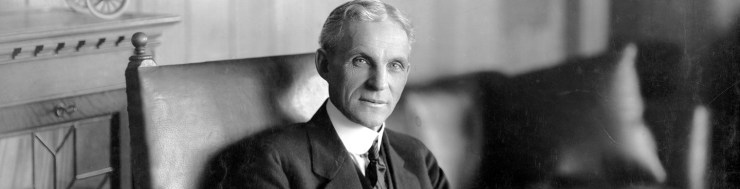
HENRY FORD
30 July 1863 – 7 April `1947
For twenty years after, Karl Benz’s Patent Motorwagen motor cars were not available to most people. The fact that each one had to be made individually kept the cost high, which in turn kept demand low. In 1908, an American entrepreneur Henry Ford set out to change that, when he introduced what he called ‘a car for the great multitude’.
Courtesy of Innovative History:
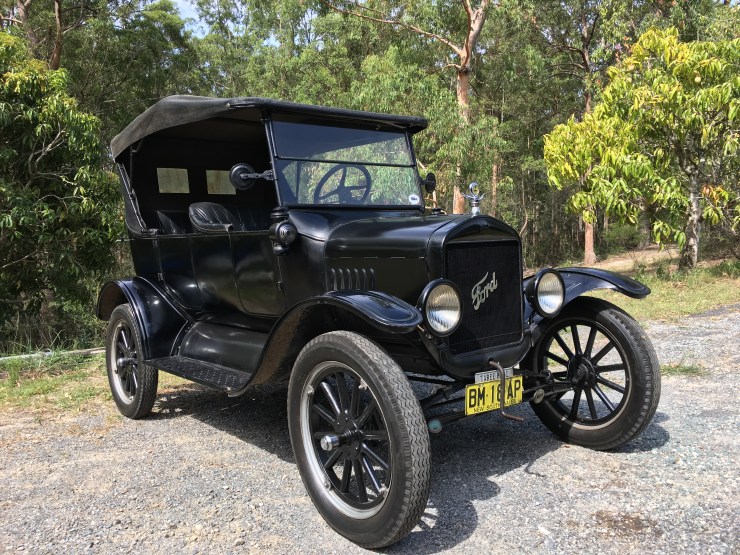
The affordable Ford Model T was a breakthrough being made from interchangeable parts in a factory with tools laid out in an efficient arrangement. From 1913, the cars were manufactured on assembly lines. Ford’s famous motto was: ‘You can have a car in any colour you want, as long as it is black.’
Courtesy of Bloomberg Quicktake: Originals:
One of Ford’s employees had seen how effective production lines could be when he visited a meat-packing factory in Chicago. The application of the idea to the motor car industry brought costs down dramatically, made Henry Ford incredibly rich and had a rapid and profound effect on the world of the twentieth century.
“Drive” by The Cars (courtesy of Cafe Instrumental):


Courtesy of Reid Gower:
Courtesy of Inspiration Journey:

.


I understand that your highly educative series on discoveries is concluding! Great job, Joanna, thank you!! I liked the interpretation of ‘Sivathandava’ (Dance of Shiva) as ‘metaphor for modern physics’!
LikeLiked by 1 person
Thank you, Indira, for the wonderful comments, which I love and appreciate!
Joanna
LikeLiked by 1 person
A great series final post Joanna. These inventions definitely touched the majority of us in one way or another. Looking at the world wide web, perhaps it is to widely popular. Benz invention has stood the test of time and Ford’s invention made sure cars became affordable. I have enjoyed your posts in this series. Have a wonderful Thursday. Allan
LikeLiked by 1 person
Thank you so much, Allan, for the wonderfully analytical comments, which I love and appreciate!
Joanna
LikeLiked by 1 person
Dear Joanna,
Your article presents the deeper paradoxes of human civilization through the lens of scientific discoveries in a very graceful and thought-provoking way. The balance you have drawn between curiosity, progress, and their unintended consequences truly encourages introspection.
Through examples like Tim Berners-Lee and Karl Benz, you have effectively shown that every invention not only brings convenience but also opens the door to new challenges.
What stands out most is your perspective of viewing science not merely as achievement, but through the lens of wisdom and responsibility.
With regards,
Your work is truly an invitation to deeper reflection.
LikeLiked by 1 person
Thank you so much, dear Vijay, for the wonderfully thoughtful comments, which I love and greatly appreciate!
Joanna
LikeLiked by 1 person
Great essay. The entire series is great.
You mention cars and trains. I live in a town near Philadelphia. I go to Philadelphia pretty often. And the majority of times I take the train rather than drive. The train has two station stops in the heart of the city. I’m happy to avoid the driving and parking!
LikeLiked by 1 person
Thank you, Neil, for the wonderful comments, which are greatly appreciated!
Joanna
LikeLiked by 1 person
It must be wonderfully satisfying for someone like Berners-Lee to have access to so much information and to have the support and the ability to create such an efficient means of sharing it. At the same time, he must feel frustrated to see it misused. It seems there is nothing humanity can create that they will not also abuse. Perhaps what scientists should research is a means of extracting from our DNA that which drives human greed and avarice. I agree completely that transport by train is preferable. My mother took an overnight train and crossed a river in full flood in a small boat rather than fly for 90 minutes! As for cars – when I see the poor Amish horses out in all weather pulling heavy loads, I am grateful they have been replaced and here traffic is no problem, but in so many places, oh dear, the congestion and pollution! There are too any of us. Lovely videos and music again. Where do you find them all? Many thanks.
LikeLiked by 1 person
Thank you so much, Carolyn, for the brilliant comments, which I love and appreciate! Your observations made me smile!
Joanna
LikeLike
Thank you so much, Joanna, for yet another enriching post!
The opening quote by Gene Cernan is compelling enough to capture a reader’s attention from the very start. Curiosity, indeed, lies at the very core of our existence, so long as humanity endures, the spirit of inquiry will never fade. I also found myself deeply resonating with your introduction, especially the reflections on chance discoveries and the philosophy of science.
The account of Tim Berners-Lee and the creation of the World Wide Web is fascinating at its very heart. It is almost impossible to imagine the modern world without such a transformative invention. Your mention of CERN also brought to mind the landmark discovery of the Higgs Boson in 2012.
It was a delight to see the reference to the statue of Nataraja, Lord Shiva, the cosmic creator and transformer. His image is cherished in countless Indian homes, symbolising the rhythm of the universe. I was also intrigued to learn about Berners-Lee’s time at Queen’s College, Oxford, which resonated personally with me, having studied at Queen’s College in Varanasi. The image of the college was especially evocative.
Your detailed narration of the invention of the motor car beautifully highlights the many obstacles encountered along the way, as well as the patience, perseverance, and determination of Karl Benz, qualities without which success might have remained out of reach. His early personal loss evokes deep sympathy and adds a poignant layer to his journey.
Henry Ford’s remark on colour appears, to me, more of a strategic decision, favouring black for the sake of efficiency and uniformity, even though it demands greater upkeep.
Thank you, Joanna, for this concluding post in your “Great Scientific Discoveries” series. Like the earlier ones, it is both informative and engaging; truly a rewarding experience.
LikeLike
Thank post you so much, Kaushal, for your excellent review of my post, which I love and deeply appreciate! As always, your kind words lift my spirit!
Joanna
LikeLiked by 1 person
“Curiosity is the essence of our existence.”
What a wonderful wrap-up to your series of posts regarding The Great Scientific Discoveries, Joanna! You did an amazing amount of research for each part. Thanks so much for sharing these landmark discoveries my dear! 🚅🌎🚙
LikeLike
Thank you so much, dear Kym, for the wonderful comments, which I love and very much appreciate!
Joanna x
LikeLiked by 1 person
A very informative and enjoyable read. I especially liked reading about the start of the World Wide Web. As far as “technical inventiveness” goes, the internet has an oversize impact life on earth. Wonderful post!
LikeLike
Oh my dear Joanna, you are so very welcome as always my friend. My pleasure! 🥰💖😊
LikeLike
Thank you so much, Diana, for the beautiful comments, which I love!
Joanna
LikeLiked by 1 person
Thank you, dear Kym! You are more than welcome, as always!
Joanna
LikeLiked by 1 person
🤩💖🤩
LikeLike
It’s truly my pleasure, Joanna. You’re so very welcome!
LikeLike
Thank you!
Joanna
LikeLiked by 1 person
XXX!
LikeLiked by 1 person
It’s hard to believe that the World Wide Web such a difference. DARPA invented the Internet but it took visionary to create the WWW. I can remember back in in the mid 90s looking up the specifications for the amount of sand was required for beach volleyball. I was trained as a librarian and nobody else could have come up with the idea then. Now anyone can do that.
LikeLike
Thank you, Pat, for the thoughtful comments, which are greatly appreciated!
Joanna
LikeLike
What a phenomenal closure to a great series that truly captured all of the discoveries. The video was amazing right after that! Thank you so much for sharing! 💕🙏❤️
LikeLike
Thank you, Cindy, for the kind comments, which are greatly appreciated.
Joanna
LikeLiked by 1 person
My pleasure, Joanna. I remember those days.
LikeLike
Yes!
Joanna
LikeLike
My pleasure, Joanna! 🤗💕❤️
LikeLike
Thank you so much, Joanna, for yet another enriching & educative post setting the tone with a very meaningful opening quote“Curiosity is the essence of our existence.” by Gene Cernan ! The detailed account of Tim Berners-Lee and the creation of the World Wide Web is quite fascinating. It is almost impossible to imagine the modern world without such a transformative invention.Your detailed narration of the invention of the motor car beautifully highlights the many obstacles encountered along the way, as well as the patience, perseverance, and determination of Karl Benz, qualities without which success might have remained unattainable. Thank you, Joanna, for this concluding part of your “Great Scientific Discoveries”. Like the earlier ones, it is both informative and engaging !
LikeLike
Thank you, Dhirendra, for the wonderfully analytical comments, which I love and deeply appreciate!
Joanna
LikeLiked by 1 person
My pleasure, Joanna 🙏
LikeLike
A fascinating and very comprehensive post.
It’s incredible to think how curiosity, simple ideas, and even chance have completely changed the way we live and connect with the world.
Warm regards and hugs from afar, my friend Joanna.
LikeLike
Thank you, Lincol, for the wonderful comments, which are greatly appreciated!
Joanna
LikeLike