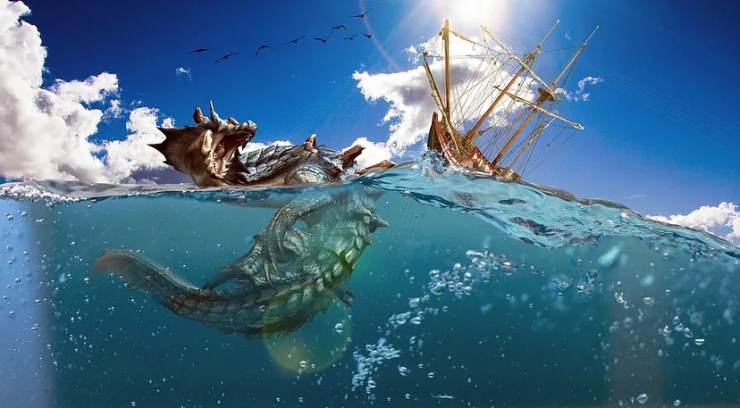

“The sea is only the embodiment of
a supernatural and wonderful existence.
It is nothing but love and emotion;
it is the Living Infinite…”
Jules Verne
Courtesy of Natural World Facts:
Courtesy of TED-Ed:
“I dream with my eyes open.”
Jules Verne
Courtesy of BBC Earth:
20,000 Leagues Under The Sea
JULES VERNE
8 February 1828 – 24 March 1905

Courtesy of Pathbooks:
Before submarines were actually invented, Jules Verne, a prolific French pioneer of science fiction and one of the most widely read authors in history, was dreaming of what it would be like to use one to travel around the world underwater. And although 20,000 Leagues Under the Sea is now considerably more than a hundred years old, it is still a thrilling and wonderfully entertaining fantasy of deep-sea adventure.

“Études, Op. 25 – No. 12 in C Minor ‘Ocean'” by Frédéric Chopin, performed by Jan Lisiecki:
The story opens with the sighting of a mysterious sea monster. An expedition is mounted to hunt it down, and the novel’s narrator, marine biologist Pierre Aronnax, joins the crew. The search extends into the Pacific, where the creature is finally found and attacked. During the fight, Professor Aronnax, his assistant Conseil, and harpooner Ned Land are thrown overboard. They end upright on top of the beast – which, they discover, is, in fact, an underwater vehicle.

Brought inside, the trio meets the ship’s inventor and commander, Captain Nemo. Brilliant, odd, slightly crazed, and with a name that is Latin for “No One,” Nemo teaches his guests about his amazing electrically powered submarine, which he has christened the Nautilus. Off they all set, through the underwater world, seeing its marvels as no one has before. Incidentally, twenty thousand leagues is the distance the Nautilus travels, not the depth to which it descends. Eventually, after feasting their eyes on awe-inspiring wonders as well as surviving the onslaught of a giant squid, Aronnax and his two pals escape from the Nautilus and make it back to land.
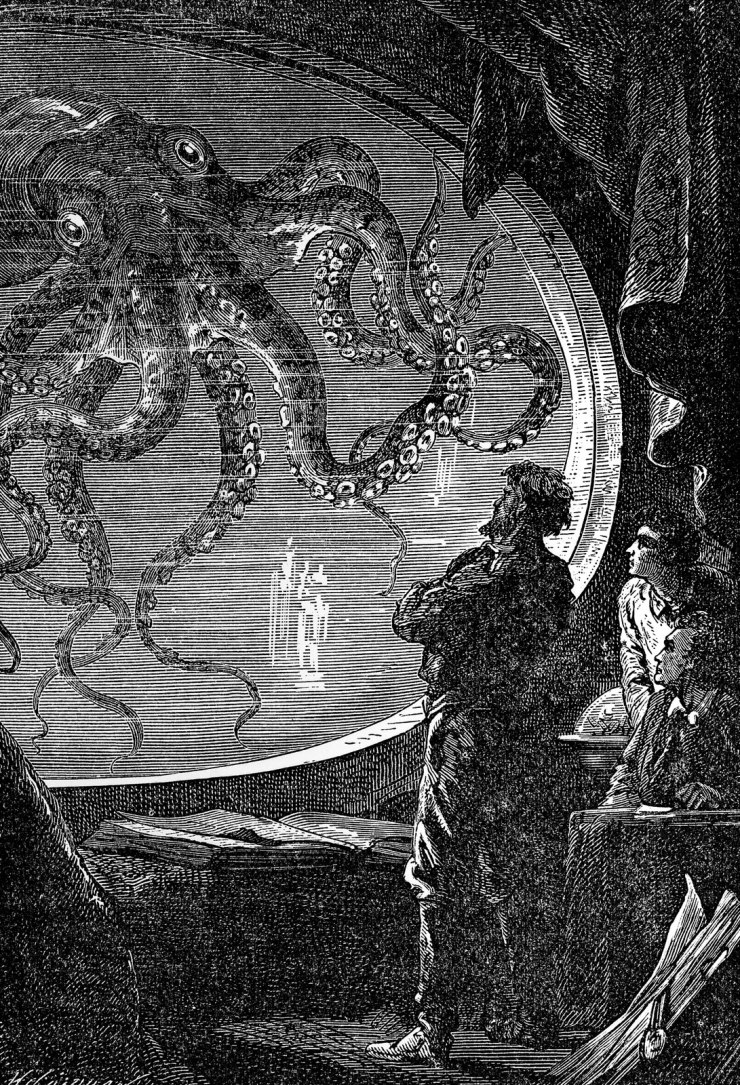
When it comes to describing life beneath the waves, Verne mixes reported facts with his abundant imagination, and this is what keeps the book still interesting today. And although Verne was prophetic in some ways, including military use of submarines, the real reason to read “20,000 Leagues Under the Sea” is to be on board as a master storyteller explores the watery deep.
“Pure Imagination” by Anthony Newley and Leslie Bricusse (courtesy of Benjamin T. Davids):

Verne’s other famous works included “Journey to the Centre of the Earth” and “Around the World in Eighty Days.” There have been several adaptations of Verne’s works. From a 1916 silent movie right up to the present day, Verne’s sagas have attracted numerous filmmakers, TV producers, and animators. The famous adaptation is the 1954 Disney version starring James Mason as Captain Nemo and Kirk Douglas and Peter Lorre.
Courtesy of JP Bazinet:
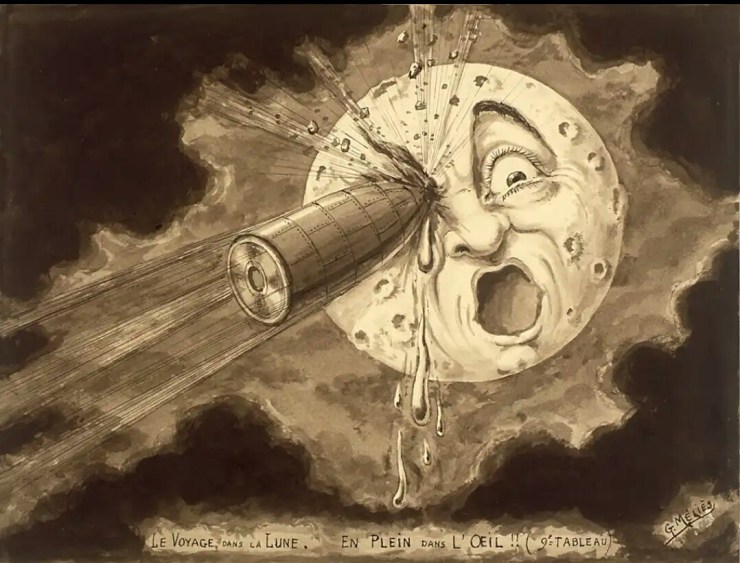
An image from “From the Earth to the Moon” by Jules Verne
An extract from 20,000 Leagues Under the Sea:
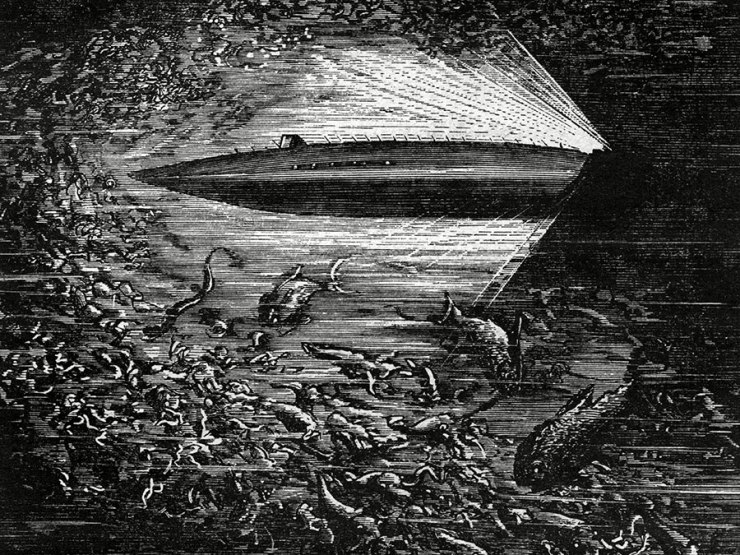
“In the year 1866, the whole maritime population of Europe and America was excited by the mysterious and inexplicable phenomenon. This excitement was not confined to merchants, common sailors, sea captains, shippers, and naval officers of all countries, but the governments of many states on the two continents were deeply interested. The excitement was caused by an enormous ‘something’ that ships were often meeting. It was a long, spindle-shaped, and sometimes phosphorescent object, much larger and more rapid than a whale. The different accounts that were written of this object in various log-books agreed generally as to its structure, wonderful speed, and the peculiar life with which it appeared endowed.
The sound of whales singing underwater, which could have been heard by the heroes of Verne’s novel:
If it was a cetacean it surpassed in bulk all those that had hitherto been classified. Moreover, reliable sightings many leagues apart, yet close in time, showed that the monster could move at tremendous speed, and was at home in warm water or in cold. In all the great centres the monster became the fashion; it was sung about in cafes, scoffed at in the newspapers, and represented at all the theatres. It gave an opportunity for hoaxes of every description.”

“In the year of 1867, some fresh facts changed it from a scientific problem to be solved to a real and serious danger to be avoided. On 5 March, the Moravian, of the Montreal Ocean Company, sailing in the northwest Atlantic, struck her starboard quarter on a rock which no chart gave in at that point. She was then going at the rate of thirteen knots under the combined efforts of the wind and her 400 horsepower. Had it not been for the more than ordinary strength of the hull in the Moravian she would have been broken by the shock, and have gone down with the 237 passengers she was bringing from Canada.”
By comparison, the different sounds made by humpback whales, which are famous for being the most altruistic animal. If interested, please take a look at my post “Can Animals Be Altruistic?”
“Nocturnes, L. 91, CD 98: III. Sirénes” by Claude Debussy, performed by Yan Pascal Tortelier, Ulster Orchestra, and The Renaissance Singers (courtesy of Fafner888):


Dear Joanna,🙏
I just finished reading your article, and I must say it’s absolutely enchanting. Your portrayal of Jules Verne’s imaginative world is so vivid and profound that I could almost feel myself diving into that mysterious undersea journey alongside Professor Aronnax and Captain Nemo.
I particularly loved how you wove together the ocean, science, and art, making the story come alive in a way that is both informative and deeply immersive. The references to music and the sounds of the deep sea added such a magical touch it truly enhanced the reading experience.
Your insights into Verne’s visionary ideas and the cultural significance of his works are beautifully articulated. Thank you for sharing such an inspiring and wonderfully crafted article it’s a joy to read!
Warm regards,
-Vijay
LikeLike
Thank you so much, dear Vijay, for the wonderfully analytical comments, which I love and greatly appreciate! With a reader as kind as you, it is a pleasure to work on my posts!
Joanna
LikeLiked by 1 person
Thank you so much, dear Joanna, for your magnificent tribute to Jules Verne and his work!
I found your post truly excellent, as always.
LikeLike
Fabulous book review. The Confederacy had a submarine, the CSS Huntley that was sunk with all hands in Charleston Harbor during the Civil War.(1862-1865). The wreck was recovered a few years ago. I also recall hearing about an American crude submarine called the Turtle that unsuccessfully tried to launch in Boston Harbor during the American revolution. But maybe the first boats that most would recognize were pre WWI.
LikeLike
Thank you so much, Pat, for the interesting comments, which are greatly appreciated!
Joanna
LikeLiked by 1 person
Very welcome, Joanna.
LikeLike
Thank you so much, dear Luisa, for the wonderful comments, which are greatly appreciated!
Joanna
LikeLiked by 1 person
Thank you, Pat!
Joanna
LikeLiked by 1 person
You are very welcome, Joanna 🙏🙏🙏
It is always my pleasure!
LikeLike
Thank you, dear Luisa, for being so kind!
Joanna x
LikeLiked by 1 person
One has to wonder what someone like Jules Verne would make of the modern world and all its discoveries. His imagination was quite prescient. It is amazing to me that mankind spends vast amounts of money and energy exploring outer space while yet there is so much we don’t know about our own planet. The little we have discovered of our oceans is extraordinary and fascinating. How much more must there be? Great music and images. I love the painting of the ship, such an elegant vessel. And whale song is hauntingly wonderful.
LikeLike
Thank you so much, Carolyn, for the wonderfully thoughtful comments, which I love and appreciate!
Joanna
LikeLike
A good post about a great author who inspired imagination in all of his readers. I read all of these three books and watched many of the movie and TV show remakes. He allowed young and old alike to imagine situations they had never experienced. Have a good day Joanna. Allan
LikeLike
Thank you, Allan, for the wonderful comments, which are greatly appreciated!
Joanna
LikeLiked by 1 person
Fine essay, as is always the case.
I was six or seven when the Disney film came out. My family was living in Brooklyn then. I remember seeing the movie with my mother in a Brooklyn movie theater.
LikeLike
A great post as usual. I was not aware that Verne was so prophetic. How interesting that his imagination was so accurate.
LikeLike
Thank you, Diana, for the wonderfully thoughtful comments, which are greatly appreciated!
Joanna
LikeLiked by 1 person
Thank you, Neil, for the beautiful memories of your comments, which I love and appreciate!
Joanna
LikeLiked by 1 person
Thank you, dear Joanna, for yet another enriching edition of your Great Books of the World series, and this time throwing light on one of Jules Verne’s immortal works.
Verne, a prolific master of science fiction, may have written primarily for young adventurers, but his captivating imagination has always transcended age. Adults, too, have long been drawn to the depth, intrigue, and visionary brilliance of his storytelling, a quality you’ve beautifully highlighted in this post with your own marvellous writing.
Twenty Thousand Leagues Under the Sea remains one of the most imaginative and thrilling tales ever conceived. It was truly ahead of its time, leagues ahead, in every sense. It’s fascinating how scientific curiosity and popular wonder can converge in such surprising and powerful ways.
I still remember reading this deep-sea fantasy; the story has never faded from my mind. The gripping tale of three men captured by the enigmatic Captain Nemo and taken on a breathtaking journey aboard the futuristic submarine Nautilus is just awesome. And the elusive Captain Nemo remains one of my favourite characters in literature.
One of Verne’s opening quotes, “I dream with my eyes open,” has always stayed with me, because whenever I hear someone speak of dreams in this way, I’m reminded of Dr APJ Abdul Kalam’s beautiful reflections on the power of dreaming, which I’ve mentioned in my writings earlier too.
Your references to Verne’s other iconic works and their adaptations added yet another layer of interest. And the whale song is simply magical. Truly, Joanna, nature’s miracles will forever remain beyond our full understanding.
Your videos, paired with stunning images and mesmerising audio, create a genuine feast for both the eyes and ears. Thank you so much, Joanna, for sharing yet another wonderful, insightful post.
LikeLike
Thank you, Kaushal, for the wonderfully analytical comments, which I love and deeply appreciate! You are right that he was a visionary, as we still don’t know so much what is hidden beneath the waters of the oceans. Only yesterday, the news from France announced that they discovered 5.000 years old lengthy wall (150 metres) at the sea bottom, which might have been used to trap fish and also to prevent flooding.
Joanna
LikeLiked by 1 person
🤗🤗🤗
LikeLike
It’s always a pleasure to read your insightful posts, Joanna. Discovery of old lengthy wall in France reminds me of submerged structures like walls, pillars, anchors etc near Dwarka suggesting an ancient city of Lord Krishna, dating back to around 3500-1500 BCE.
LikeLike
Thank you, Kaushal, for the wonderful reply! As always, you are more than welcome!
Joanna
LikeLiked by 1 person
Thank you Joanna I enjoyed reading your post 💐🙏and listening to the music 🎶
LikeLiked by 1 person
Thank you, Morag, for the kind comments, which are greatly appreciated.
Joanna
LikeLiked by 1 person
Thank you, Joanna, for your profoundly immersive part of your Great Books of the World,shedding light on one of Jules Verne’s greatest creations. Twenty Thousand Leagues Under the Sea is, indeed ,one of the most exciting descriptions of underwater life with amazing diversity of small & big living creatures . It was truly amazing.It was quite an absorbing account of aquatic life supported by great videos,Thanks you for sharing yet another enriching post ,Joanna .
LikeLike
Thank you so much, Dhirendra, for the wonderful comments, which are greatly appreciated!
Joanna
LikeLiked by 1 person
My pleasure, Joanna 🙏
LikeLike
Thank you, Dhirendra, for being so kind!
Joanna
LikeLiked by 1 person
🙏🙏🙏
LikeLike
You are welcome 🤗
LikeLike
Thank you, Morag.
Joanna
LikeLiked by 1 person
💐❤️
LikeLike
Another wonderful book. You are covering all the classics. 💕
LikeLike
Thank you, Monica, for your kind comments, which are greatly appreciated!
Joanna
LikeLiked by 1 person
Your work highlights Jules Verne as a visionary who united science, imagination, and emotion to explore the unknown. It presents 20,000 Leagues Under the Sea as a work ahead of its time, capable of envisioning future technologies—like the submarine—before they even existed.
Verne’s greatness lies not only in predicting inventions but also in his talent for inspiring wonder, curiosity, and a love of knowledge. The sea appears as a symbol of the infinite and mysterious, and literature as a space where daydreaming remains possible, even more than a century later.
Excellent, Juana. Have a wonderful day.
LikeLike
Thank you, Lincol, for your wonderfully perceptive comments, which are greatly appreciated!
Joanna
LikeLiked by 1 person
Thank you, Joanna, for your kind words. I’m so glad to hear that you found the comments helpful and meaningful. Warm regards and sincere thanks.
LikeLike
Thank you, Lincol, much appreciated!
Joanna
LikeLiked by 1 person