

“You are always someone’s
favourite unfolding story.”
Ann Patchett
“Moonlight Shadow” by Mike Oldfield featuring Maggie Reilly:
In this post, I am reviewing more books that stormed the world with the power of imagination, dynamic storytelling, and always a moral message that would transcend cultural differences and be understood everywhere.
ALEXANDRE DUMAS
24 July 1802 – 5 December 1870

Courtesy of Universal Videos:
Alexandre Dumas was born in Villers-Cotterets, France, in 1802, and when his father died in 1806, the family lived in abject poverty. As soon as Dumas was able, he travelled to Paris to find work. After a few years, he made a name for himself as an innovative playwright. He became famous for his action-packed historical plays. From 1840, he began to produce action novels, including The Three Musketeers and The Count of Monte Cristo.
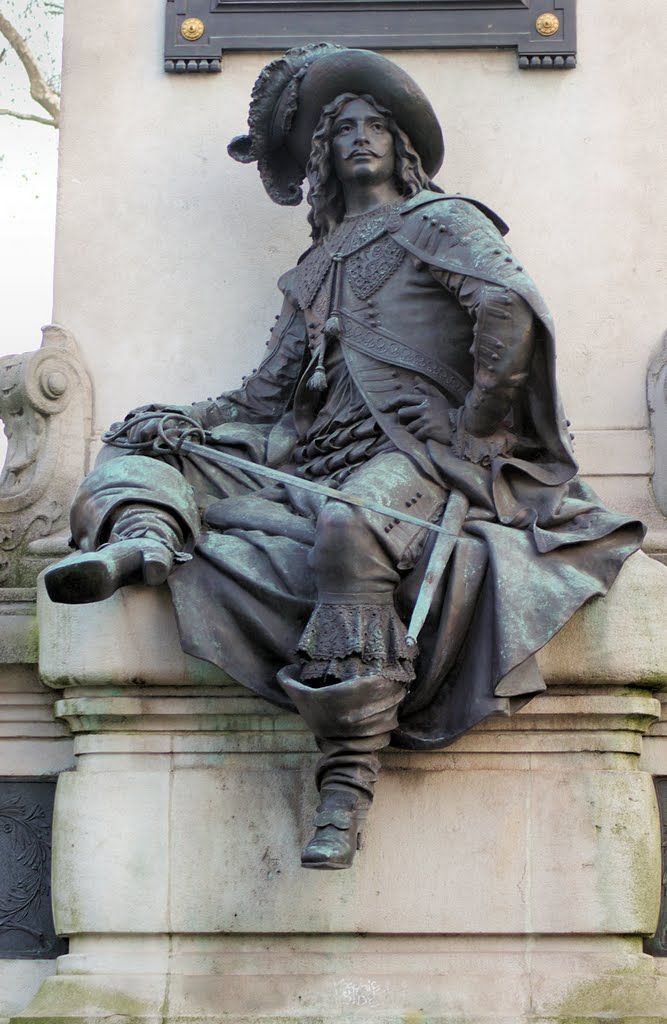
Statue of D’Artagnan in Montreal, Canada

To be able to produce so many large volumes, he created something of a story mill; employing other writers, 75 of them, and researchers to provide him with the material. The flamboyantly gifted Dumas would add his own inspiration – refining and embellishing the particulars in action-packed instalments published under his own name. The popularity and influence of his tales are undeniable. To thousands of readers, the compelling force of Dumas’s storytelling – his unrivalled command of a tale’s movement across a large historical canvas – marks every page of his novels as his own.

The Three Musketeers
Set in the seventeenth-century reign of Louis XIII and full of historical personages such as Cardinal Richelieu and the Duke of Buckingham, the story recounts the swashbuckling adventures of an impetuous young swordsman named D’Artagnan and the trio of soldiers in the king’s service who give the book its title: Athos, Porthos, and Aramis.
Cardinal Richelieu

Louis XIII, King of France

Courtesy of SandRhoman History:
Aspiring to join their ranks as a musketeer, D’Artagnan follows his temper and his taste for amorous entanglement into perilous situations from which his new friends must extricate him. Duels, romantic liaisons, and court intrigue come fast and furious as the dialogue-driven chapters fly by. The heroes’ primary antagonist, the scintillatingly seductive Milady, is one of the most vivid and alluring villains in all literature, and nearly a match for D’Artagnan and his fellows.

Literary entertainment gets no better than this; you will lose hours and hours of valuable time and relish every moment.
“String Quintet in E Major”, G. 282 III. Minuetto – Trio by Luigi Boccherini, performed by London Philharmonic Orchestra:
Dumas wrote two sequels to The Three Musketeers: Twenty Years After and The Vicomte de Bragelonne (sometimes called The Man in the Iron Mask.) There have been countless adaptations of The Three Musketeers and D’Artagnan has been played on-screen by Douglas Fairbanks, Gene Kelly, Michael York, and Chris O’Donnell.
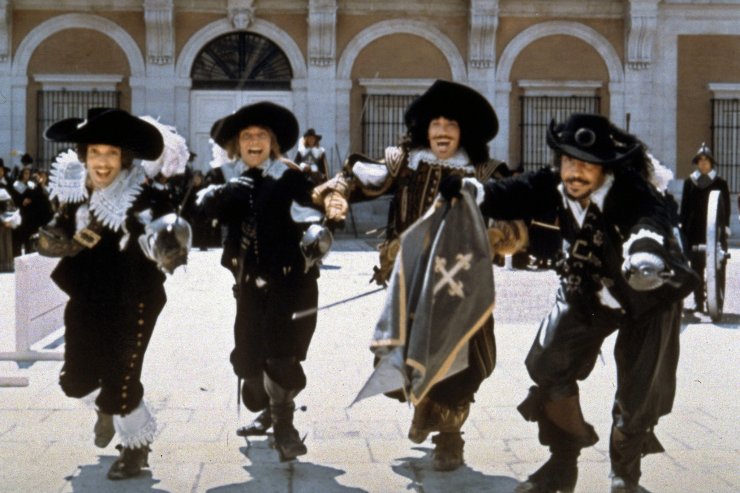
Coming soon, courtesy of Pathe:
An extract from The Three Musketeers:
“As Athos and Porthos had foreseen, at the expiration of half an hour D’Artagnan returned. He had this time again missed this man, who had disappeared as if by enchantment. D’Artagnan had run, sword in hand, through all the neighbouring streets, but had found nobody resembling him whom he was looking for. While D’Artagnan was running through the streets and knocking at doors, Aramis had joined his companions, so that on returning home D’Artagnan found the reunion complete. ‘Well?’ cried the three musketeers all together, on seeing D’Artagnan enter with his brow covered with perspiration and his face clouded with anger.

‘Well’ cried he, throwing his sword upon the bed; ‘this man must be the devil in person. He has disappeared like a phantom, like a shade, like a spectre.’
He then told his friends, word for word, all that had passed between him and his landlord, and how the man who had carried off the wife of his worthy landlord was the same with whom he had had a difference at the hostelry of the Franc-Meunier.
‘And did the mercer,’ rejoined Athos, ‘tell you, D’Artagnan, that the queen thought that Buckingham had been brought over by a forged letter.’
‘She is afraid so.’
‘Wait a minute, then.’ said Aramis.
‘What for?’ demanded Porthos.
‘Gentlemen,’ cried Aramis, ‘listen to this.
‘Listen to Aramis,’ said his three friends.
‘Yesterday I was at a house of a learned doctor of theology whom I sometimes consult about my studies.’
Athos smiled.
‘This doctor has a niece,’ continued Aramis.
‘A niece, has he?’ interrupted Porthos.
‘A very respectable lady,’ said Aramis.
The three friends began to laugh.”
“Concerto in C Major”, RV 425: II. Largo (Arr. for Guitar and Mandolin) by Antonio Vivaldi, performed by Craig Ogden and Alison Stephens:
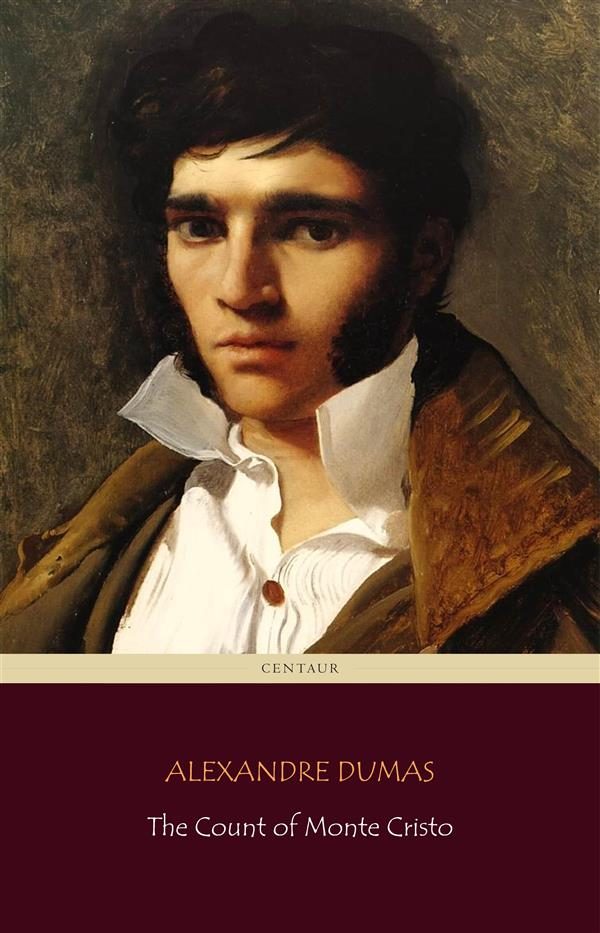
The Count of Monte Cristo
These are the fastest 1,200 pages you will ever read! When it comes to page-turners, The Count of Monte Cristo is the greatest of them all. Despite the novel’s gargantuan dimensions – it runs to more than twelve hundred pages – each of its chapters is like an exhibit in a compendium of narrative suspense; it is hard to imagine any thriller plot on page or screen that isn’t foretold in the fantastic adventures of Edmond Dantes.

Dantes is an earnest, responsible young sailor who, as the novel begins, has returned to Marseilles to marry his beloved Mercedes. Yet, on the eve of their wedding, he is nefariously accused of being a traitor, wrongfully convicted, and sentenced to life imprisonment in an impregnable chateau. So begins Dumas’s sprawling tale of vengeance, cunning, patience, and hope. As Dantes is transformed into the unforgettable figure who gives the book its title, he comes to combine the attributes of Odysseus, Robin Hood, and James Bond, a Western gunslinger, and James Bond meting out his artful and implacable justice with equal doses of vindictiveness and generosity.

“Parce mihi Domine” by Cristobal de Morales, performed by Jan Garbarek and The Hilliard Ensemble:
An extract from The Count of Monte Cristo:
“The vague disquietude which prevailed among the spectators had so much affected one of the crowd that he did not await the arrival of the vessel in harbour, but jumping into a small skiff, desired to be pulled alongside the Pharaon, which he reached as she rounded into La Reserve basin.

When the young man on board saw this person approach, he left his station by the pilot, and hat in hand, leaned over the ship’s bulwarks. He was a fine, tall, slim young fellow of eighteen or twenty, with black eyes, and hair as dark as raven’s wing, and his whole appearance bespoke that calmness and resolution peculiar to men accustomed from their cradle to contend with danger.
‘Ah, it is you, Dantes?’ cried the man in a skiff. ‘What is the matter? and why have you such an air of sadness aboard?’
‘A great misfortune, Mr Morrel,’ replied the young man – ‘a great misfortune, for me especially! Off Civita Vecchia we lost our brave Captain Leclere.’
‘And the cargo?’ inquired the owner, eagerly.
‘It is all safe, Mr Morrel, and I think you will be satisfied on that head. But poor Captain Leclere -‘
‘What happened to him?’ asked the owner, with an air of considerable resignation. ‘What happened to the worthy captain?’
‘He died.’
‘Fell into the sea?’
‘No, sir, he died of brain fever in dreadful agony.’ Then turning to the crew, he said. ‘Bear a hand there, to take to sail!’
All hands obeyed, and at once the eight or ten seamen who composed the crew sprang to their respective stations at the spanker brails and outhaul, topsail sheets and halyards, the jib downhaul, and the topsail clewlines and buntlines.”
A clip from the 2002 film (courtesy of sergeson):


Fascinating recaps, Joanna. I read of several artists who had a stable of painters who helped with some of the creations with input from the master. This is the first time I recall hearing an author employ that concept.
LikeLiked by 1 person
Dear Joanna, these are two of my favourite books! Your write up refreshed my memories of reading these in school. The cherry on the top is the amazing song, “Moonlight Shadow”, that you start the post with. Thank you.
LikeLike
Thank you, Punam, for your beautiful comments, which are very much appreciated!
Joanna
LikeLiked by 1 person
Thank you, Pat, for your interesting comments, which I found greatly fascinating!
Joanna
LikeLiked by 1 person
My pleasure and thanks, Joanna.💞😍
LikeLike
You are very welcome, Joanna.
LikeLike
Thank you, Punam!
Joanna
LikeLiked by 1 person
Thank you again, Pat!
Joanna x
LikeLiked by 1 person
Very commendable effort here, Joanna!
LikeLike
Thanks for the insight into how this master of story telling worked his magic. The two novels profiled exhibit this fully and have been told and retold on the screen over time. They still hold their swashbuckling fascination to this day. Happy Thursday Joanna. Allan
LikeLike
Thank you, Indira, for your kind comments, which are greatly appreciated!
Joanna
LikeLiked by 1 person
Thank you, Allan, for your wonderful comments, which I greatly appreciate!
Joanna
LikeLiked by 1 person
Such romantic and heroic characters! I love the statues and the pictures. Was Dumas the first to compile a serial? The 3 Musketeers have certainly retained their popularity. I have never read the books so I appreciate your introduction. This is something you really have a gift for, Joanna and you find such delightful music to include. Many thanks!
LikeLike
Thank you, Carolyn, for your wonderful comments, which I greatly appreciate! Yes, Dumas was the first.
Joanna x
LikeLike
I like the photo of Dumas. He has a twinkle in his eye. I’m guessing he was a good-hearted, fun-loving individual.
LikeLike
I always enjoy learning about the authors behind the novels. Thank you for sharing.
LikeLiked by 1 person
Thank you, Diana, for your kind comment, which is much appreciated!
Joanna
LikeLiked by 1 person
Thank you, Neil, for your thoughtful comment, which is greatly appreciated!
Joanna
LikeLiked by 1 person
💙💜
LikeLike
Thank you so much for your kind comment, which is greatly appreciated!
Joanna
LikeLike
Thank you, Joanna, for yet another fascinating post on the prolific writer, Alexandre Dumas and his two timeless classics. It was saddening to learn that Dumas lost his father when he was just four years old and grew up in abject poverty. Coincidentally, today I wrote about Lal Bahadur Shastri, who lost his father at the age of two. I myself lost mine at twelve, so I can deeply empathise with Dumas and admire how he rose above such an early setback to achieve remarkable success.
You rightly highlighted that he created a veritable “story mill” by employing around 75 writers, because he was accused of using ghostwriters. Incidentally, I too have ghostwritten articles and speeches for top executives, so that point particularly resonated with me.
Of his works, “The Three Musketeers” has always been my favourite since childhood. Its thrilling plot and adventurous spirit continue to captivate readers across generations. Although I haven’t read the two sequels you mentioned, the exploits of D’Artagnan and the inseparable trio—Athos, Porthos, and Aramis—are incredible. I was surprised to learn that the story was said to be inspired by real events, something I initially found hard to believe.
The Count of Monte Cristo too, inspired by the true story of a wronged shoemaker, powerfully conveys the theme of revenge. The young sailor, Edmond Dantès’s anguish at being unjustly branded a traitor and condemned to lifelong imprisonment is masterfully woven into a gripping narrative.
Thank you once again for the effort you put into publishing such an exceptional post. The illustrations- images, and audio-visual clips you included are superb, as always. Kudos to you, Joanna!
LikeLike
Thank you, Kaushal, for the wonderful comments, which I deeply appreciate! I am glad that you liked music, too! Your kind words made my day!
Joanna
LikeLiked by 1 person
Truly my pleasure, Joanna! You’re most welcome.
LikeLike
Thank you, Kaushal! You are very kind!
Joanna
LikeLiked by 1 person
I remember trying to read Count of Monte Cristo in French in high school. After reading your except I can better understand why I could not get through that book – in French! (I did read The Little Prince in French first and have read it many, many times in English since.)
When you said that Dumas was “employing other writers, 75 of them, and researchers to provide him with the material.” I had to smile. That sounds like a 19th century version of using AI for research and editing. 🙂
LikeLiked by 2 people
Thank you so much, LuAnne, for your wonderfully thoughtful comments, which are greatly appreciated!
Joanna
LikeLiked by 1 person
Joanna ji, 🙏
Your review is not merely a literary analysis but feels like a spiritual experience. The ease with which you have revealed the essence of Alexandre Dumas’s life and works reflects a beautiful confluence of the depth of the soul and the height of consciousness. It seems as if waves of creative energy flow from your words an energy that made a creator like Dumas eternal.In your writing, “Art is not merely the arrangement of words, but the expansion of the soul” this feeling comes alive vividly. Your depiction of The Three Musketeers and The Count of Monte Cristo reminds us that every great story builds a bridge between light and darkness, karma and destiny, divine power and human frailty. The way you have presented these dimensions with grace and reverence touches the heart deeply.Your review shows that literature is not just read, it is experienced not with the mind, but with the soul. The flow and sweetness in your language are like a prayer, bringing both peace and inspiration within the reader. It is not merely a tribute to Dumas’s stories, but to the immortal resilience of the human spirit.Your writing undoubtedly reminds us that true art is born where sensitivity, imagination, and light converge.
– Vijay
LikeLiked by 2 people
Thank you so much, dear Vijay, for your wonderfully analytical comments, which lifted my spirits and made my day! Also, thank you for persevering and finding my post despite the previous problems!
Joanna
LikeLiked by 2 people
The Three Musketeers, Its one of the first books, I’ve read. The Count of Monte Cristo – such a Great books. I’ve always admired how he used adventure as a lens to explore loyalty and redemption. Always a treat when you make classics feel alive and relevant.
LikeLiked by 2 people
Thank you so much, Ritish, for your wonderful comments, which I greatly appreciate!
Joanna
LikeLiked by 2 people
Fabulous, my two favorite books. I’ve been gone for a few weeks, not checking WP. Today, I wondered how far back in the Reader I wanted to go. Catching up is tiring. I was pleasantly surprised to read about Dumas!! Interesting that he used other writers to help him. Surprised they would not have complained that he then had the work under “his” name.
LikeLike
Thank you, Monica, for your kind comments, which are greatly appreciated! He only used their ideas but wrote everything himself.
Joanna
LikeLiked by 1 person
Joanna, this post brought back many fond memories of reading these books in high school and watching many movies made from the books over the years. Thank you so much for providing the background information about times and places and how the books were written. Somehow, I suddenly want to watch a movie based on The Count of Monte Cristo. I wonder if I can talk Robert into watching with me. 😁
LikeLike
Thank you, Cheryl, for your wonderful comments, which are greatly appreciated! My regards to you both!
Joanna
LikeLiked by 1 person
Excellent publication. You have managed to convey all the greatness of Dumas and the timeless power of his stories. A fascinating and very well-researched read.
Warm hugs from afar, my friend Joanna.
LikeLike
Thank you, Lincol, for your wonderful comments, which are greatly appreciated!
Joanna
LikeLiked by 1 person
Thank you, Joanna, for sharing so much beauty in your words. It’s always a pleasure to read you! 🤗🤗
LikeLike
Thank you, Lincol, for your kind words!
Joanna
LikeLiked by 1 person
With pleasure, Joanna. It’s always a delight to read your writing and be captivated by its sensitivity. Warm regards. 🤗👏🫂
LikeLike
Thank you, Lincol!
LikeLike