
“A simple smile.
That’s the start of opening your heart
and being compassionate to others.”
The Dalai Lama
“Yule” by Daridel:
Courtesy of LoveLostwithiel:
When I published my post about “A Christmas Carol”, shortly before 25th December, a few readers expressed regret that I hadn’t included more books by the greatest English writer, and one of the greatest in the world.
Charles Dickens is without a doubt the most ingenious author in English literature.
Courtesy of Penguin Books UK:
I have all of his 36 books in the original fabulous presentation of light chocolate brown and lots of gold decoration, with original drawings, published in 1875 by Chapman and Hall, the renowned publishers of Piccadilly, London. In time of need, I can pick up any title to be transported into a world that absorbs me so completely that I don’t remember why I was seeking distraction, and just keep on turning the pages to read more. As I already know, each of his work stands as the proof of his genius.
When we open one of his formidable volumes, we soon recognize a peculiar sense of dynamism. It is as if the author has not set out to write a novel, but has been dropped into a pulsing reality he has to write his way through, improvising a narrative out of the available material, much in the way we must construct a life. That is why so many of his novels – the early Dickensian – defining ones especially such as Oliver Twist and David Copperfield – begin with the birth with of a protagonist and follow his adventures into adulthood. No surprise, then, that the stories are ultimately about fate, which may seem to unfold around his heroes, but is more truly dependent upon their discovering, one step at a time, the destination of their personal journeys.
“Symphony No. 1 in A Flat Major”, Op. 55 – 3. Adagio by Edward Elgar, performed by Staatskapelle Berlin and Daniel Barenboim:
The “biographical” approach suggests a reason his supporting characters, who contribute so much to our pleasure in reading Dickens, are so boldly drawn, their defining traits exaggerated to within an inch of caricature. Think of the obsequious Uriah Heep in David Copperfield, or the eternally disappointed bride in Great Expectations.
For all their vivid presence and comic, even when sinister, verve, these figures are described not as being but as experiences. What we remember of people in our own past has a similar quality. Recall your favourite aunt and you will see in miniature what Dickens does at scale. The qualities that define a person in recollection are those that are larger than life markers for the whole being that serve as milestones in memory.
Just so, his characters are both less naturalistic and more real than the creations of other novelists, the way a snapshot coloured with reminiscences can coalesce our lived experience more tellingly than a return visit to its physical setting. It is the way our minds and our memories work, animating people and places whenever we turn our attention to them fully.
Uniquely, Dickens does this not only with his characters, but also with streets and buildings, landscapes and weather, moral challenges and social conventions, even government offices.
Dickens discovered stories wherever he looked – in the shape of chimneys, in law courts, in fog – even before he peopled them with characters. He knew that we live in stories every minute, and no other writer sweeps us up into the moment -by-moment storyness of life in quite the same way.
The enduring popularity of his creations proves the importance of his books’ imaginative life.
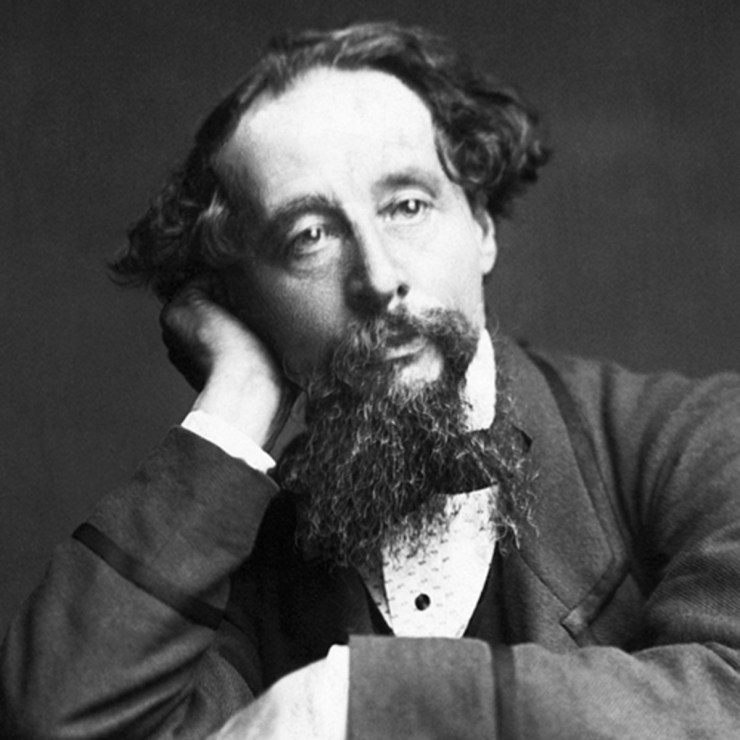
CHARLES DICKENS
1812 – 1870
Courtesy of TED-Ed:
David Copperfield and Mr Micawber

David Copperfield
“Of all my books, I like this the best”
Charles Dickens
“Whether I shall turn out to be the hero of my own life, or whether that station will be held by anybody else, these pages must show.”
This is how this wonderful story begins, a novel so filled with character, inventions, suspense, and inspired retelling that one finishes it with overwhelming regret. The turning of the last page closes the book on such a world that one immediately feels impoverished. This book is my favourite too.
David Copperfield and Peggotty

Dickens famously called Copperfield the “favourite child” of all his literary legacy, and its autobiographical frame goes some way towards explaining why. The eighth of his novels to be written, it is the first one to be narrated in the first person, and, from the opening words, the direct address of the protagonist is captivating. The coming-of-age tale that David relates has many points of contact with Dickens’ own experiences as the son of a debtor, as an adolescent employee in a factory, as a parliamentary reporter, and, lastly, as a successful novelist.
Mr Dick, David Copperfield and Betsey Trotwood
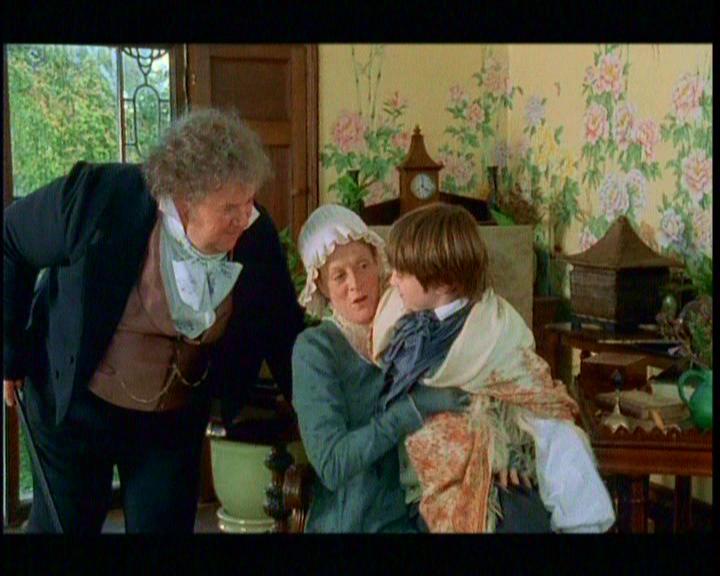
The book is crammed with enough memorable characters to sustain the careers of half a dozen storytellers. The cast includes – to mention only a few – David’s imperious aunt, Betsey Trotwood, who comes to his rescue with an asperity as sharp as her magnanimity is deep; Aunt Betsey’s simple-minded protege and muse, Mr Dick; the improvident, incorrigibly optimistic, and unabashedly grandiloquent Mr Micawber; the charming, caddish seducer Steerforth; the unforgivable, unforgettably named Uriah Heep, whose unctuous servility cannot mask his evil intent; and David’s childhood housekeeper and lifelong friend and ally, the stalwart Peggotty, whose caring nature reflects the unaffected nobility of her family of Yarmouth fishermen. Through all the plotting and sub-plotting, the overriding sentiment of Dickensian fiction – that there are kindness and goodness in the world that underpins everything; the facades of wealth and privilege, the social currency of fashion, even when we least expect it – carries the hero of this novel towards the satisfaction of a happy ending.
From “The Personal History Of David Copperfield” (courtesy of Searchlight Pictures):
You shouldn’t read only one Dickens, but if you do, make it David Copperfield.

An extract from David Copperfield:
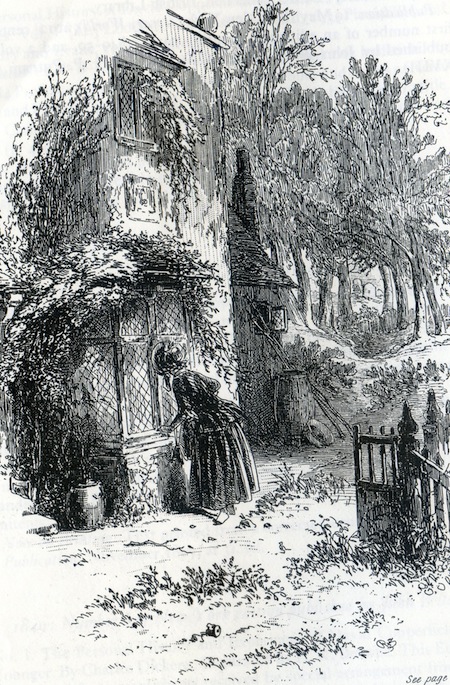
“My mother was sitting by the fire, but poorly in health, when lifting her eyes to the window opposite, she saw a strange lady coming up the garden. My mother had a sure foreboding at the second glance, that it was Miss Betsey. The setting sun was glowing on the strange lady, over the garden fence, and she came walking up to the door with a fell rigidity of figure and composure of countenance that could have belonged to nobody else.
When she reached the house, she gave another proof of her identity. My father had often hinted that she seldom conducted herself like any ordinary Christian, and now, instead of ringing the bell, she came and looked in at that identical window, pressing the end of her nose against the glass to that extent, that my poor dear mother used to say it became perfectly flat and white in a moment. She gave my mother such a turn, that I have always been convinced I am indebted to Miss Betsey for having been born on a Friday.
My mother had left her chair in her agitation, and gone behind it in the corner. Miss Betsey, looking round the room, slowly and inquiringly, began on the other side, carried her eyes on, like a Saracen’s Head in a Dutch clock, until they reached my mother. Then she made a frown and a gesture to my mother, like one who was accustomed to being obeyed, to come and open the door. My mother went.
‘Mrs David Copperfield, I think,’ said Miss Betsey; the emphasis referring, perhaps, to my mother’s weeds, and her condition.
‘Yes,’ said my mother faintly.
‘Miss Trotwood,’ said the visitor. ‘You have heard of her, I dare say?’
My mother answered she had had that pleasure. And she had a disagreeable consciousness of not appearing to imply that it had been an overpowering pleasure.
‘Now you see her,’ said Miss Betsey. My mother bent her head, and begged her to walk in.”
“The Order of Things” (from “Dickensian”) by Debbie Wiseman:
Oliver Twist
“Please, sir, I want some more” is among the most famous utterances in Dickens. It’s spoken by a very small orphan named Oliver Twist to the man in charge of ladling out the meagre portion of gruel. Oliver lives with other parentless children in a workhouse established by society to house impoverished youngsters.
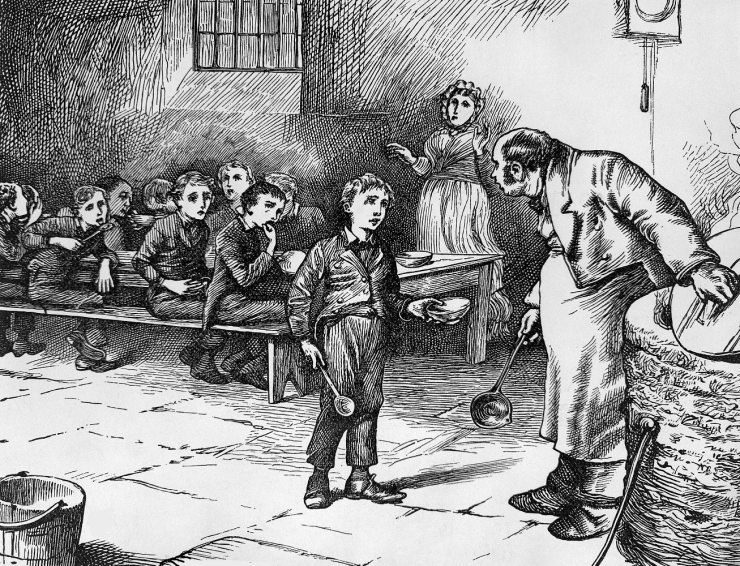
In a single sentence, it conjures up all the forces at the heart of Oliver’s tale: innocence, want, mischief, hunger, boldness, desperation, misfortune. And, last but not least, institutionally sanctioned cruelty: “The master aimed a blow at Oliver’s head with the ladle, pinioned him in his arms, and shrieked aloud for the beadle.”
From “Oliver Twist” (1948) (courtesy of WW Movie Clips):

Oliver Twist was its author’s second novel, telling a continuous story in a way his first, the delightful but episodic Pickwick Papers, did not. What is innovative in the book is not its shape, but its focus. Never before had a child been put so centre stage in a novel, more importantly, never before had childhood been treated in a prolonged narrative as a state of being in its own right, with all the colours and contours of an emotional landscape as fully developed as an adult’s.
Fagin and his pupils

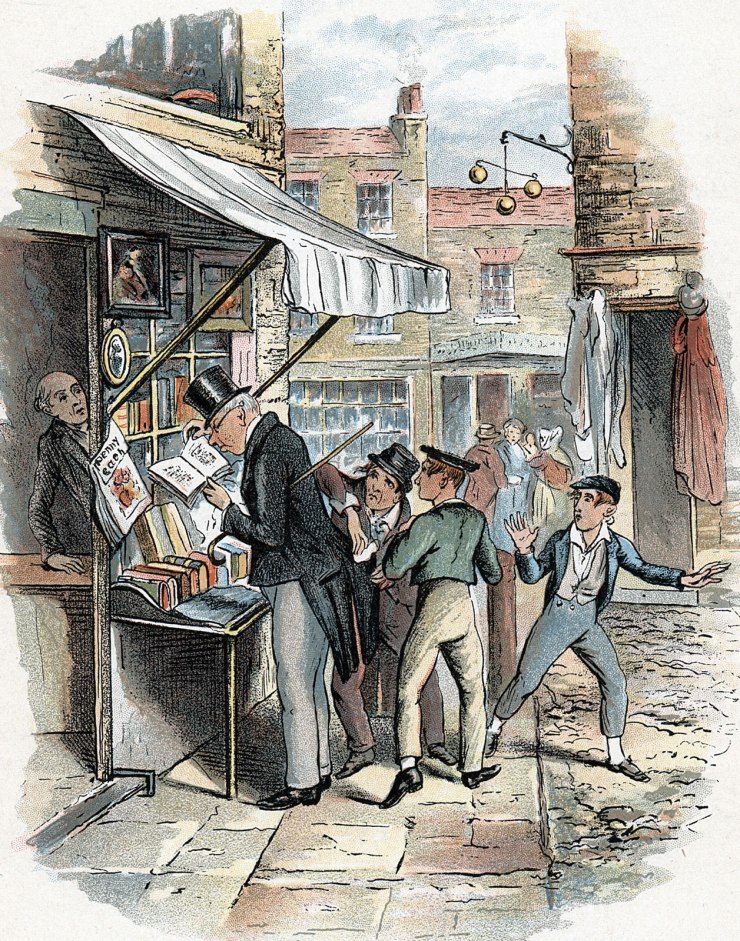
As Oliver progresses from workhouse minion to undertaker’s assistant to conscript in the thieving army of urchin pickpockets led by the Artful Dodger and in thrall to the seedy ringleader Fagin, the reader is treated to a searing social satire on the treatment of paupers and bereft children, a vivid portrayal of the urban criminal underworld, and a suspenseful if murky plot that is a rollercoaster of dramatic events, hopes, and fears, degradation, and redemption. It’s an exhilarating chase, led by a young writer learning to harness his extraordinary creative energy.
“Fagin’s Romp” (from “Oliver Twist”) by Sir Arnold Bax, performed by National Philharmonic Orchestra:
A Tribute (courtesy of Charles Dickens):

 naturetails
What a wonderful perspective on an author who gave us so many excellent tales. I have not read all of his works, but have read Oliver Twist, David Copperfield, a Tale of Two Cities, Great Expectations and a Christmas Carol. He certainly wrote about the highs and lows of the times and his characters were richly filled out. Happy Thursday Joanna. Allan
LikeLike
Thank you, Allan, for your wonderful comments, which are greatly appreciated!
Joanna
LikeLiked by 1 person
Wonderful homage to both the author and the novel, Joanna. Uriah Heep might be one of the most descriptive names on literature.
LikeLike
Thank you, Pat, for your excellent comment, which resonates with my belief.
Joanna x
LikeLiked by 1 person
Very welcome, Joanna.
LikeLike
Thank you so much, Pat!
Joanna
LikeLiked by 1 person
He seems to have absorbed detail like blotting paper as he could describe a scene so that you could see, feel and smell it and I agree that he must have placed himself in the shoes of his characters, giving them life that was believable. An extraordinary talent. What would Mr Dickens make of modern society, I wonder. I fear it would distress him to see how little we have learned, finding only new ways to torment the less fortunate. How precious is your library of Dickens novels! Thank you Joanna!
LikeLike
Thank you, Carolyn, for your wonderfully thoughtful comments, which are very much appreciated!
Joanna x
LikeLike
A very insightful post that reflects both your respect for the author and your love of his work.
LikeLike
Hi Joanna. I’ve read at least four of his novels, but none in a very long time. Of those I’ve read, I think I liked Nicholas Nickleby the best.
LikeLike
Thank you, Neil, for your interesting comments, which are greatly appreciated!
Joanna
LikeLiked by 1 person
Thank you, Diana, for your wonderfully spot-on comments, which are very much appreciated!
Joanna
LikeLiked by 1 person
Thank you, Joanna, for yet another illuminating post on Charles Dickens and his timeless masterpieces—Oliver Twist and David Copperfield. It is always a delight to revisit them through your thoughtful writing. As I once mentioned, Oliver Twist had been part of our school curriculum, and it left a lasting impression on me.
Interestingly, both novels share the theme of young orphans navigating harsh worlds. Oliver struggles against countless setbacks in his search for safety and happiness amid the criminal underworld, while David faced the cruelty of a stepfather after his mother remarries, his life abruptly altered. Yet, where Oliver Twist carries a somber tone, David Copperfield offers a more hopeful and optimistic journey, filled with discoveries of love and life.
Both, however, are rich with lessons that only a great writer like Dickens could so vividly bring forth—and your engaging reflections made revisiting them all the more rewarding.
I especially appreciate your insight that Dickens found stories everywhere, for indeed we live within stories at every moment. His deep concern for orphans, women, and the mentally challenged reveals his sharp eye for how society’s weakest are so often oppressed by the powerful, making him not just a storyteller but a true social critic.
The excerpts you selected from David Copperfield beautifully highlighted the tender relationship between David and his mother, reminding us why this novel is often regarded as Dickens’ greatest work.
Thank you, Joanna, once again, for presenting his legacy with such clarity and warmth. Your thoughtful blend of words, images, audios, and videos made this post not only informative but also a captivating tribute to a truly deserving author.
LikeLike
Thank you so much, dear Kaushal, for the wonderful and analytical comments! Reading your extraordinary reviews of my posts makes me truly grateful for your ability to illuminate every nuance of a writer’s aim, and for having you as the reader and friend. I think that Charles Dickens would be impressed with your unique talent, and in his name, I thank you from the bottom of my heart!
Joanna
LikeLiked by 1 person
Such a beautiful comment, dear Joanna! I feel truly honoured. Reading your posts is always a delight, and I make it a point to set aside time just for them. Thank you so much—your presence is always a joy.
LikeLiked by 1 person
Thank you so much, dear Kaushal, for being always kindness personified!
Joanna
LikeLiked by 1 person
🙏💐🙏
LikeLike
What a delightful post about the work of Dickens. I have always enjoyed both the books and the captivating movies made from them! Thank you, Joanna! 💐
LikeLike
Thank you so much, dear Cheryl, for your wonderful comments, which are greatly appreciated!
Joanna x
LikeLike
Thank you, Joanna, for your yet another fascinating post on Charles Dickens and his great masterpieces—Oliver Twist and David Copperfield.The passages you selected from David Copperfield beautifully highlighted the tender relationship between David and his mother, reminding us why this novel is often regarded as Dickens’ greatest work. Thank you, Joanna, for painstakingly & so beautifully presenting the great legacy of the author. Namaste !
LikeLike
Thank you, Dhirendra, for your wonderful comments, which are greatly appreciated! It certainly is my favourite, as was Dickens, too.
Joanna
LikeLike
I really love how you make Dickens characters feel so alive. Those 1875 editions are surely pure magic. You make me want to pick up one of his books all over again.
LikeLike
Think you, Ritish, for the wonderful comments, which are greatly appreciated! Rereading Dickens is very much recommended!
Joanna
LikeLike
I’m just now getting to this posting because I’ve learned I must set aside the time necessary to completely appreciate it. Your time and effort on your blog is most appreciated.
LikeLike
Thank you, Kenne. Please take your time!
Joanna
LikeLike
Thank you Joanna for another great article!
LikeLike
Thank you, dear Filipa, for your uplifting comments, which make me very happy!
Joanna xx
LikeLiked by 1 person
What an inspiring read. It is a beautiful tribute to Dickens and the inexhaustible power of his stories. Reading it is like rediscovering humanity on every page, with all its lights and shadows. Thank you for sharing a journey so full of passion for books and the magic of words. 📖💛
Have a wonderful day! 🤗🤗
LikeLike
Thank you, Lincol, for the beautiful comments, which I deeply appreciate!
Joanna
LikeLiked by 1 person
With pleasure, Joanna. Thank you for sharing such beauty. I wish you a beautiful day, full of light and serenity. 😊🤗
LikeLike
Thank you, Lincol, you are very kind!
Joanna
LikeLiked by 1 person
🤗🤗🤗
LikeLike