

“Life is an echo,
what you send out,
comes back.
What you sow,
you reap.
What you give, you get.
What you see in others,
exists in you.”
Zygmunt Ziglar
Courtesy of Andy Matthews:
“It is nothing to die;
it is dreadful not to live.”
Les Misérables, Victor Hugo
This post is about the inconquerable power of the human spirit. It comes to the fore in times of wars, civil unrest, or the unprecedented scourge in today’s world – the pandemic. The self-sacrifice of people in such times is transcending the most striking actions the famous books can offer. One of my favourite books was written by Victor Hugo, and it was and is one of the most loved ones; it is of course – Les Misérables, an epic tale of injustice and adversity, love and hope.
The spirit of Hope, the Himalayas

“Au Matin” by Marcel Tournier (courtesy of anastasiaharp):
VICTOR HUGO
1802 – 1885

Courtesy of Homer Thompson:
Victor Hugo was born in 1802 at Besançon, now the capital of the department of Doubs in eastern France.
Besançon, France

Courtesy of Lucas Dubiez:
His father, a career officer in Napoleon’s army, was at that time a major, but rose eventually to the rank of general and was created a count.
The parents of Victor Hugo

His various garrison appointments necessitated moving around a lot, and the education of the young Victor took place in Italy, Spain, and in Paris where the family settled at the Maison des Feuillantines. This was certainly good for him, and he received a very thorough grounding in humanities, even reading Tacitus at the age of 7.
Maison Feuillantines in Paris, France
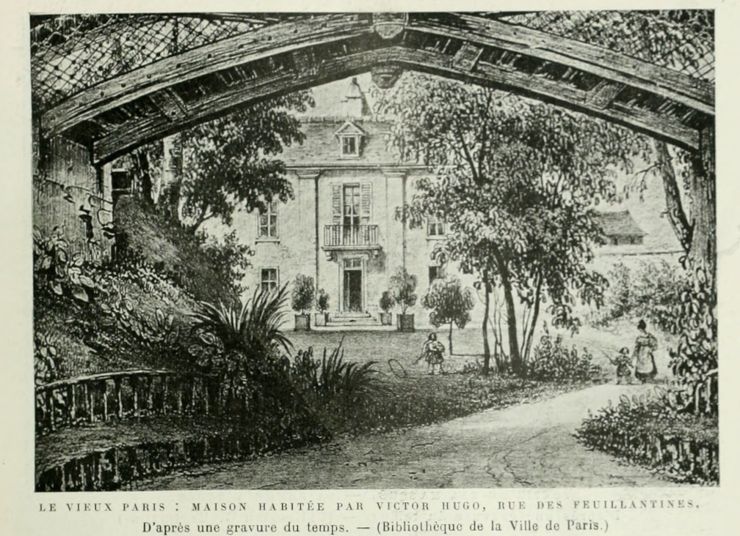
Hugo had three elder brothers. His literary ability was obvious very early on; a poem written while he was still at school won a literary prize, and with his brother Abel, he launched the review magazine, the Conservateur Litteraire, which although, it survived for only two years, achieved some prominence as a mouthpiece of the Romantic movement.
Victor Hugo and his brothers Abel and Eugene

He was always deeply concerned with the social and political developments of his time. Hugo’s politics had changed in the light of events and as a reflection of his personal growth, but he was first and foremost, by nature as well as by conviction, a romantic.
Courtesy of Musées Parisiens à découvrir:
Hauteville House, now a Hugo museum, St Peter Port, Guernsey


The Drawing Room at Hauteville House

Victor Hugo’s bedroom at Hauteville House

Hugo’s dissatisfaction with Louis Napoleon’s Second Empire was so great that he was forced to leave France. After staying for a time in Brussels, he moved to the Channel Islands, first to Jersey and then to Hauteville House in Guernsey, where he lived with his wife and family for fourteen years. It was here that he wrote and completed the novel which is generally considered his masterpiece, Les Misérables, published in 1862. Victor Hugo, anxious to learn how his new book had been received, is said to have cabled his publisher with a message which read simply “?” The publisher cabled back “!”
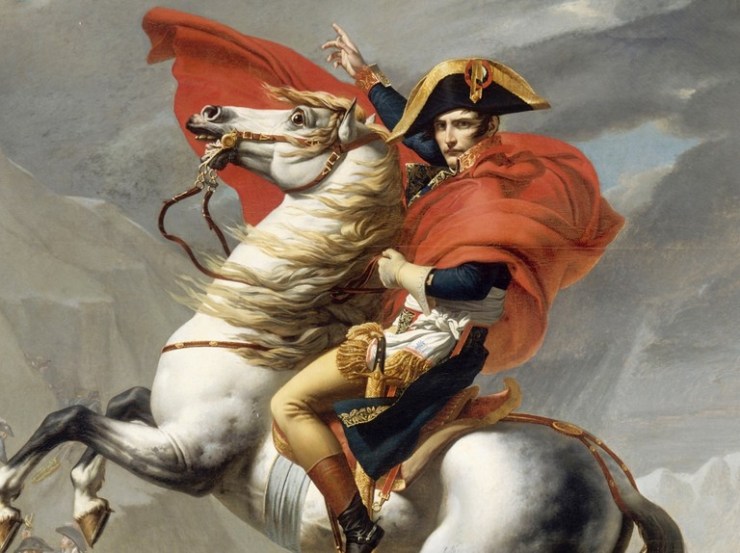
Napoleon Bonaparte, Emperor of the French
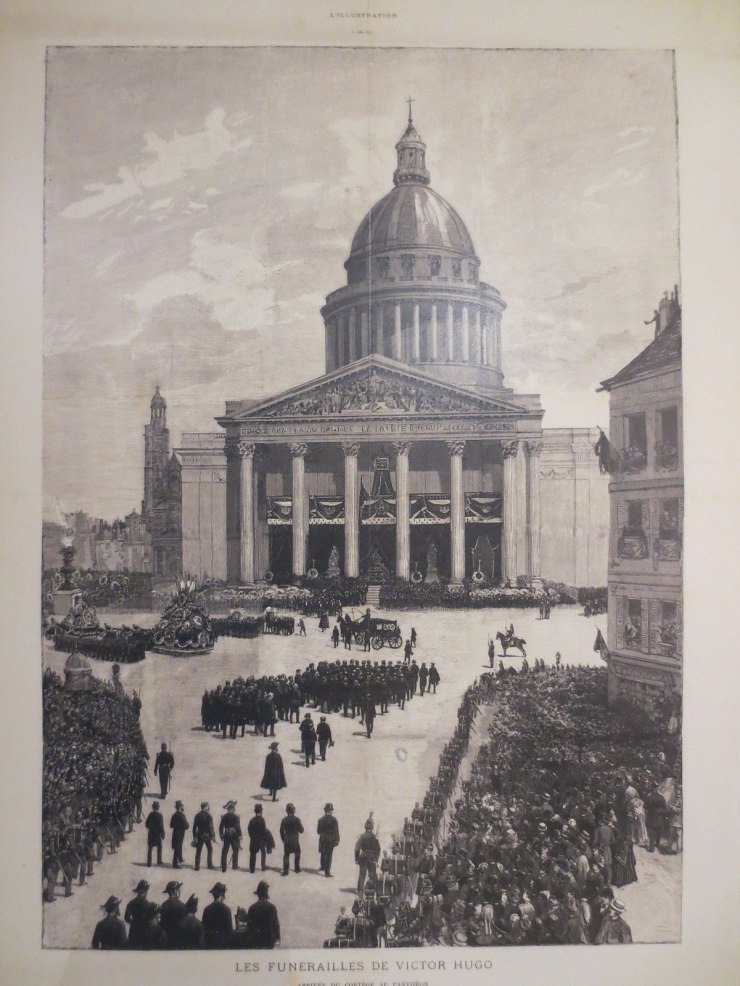
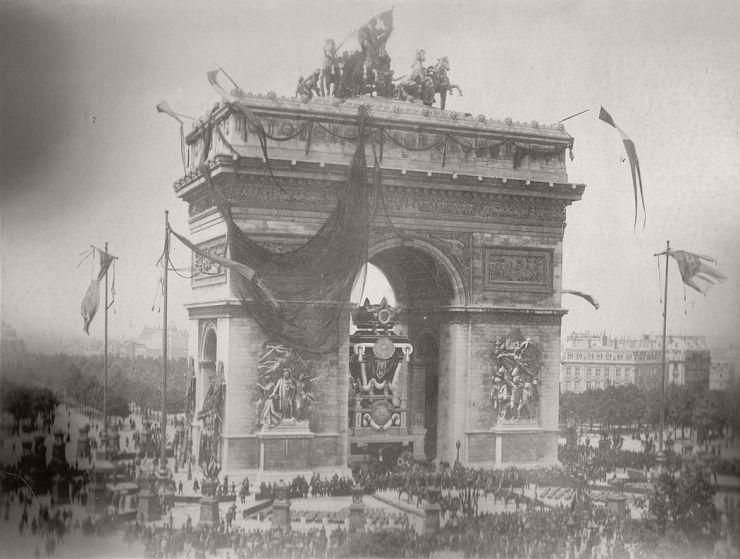
In his long life, Victor Hugo amassed glory on a scale we can scarcely imagine today. Upon his death at the age of eighty-three, his body was laid in state in Paris beneath the Arc de Triomphe, and two million people paid their respects to the revered poet, dramatist, and novelist before he was buried in a pauper’s coffin, as his will stipulated, in the Pantheon.
“Symphony No. 3 in E-Flat Major, Op. 55 ‘Eroica’ – 2. Marcia funebre (Adagio assai)” by Ludwig van Beethoven, performed by Wiener Philharmoniker and conducted by Claudio Abbado:
The funeral of Victor Hugo at The Pantheon
Lying in state at The Arc de Triomphe

Hugo’s epic funeral diminishes the early farewell of other writers the way Les Misérables – in its length, scope, and magnanimity – towers over all but a handful of novels. The product of two decades of literary labour, Les Misérables was begun while the author enjoyed political favour in Paris, and was finished during Hugo’s nineteen years political exile in the Channel Islands. Hugo’s fierce advocacy for the poor and oppressed (the book’s title could be translated as The Wretched) runs like an electric current through the intricate plot of the story he created.
St Peter Port, Guernsey

The English translation was made by Hugo’s friend Charles Edwin Wilbour; astonishingly, Wilbour translated the fifteen-hundred-page novel in time for it to be published in New York in 1862, the same year it appeared in France. It is a mark of Hugo’s popularity that translators working in several other tongues matched Wilbur’s achievement. A superb translation by Julie Rose, the most complete and textually reliable to date, appeared in 2008 and supersedes all previous versions.

You can see from the manuscript below why without the benefit of a laptop, it took twenty years to write this novel!

“You cannot change your past, but other
people’s opinions do not define reality.”
Kingsley Vincent
LES MISÉRABLES
Barricades on the streets of Paris
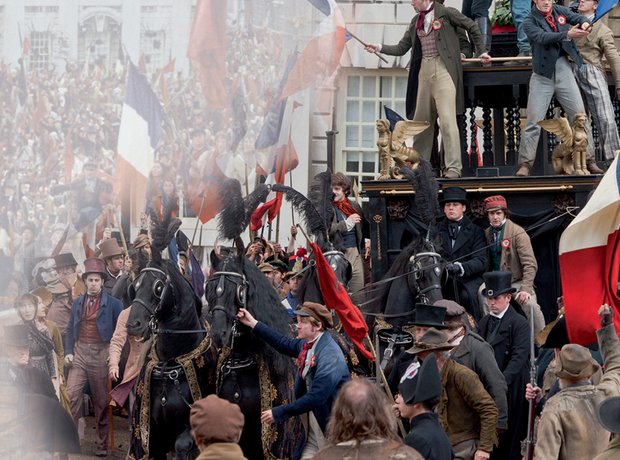
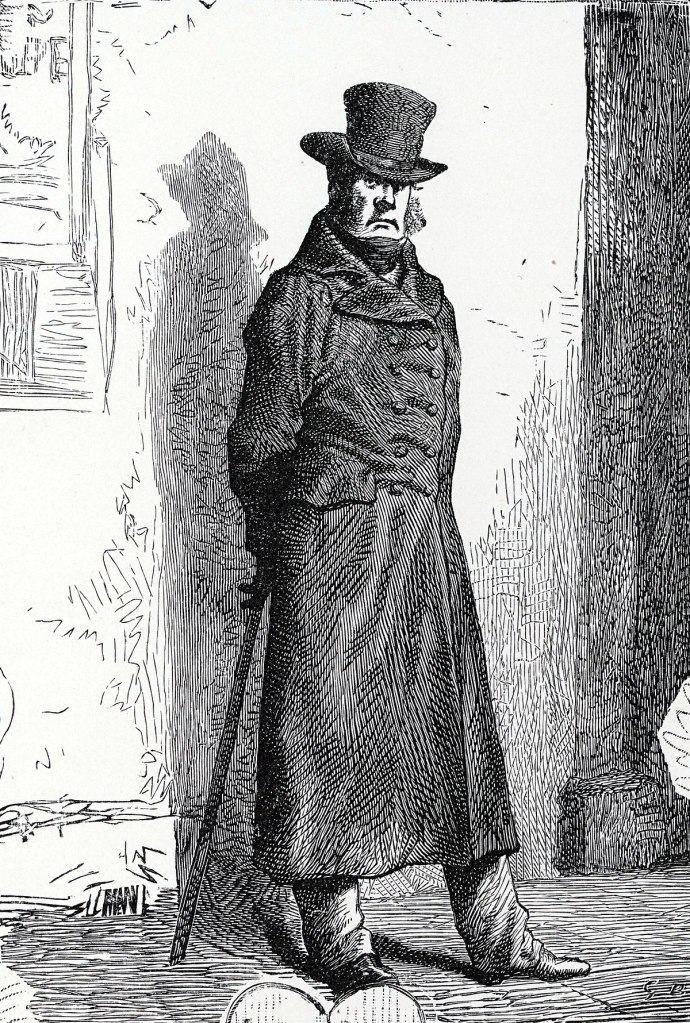
At the core of this vast narrative is Jean Valjean, a peasant imprisoned for stealing a loaf of bread to feed his sister’s starving children. This act will haunt him through all the events that follow, for even though the noble Valjean can escape prison, he cannot escape his past, which relentlessly pursues him in the body of the implacable Inspector Javert, below.
The plot leads readers from the countryside to the urban underworld, from the Battle of Waterloo to the Parisian sewers through which Valjean flees in one of the most famous episodes in all of fiction. Teeming with unforgettable characters – including the saintly bishop, Monseigneur Bienvenue, the young and unfortunate seamstress Fantine, her orphaned daughter Cosette, the street urchin Gavroche, the villainous Thenardier, and the fiery revolutionary Marius – Les Misérables encompasses historical events, social injustice, personal suffering, and sacrifice, and love in all its hopes and heartache. As the author leads the reader down what seems to be every alleyway in Paris, he wears on his sleeve the human sympathy that animates the most unforgettable novels.
Valjean carrying Cosette

“Tears of a Silent Heart” by Michael Ortega:
An extract from Les Misérables
“An elderly lady who came out of the cathedral at this moment saw him lying there and asked, ‘What are you doing?’
He answered roughly and angrily:
‘My good woman, you can see what I am doing. I’m sleeping here.’
‘On this bench?’, she asked.
‘I’ve slept for nineteens years on a wooden mattress’, the man said. ‘Now it’s stone.’
‘Were you a soldier?’
‘Yes, – a soldier.’
‘Why don’t you go to an inn?’
‘Because I haven’t any money.’
‘Alas,’ said Madame de R, ‘I have only four sous in my purse.’
‘That’s better than nothing.’
The man took the four sous and Madame de R – said:
‘It’s not enough to pay for lodging at an inn. But have you tried everything? You can’t possibly spend the night here. You must be cold and hungry. Someone would surely take you in out of charity.’
‘I’ve knocked at every door.’
‘You really mean?’
‘I’ve been turned away everywhere.’
The lady touched his arm and pointed across the square to a small house beside the bishop’s palace.
‘Have you really knocked at every door?’
‘Yes.’
‘Have you knocked at that one?’
‘No,’
‘Then do.’
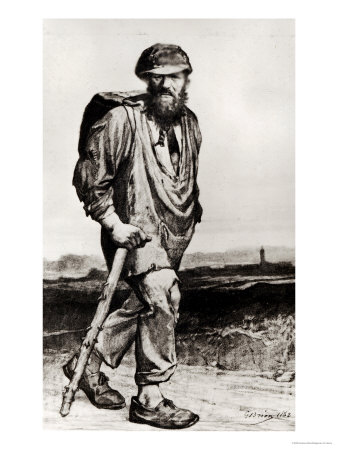
At this moment there was a heavy knock at the door.
‘Come in,’ said the bishop.
The door opened. It was flung widely open, as though in response to a vigorous and determined thrust. The man entered. He stepped across the threshold and then stood motionless with the door still open behind him. His knapsack hung from his shoulder and his stick was in his hand. The firelight falling on his face disclosed an expression of exhaustion, desperation, and brutish defiance. He was an ugly and terrifying spectacle.
The bishop was calmly regarding the stranger. He opened his mouth to speak, but before he could do so, the man, leaning on his stick with both hands and gazing around at the three elderly people, said in a harsh voice:
‘Look. My name is Jean Valjean. I am a convict on parole. I’ve done nineteen years in prison. They let me out four days ago and I’m on my way to Pontarlier. I’ve walked from Toulon in four days and today I have covered a dozen leagues (about thirty miles). When I reached this place I went to an inn and they turned me out because of my yellow ticket-of-leave which I’ve shown at the Mairie as I’m obliged to do. I tried another inn and they told me to clear out. Nobody wants me anywhere. I tried prison and the doorkeeper wouldn’t open. I crawled into a dog-kennel and the dog bit me and drove me out just as if he were a man and knew who I was. I thought that I’d sleep in a field under the stars, but there weren’t any stars and it looked as though it was going to rain, and no God to stop it raining, so I came back here hoping to find a doorway to sleep in. I lay down on a bench in the square outside and a good woman pointed to your door and told me to knock on it. So I have knocked. ‘What is this place? Is it an inn? I’ve got money. I’ve got one hundred and nine francs and fifteen sous, the money I earned by nineteen year’s work in prison. I’m ready to pay, I don’t care how much. I’ve got the money. I’m very tired, twelve leagues on foot, and I’m hungry. Will you let me stay?’
‘Mrs Magloir,’ said the bishop, ‘will you please lay another place.’
The man moved nearer to the light of the table lamp, seeming not to understand.
‘It’s not like that,’ he said. ‘Weren’t you listening? I’m a convict, a felon, I’ve served in the galleys.’ He pulled a sheet of yellow paper out of his pocket and unfolded it. ‘This is my ticket-to-leave, yellow, as you see. That’s why everybody turns me away. Will you take me in?’
‘Mrs Magloire,’ said the bishop, you must put clean sheets on the bed in the alcove.’ The bishop turned to the man.
‘Sit down and warm yourself, Monsieur. Supper will be very soon ready, and the bed can be made up while you’re having a meal.’

‘You really mean it? You’ll let me stay? A convict – and you aren’t turning me out! You called me ‘Monsieur’. I’m ready to pay. May I ask your name, Sir? You are an innkeeper, aren’t you?’
‘I’m a priest,’ said the bishop, ‘and this is where I live.’

At sunrise that morning Monsieur Bienvenue was in his garden. Mme Magloire came running out to him in great agitation.
‘Monseigneur, monseigneur, do you know where the silver basket is?’
‘Yes’, said the bishop.
‘Thank the Lord! I could not think what happened to it’.
The bishop had just retrieved the basket from one of the flower beds. ‘Here you are.’
‘But it is empty!’ she exclaimed. ‘Where is the silver?’
‘So it is the silver you are worrying about?’ said the bishop.
‘I cannot tell you where that is.’
‘Heaven save us, it has been stolen! That man who came last night!’

Mme Magloire stood dumbfounded. ‘What will Monseigneur eat with now?’
He looked at her with seeming astonishment, ‘There is always pewter.’
‘Pewter smells.’
‘Well then, iron.’
‘Iron has a taste.’
‘Then,’ said the bishop, ‘wooden forks and spoon.’
A few minutes later he was breakfasting and remarked cheerfully that no spoon was needed for dipping bread into a bowl of milk when a knock sounded at the door.
The door opened to disclose a dramatic group. Three men were holding a fourth by the arms and neck. The three were gendarmes, the fourth was Jean Valjean. A sergeant of the gendarmes entered the room and saluted.
‘Monseigneur…’ Jean Valjean looked up. ‘Isn’t he curé?’
‘Silence’, said one of the gendarmes. ‘This is his Lordship the Bishop.’
The bishop was coming towards them rapidly.
‘So here you are!’ he cried to Jean Valjean. ‘I am delighted to see you. Have you forgotten that I gave you the candlesticks as well? They are silver like the rest, and worth a good two hundred francs. Did you forget to take them?’
Jean Valjean’s eyes had widened. He was now staring at the old man with an expression no words can convey.
‘Monseigneur,’ said the sergeant, ‘do I understand that this man was telling the truth? We found this silver in his knapsack and -‘
‘And he told you,’ said bishop with a smile, ‘that it had been given to him by an old priest with whom he stopped the night. You felt bound to bring him here but you were mistaken.’
‘We must let him go?’
‘Certainly.’
The gendarmes withdrew.
‘Jean Valjean, my brother, you no longer belong to what is evil but to what is good. I have bought your soul to save it from black thoughts and the spirit of perdition, and I give it to God.’

“Après un rêve, Op. 7, No. 1 (Arr. for Cello and Piano)” by Gabriel Fauré, performed by Sheku Kanneh-Mason and Isata Kanneh-Mason:



That’s a touching passage you quoted.
While Victor Hugo is known in the English-speaking world as a novelist, in France he’s pre-eminent as a poet. It’s hard to appreciate poetry in a foreign language.
LikeLike
Thank you, Steve, for the thoughtful comments! I think that his masterpiece is what everyone associates with him.
Joanna
LikeLike
Thank you Joanna for this wonderful post. Most will probably know something about Les Miserables but you have taken time to fill me in about the man himself. 🤗💐👏💌
LikeLike
Thank you, Ashley, for the wonderful comments, which are greatly appreciated!
Joanna
LikeLiked by 1 person
Excellent article, amply supported by visuals! Fine sharing, Joanna.
LikeLike
Thank you, Indira, for the wonderful comments, which are very much appreciated!
Joanna
LikeLiked by 1 person
I had to read Les Miserables in French when I was in high school, and I found it a bit tiring… but then I reread it calmly, without the obligation to do so anymore and I was enchanted by it.
I’ve also seen some film and television adaptations of it.
This wonderful and rich post of yours has made me appreciate its value once again.
Thank you from the bottom of my heart💓 , dear Joanna
LikeLike
Thank you so much, dear Luisa, for your wonderful and uplifting comments, which made my day!
Joanna xx
LikeLiked by 1 person
You’re more than welcome, as always ❤️
LikeLike
Thank you so much, dear Luisa, you are very kind!
Joanna xx
LikeLiked by 1 person
🙏😘🙏
LikeLike
You inspired me to get down a book that has been with me since 1961 Les Auteurs du Nouveau Programme. It was how they taught us literature and of course it included pieces by Hugo. For a challenge I am thinking I should obtain Les Miserables in French. I do watch programs in French from time to time but of course the language of a convent school girl of the early ’60’s is not exactly sophisticated. It is a lovely language. Hugo was a champion of the oppressed, the French Dickens. You memorialise these authors beautifully Joanna. Always such a pleasure.
LikeLike
XXX!
LikeLiked by 1 person
Thank you, Carolyn, for your wonderful comments, which are greatly appreciated! If you can read
Victor Hugo in French you have my admiration and RESPECT!
Joanna x
LikeLike
Although I have not read the book, I have seen the marvelous musical several times. Les Mesirables came out in 1862, during America’s Civil War. Lee’s Confederate Troops (underfed, under provided with weapons and uniforms, and most other military necessities) called themselves Lee’ s Miserables after the book. Another great chapter in your Great Books of the World series, Joanna.
LikeLike
Thank you, Pat, for the wonderfully interesting and thoughtful comments, which are very much appreciated!
Joanna
LikeLiked by 1 person
Truly my pleasure, Joanna. 💞🐶🥳
LikeLike
What an excellent history of this writer and of his most famous work. I recall reading Les Miserable at an early age and being struck by the desperate circumstances of the time. A great excerpt, as well Joanna. Have a wonderful Thursday. Allan
LikeLike
Thank you, Allan, for the wonderful comments, which are very much appreciated!
Joanna
LikeLiked by 1 person
Thank you, Pat!
Joanna x
LikeLike
Another beautiful post! In the States I think we know The Hunchback better because of the iconic movie made during the 1930s.
LikeLike
Thank you, Phil, for the interesting comments, which are greatly appreciated!
Joanna
LikeLiked by 1 person
Another excellent posting — much appreciated.
LikeLike
Thank you, Kenne, for your wonderful comments, which made me very happy!
Joanna
LikeLike
A very interesting post, as usual, and the tale of another author who might be as interesting or more so than his work.
LikeLike
Two million people paid their respects to him in Paris after his death — he was revered!
LikeLike
Yes, Neil, he rightly was! Thank you for your thoughtful comment, which is greatly appreciated!
Joanna
LikeLiked by 1 person
Thank you, Diana, for your thoughtful comment, which is greatly appreciated!
Joanna
LikeLiked by 1 person
Thank you, Joanna, for writing this week about the legendary author Victor Hugo, who, besides his novels, also had a poetic side. I especially loved how you opened the post—with a thoughtful quote by Zig Ziglar, followed by a moving tribute to the Spirit of Hope, the Himalayas.
Thank you for talking about Hugo’s monumental work Les Misérables, a magnum opus spanning nearly 1500 pages. It’s wonderful that it has been translated by many including Wilbour and Julie Rose, making it accessible to a wider audience. The image of the manuscript you shared offers a glimpse into the immense challenge of publishing such works, including their translations.
As I read your post and the excerpts, I felt an emotional connection. The character of Jean Valjean—a peasant imprisoned for stealing bread to feed his sister’s starving children—is deeply compelling. Sadly, such harsh realities still echo in today’s world.
The story of his release and transformation is incredibly moving. The Bishop’s act of mercy—claiming the stolen silverware was a gift and even adding the silver candlesticks—was a powerful gesture of compassion. It not only saved Valjean from punishment but also planted the seed for his redemption.
Your post, enhanced with beautiful visuals, music, and videos, flows effortlessly and enriches the reading experience. Thank you once again, Joanna, for the care and creativity you pour into your work. It’s truly appreciated.
LikeLike
Thank you so much, Kaushal, for your wonderfully analytical comments! Your kind words are deeply appreciated! I love this book because it touches my heart with the compassion shown to a convict brutalised by the inhuman treatment in prison.
Joanna
LikeLiked by 1 person
You’re right, Joanna, Buddha had said, “Hatred is never ended by hatred but by love.”
You’re welcome, always.
LikeLike
Thank you, Kaushal, for the quote from the great Buddha! Your kindness is much appreciated!
Joanna
LikeLike
Thanks, Joanna ,for your post on the great novel writer Victor Hugo. You the post—with a thoughtful quote by Zygmunt Ziglar: “Life is an echo,what you send out, comes back.
What you sow,you reap.
What you give, you get.
What you see in others, exists in you.”
Then there was the great tribute to the Spirit of Hope, the Himalayas. The character of Jean Valjean—a peasant imprisoned for stealing bread to feed his sister’s starving children—is deeply agonising. Sadly, such harsh realities still echo in today’s world. The story of Jean Valjean’s release and transformation is incredibly moving. The Bishop’s act of mercy—claiming the stolen silverware was a gift and even adding the silver candlesticks—was a powerful gesture of compassion. It not only saved Valjean from punishment but also planted the seed for his redemption. Alongwith your description of Hugo’s work Les Miserables & the great audios & images ,your post is truly very engaging and passionate !Thanks for sharing ,Joanna
LikeLike
Thank you so much, Dhirendra, for the wonderfully thoughtful comments, which are deeply appreciated!
Joanna
LikeLiked by 1 person
Namastey 🙏🏻
LikeLike
Thank you, Dhirendra, Namaste!
Joanna
LikeLiked by 1 person
Joanna, thank you for sharing this fascinating spotlight on Victor Hugo. And your photos are absolutely a delightful complement to your composition my friend. May you have an awesome-filled week! 🤗💖😘
LikeLiked by 1 person
Thank you, dear Kym, for your wonderfully thoughtful comments, which are much appreciated!
Joanna x
LikeLiked by 1 person
It is my pleasure always Joanna. You are so very welcome my friend. 😊💖😘
LikeLike
Thank you, Kym!
Joanna x
LikeLiked by 1 person
It’s always my pleasure Joanna! 😊💖🌞
LikeLike