

“Interstellar” by Hans Zimmer (courtesy of Patrik Pietschmann):
“One glance at a book and you hear the voice of
another person, perhaps someone dead for 1,000 years.
To read is to voyage through time.”
Carl Sagan
Courtesy of 7MB, “7 Notes to Infinity: 01”
“The infinite!
No other question has ever moved so profoundly the spirit of man.”
David Hilbert, mathematician
Courtesy of Tedx Talks:
Courtesy of Sabine Hossenfelder:
This is the extraordinary story of “The Man Who Knew Infinity”, described in the book by Robert Kanigel.
Humankind has been exploring and discovering mathematics for millennia. Maths advanced our species, with early arithmetic and geometry providing the foundation for the first cities and civilization. One of the oldest of recreational mathematics, magic squares, can be found in various Indian texts from around 100 CE. I wanted the first part of this post to be a guided tour of India’s mathematical history and its highlights. The second part belongs wholly to a man who made such an impact on the mathematical knowledge of the world that books were written about him, the papers he left are still being studied and Hollywood made a film of his short, eventful, and tragic life. His name was SRINIVASA RAMANUJAN.
Courtesy of Phi Beta Kappa:
Trailer for “The Man Who Knew Infinity” (courtesy of IFC Films):
The interest in mathematics is so great that there is no telling who will continue the discoveries of many still unknown solutions, or where or when. To make the biggest advancement in mathematics during this or even the next centuries we need to involve all people, perhaps reading this post will encourage you to get involved.
Courtesy of Guardian News:
I would just like to ask anyone who doesn’t like maths to if necessary, skip the history of mathematics but please read about the greatest mathematicians that have ever lived. You won’t be disappointed!
“We owe a lot to the Indians who taught us how to count,
without which no worthwhile scientific discovery could have been made.”
Albert Einstein
PART ONE – India’s mathematical heritage.
The history of mathematics goes back to early humans, and as the earliest civilisation goes back to India ten thousand years ago, it is possible to find and establish how humans started to count. Hunter-gatherers would have sat on the ground, adding up the spoils of a few berries picked from bushes, or a few stones needed, or even the animals they had brought back from a hunting trip. The discovery that two rabbits added to two more rabbits will be four, must have seemed to those people profound, but also it was a discovery and not an invention. The mathematical rules are independent of human history; 2 + 2 = 4. The laws of mathematics, like the laws of physics, are universal, eternal, and unchanging. When mathematicians first demonstrated that the angles of any triangle in a flat plane when added together come to 180°, a straight line, wasn’t their invention: they have simply discovered a fact that had always been, and always will be, true.
“It is impossible to be a mathematician
without being a poet of the soul.”
Sofya Kovalevskaya
The first counting was done by making cuts or marks on a stick as a reliable means of quantifying the things needed. Later on, symbols were added and the first system of numbers began. With the addition or depletion of items, it was the start of basic operations of arithmetic. In time, with the progress into farming and trade, society’s need for arithmetical operations and a numeral system became an essential requirement for all kinds of transactions, like stock-taking, taxes, weights, lengths, and others. In the early civilisations these new discoveries in mathematics, specifically the measurement of objects in space became the foundation of geometry. A simple but accurate builder’s square can be made from a triangle with sides of three, four, and five units. Without that accurate tool and knowledge, roads and canals could not have been built.
“In mathematics,
the art of asking questions
is more valuable than solving problems.”
Georg Cantor
As new applications for these mathematical discoveries were found in astronomy, navigation, engineering, taxation, and others – further patterns and ideas emerged. Ancient Indian civilisation established the foundation of mathematics through this independent process of application and discovery from around the middle of the 100 DC. Some sources place the date 3-4 hundred years later; knowing how developed Indian civilisation was, I have chosen the earlier date. The major field in mathematics is algebra which is the study of structure, the way that mathematics is organised. At some time Indian civilisation developed its own numerical system.
“Mathematics, rightly viewed,
possesses not only truth,
but supreme beauty.”
Bertrand Russell
“Nocturne in C# Minor, Op. Posth., KK IVa, No. 16, B. 49 “ by Frédéric Chopin, performed by Lang Lang:
Brahmagupta (598 – 660 AD)
Courtesy of discovermaths:
One of the most famous Indian mathematicians, also an astronomer, was Brahmagupta who lived in Bhillamala, northwest India – a centre of learning in those fields. He became head of the leading astronomical observatory at Ujjain and incorporated new work on number theory and algebra into his studies on astronomy. His use of the decimal number system and the algorithms he devised spread throughout the world and informed the work of later mathematicians. His rules for calculating with positive and negative numbers, which he called “fortunes” and “debts”, are still cited today. He died in 668, only a few years after completing his second book. His most well-known books – Brahmasphuta Siddhanta (The Correctly Established Doctrine of Brahma) published in 628, and Khandakhadyaka (Morsel of Food) in 665.
“The fact that we work in 10s as
opposed to any other number
is purely a consequence of our
anatomy. We use our ten fingers
to count.”
Marcus de Sautoy
The village where he lived, Bhillamala, during the reign of King Vyaghramukha, is in Rajasthan situated between Mount Abu and the river Luni. We know that his father’s name was Jisnu Gupta and his grandfather’s name was Bishnu Gupta. From a very young age, he was interested in mathematics. When he was thirty years old in 628, he wrote the Brahmasphuta Siddhanta. This work consists of 24 chapters and contains 1008 slokas (verses). Brahmagupta recorded Astronomy, Arithmetic, Algebra, and Geometry in his work. In 655, he wrote the Khandakhadyaka. This work, related to Astrological texts, has eight chapters.
An Indian scholar visited the court of al-Mansur in Baghdad in 773 AD. He carried with him a copy of Brahmasphuta Siddhanta. The intrigued Caliph ordered this work to be translated into Arabic.
In Arithmetics, Brahmagupta mentioned four methods of multiplication: goumutrika, khanda, bheda, ista. In Geometry, he gave an exact formula for the area of a cyclic quadrilateral. Although I have in front of me all his calculations, there isn’t enough space to include them here. Let me just say that I am completely overwhelmed by the knowledge and power of their intellect, and I have to repeat again, and again, those people lived 3000 years ago!!
Brahmagupta was the first mathematician to introduce zero as a digit in his first work. He established zero as a number in its own right and not just a placeholder. He also solved quadratic equations using only positive integers. Quadratic equations contain the power of 2, so are used when calculating with two dimensions. Brahmagupta wrote a formula for solving quadratic equations that could be applied to equations in the form ax2 + bx = c. Mathematicians at the time did not use letters or symbols so he wrote his solution in words but it was similar to the modern formula.
Courtesy of Science Museum:
In Astronomy, he also gave the methods for calculating the position of heavenly bodies over time (ephemerides), their rising and setting, and the calculation of solar and lunar eclipses. He explained that the degree of the illuminated part of the Moon depends on the relative positions of the Sun and the Moon, and this can be computed from the size of the angle between the two bodies. Brahmagupta observed that the Earth and other planets are spherical. He had an idea about gravity. He wrote: “a body falls towards the Earth as it is nature of the earth to attract bodies just as it is the nature of the water to flow.”

The Hindu -Arabic numeration that is employed today is a base-10 (decimal system). It requires only 10 symbols – 9 digits ( 1, 2, 3, 4, 5, 6, 7, 8, 9) and a zero. The fact that they worked in 10s and not in any other number is a consequence, one could think, of human anatomy. We have 10 fingers on which we count. As I have mentioned before, the Hindu-Arabic decimal system used throughout the world today has its origins in India. Magic squares are probably the earliest example of “recreational mathematics”. Their exact origin is unknown but magic squares are discussed in Indian texts dating from 100 CE, and Brihat-Samhita c. 550CE, a book of divination, includes a magic square used to measure out quantities of perfume. Magic squares have been an enduring source of fascination for mathematicians.
“The most magically magical
of any magic square ever made
by a magician.”
Benjamin Franklin
talking about one he discovered
Aryabhata (474 – 550 AD)
Courtesy of That Works Media:
The greatest ancient Indian mathematician and astronomer Aryabhata was born in Pataliputra in the region known as Ashmaka, during the golden era of expansion of learning in sciences, arts, philosophy, and astronomy, the Gupta era. His major work, completed in 499 AD, when he was 23 years old, was Arybhatiya, a treatise in Sanskrit on mathematics and astronomy. In his work, Aryabhata did not use the Brahmi numerals. He continued the tradition from Vedic times and used letters of the Sanskrit alphabet to denote numbers, expressing quantities in mnemonic verses. He used an ingenious system to express numbers on the decimal place value model.
His contribution to mathematics, astronomy, and sciences is immense, and yet he has not been accorded recognition in the world history of science. His first name “Aryo” is a term used for respect, such as “Sri”, whereas Bhata is a typical “north Indian” name. It is beyond comprehension that when in Europe people were executed for doubting that Earth is flat, Aryabhata correctly believed that the planets and the Moon shone by reflecting sunlight and that the motion of the stars was due to the Earth’s rotation.
“Politics is for present, but an equation is for eternity.”
Albert Einstein
His major work Aryabhtiya, a compendium of mathematics and astronomy, was extensively referred to in the Indian mathematical literature and has survived to modern times. Interestingly, it contains a description of several astronomical instruments he used. More about his astronomical instruments and his unbelievable achievements later. One can only wonder what he would have discovered had he had today’s telescopes and NASA’s technology as his intellect surpasses that of anyone today. While we were still sitting on trees or in caves, 3000 years ago, he established that Earth was spherical and rotates on its axis. He explained that the apparent daily east-west motion of the sun, moon, planets, and stars is due to the rotation of the earth from West to East. In the same way that someone in a boat going forward sees unmoving objects on the banks going backward. He calculated the time of sidereal rotation of the Earth as 23h 56m 4.1s. The modern value is 23h 56m 4.091s, this is with all our modern technology, he – not having either a computer or a telescope.
“Piano Concerto No.2, II.” by Sergei Rachmaninov, performed by Hauser and London Symphony Orchestra:
The Ujjain Observatory was constructed by Savai Raja Jay Singh between 1725 and 1730 AD. Similar observatories were constructed by Raja Jaysingh at four other places Delhi, Jaipur, Mathura, and Varanasi. Motions and orbits of the planets are studied through various instruments.
One of the instruments, Shanku (Gnomon) Yantra at Ujjain Observatory
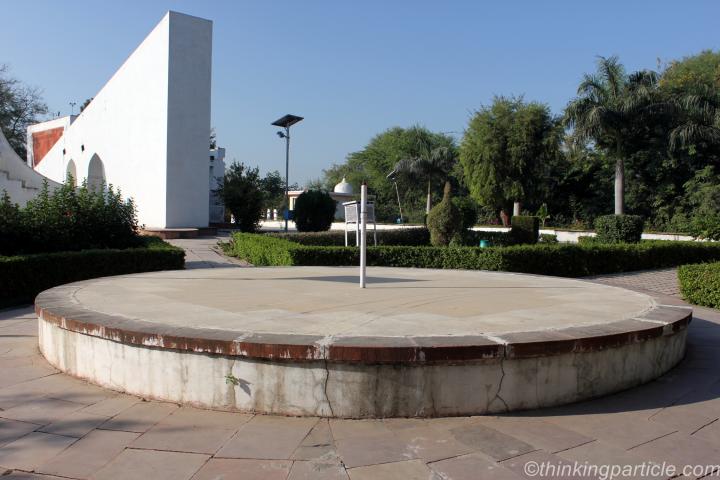
At the centre of the circular platform, a vertical gnomon (Shanku) is fixed. The platform is in the horizontal plane. Seven lines are drawn on it with the help of the shadow of the gnomon. The 22nd December represents the shortest day of the year, on 21st March and 23rd September, the days and nights are equal and 22nd June represents the longest day of the year. These lines also represent the zodiac signs. With the help of the shadow of the gnomon, the angle of elevation and Zenith distance of the Sun can be determined. On equinoctial days the mid-day shadow of the gnomon represents the latitude of the Ujjain.
Aryabhata described the instruments he used in his astronomic observatory:
the gnomon (shanku-yantra), a shadow instrument (chaya-yantra), semi-circle, and circle-shaped (dhanur-yantra), an umbrella-shaped device (chhatra-yantra), and at least two water clocks. Aryabhata did not use the Brahmi numerals. Continuing the Sanskrit tradition from Vedic times, he used letters of the alphabet, and pursued the study of chords to produce the first table of what is now known as the sine function ( all the possible values of sine/cosine ratios for determining the unknown length of the side of a triangle when the lengths of the hypotenuse – the triangle’s longest side – and the side opposite the angle are known).
Against the then-common belief as to the cause of eclipses, Aryabhata stated that the moon and planets have no light of their own, and they reflect the light of the Sun. The lunar eclipse, he explained, occurs when the moon enters into the Earth’s shadow and a solar eclipse occurs when a new moon passes directly between Earth and the sun. His computations regarding eclipses and the positions and periods of the planets are very accurate and differ a few seconds from the modern calculation obtained by advanced sophisticated instruments. Aryabhata established an observatory in the sun-temple situated in Terigona, Bihar. He held the belief that the planets’ orbits are elliptical. He stated that the planets really all move at the same speed. The nearer ones seem to move more rapidly than the more distant ones because their orbits are small.
Aryabhata would be a mathematician unparalleled even in modern times and his discoveries in astronomy were about 1000 years before the birth of Nicolaus Copernicus (1473-1543 ), Galileo Galilei (1564-1642), and Johannes Kepler (1571-1630 ).
Various steps have been taken in independent India to honour this great mathematician. The first unmanned Earth Satellite built by India was launched from a Russian-made rocket on 19 April 1975 and it was named after him.
The astronomical research institution situated in Nainital is named after him – Aryabhata Research Institute of Observational Science. The Inner School Aryabhata Maths Competition bears his name too. A more unusual honour was naming the bacteria discovered by scientists of the Indian Space Research Organisation (ISRO) in 2009 as Bacillus Aryabhata.
Aryabhata

Brahmagupta
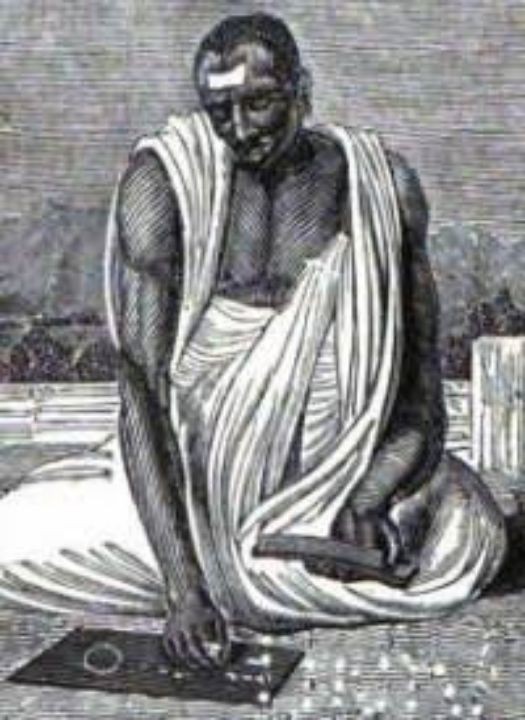

Aryabhata included a method for obtaining Pi (π) in his Aryabhatiyam astronomical treatise of 499CE: “Add 4 to 100, multiply by 8, and then add 62,000. By this rule, the calculation of the circumference of a circle with a diameter of 20,000 can be approached.” This works out as 3.1416.
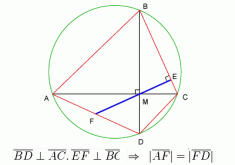
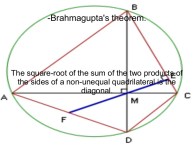
Brahmagupta computed square root approximations of π using regular polygons with 12, 24, 48, and 96 sides. He also made his own contribution to geometry and trigonometry, including what is now known as Brahmagupta’s formula. This is used to find the area of cyclic quadrilaterals, which are four-sided shapes inscribed within a circle. This area can also be found with a trigonometric method if the quadrilateral is split into two triangles.
“The logarithmic table is a small table
by the use of which we can obtain
knowledge of all geometrical dimensions
and motions in space.”
John Napier
Below is shown a 3×3 magic square in different orientations forming a non-normal 6×6 magic square, from an unidentified Indian manuscript.
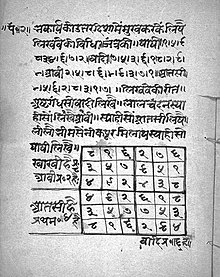
The 3×3 magic square first appears in India in Gargasamhita by Garga, who recommends its use to pacify the nine planets (navagraha). The oldest version of this text dates from 100 CE, but the passage on planets could not have been written earlier than 400 CE. The first dateable instance of 3×3 magic square in India occurs in a medical text Siddhayog (c. 900 CE) by Vrinda, which was prescribed to women in labor in order to have an easy delivery.
The oldest dateable fourth-order magic square in the world is found in an encyclopedic work written by Varahamihira around 587 CE called Brhat Samhita. The magic square is constructed for the purpose of making perfumes using 4 substances selected from 16 different substances. Each cell of the square represents a particular ingredient, while the number in the cell represents the proportion of the associated ingredient, such that the mixture of any four combinations of ingredients along with the columns, rows, diagonals, and so on, gives the total volume of the mixture to be 18. Although the book is mostly about divination, the magic square is given as a matter of combinatorial design, and no magical properties are attributed to it.
“Some mathematics problems look simple,
and you try them for a year or so,
and then you try them for a hundred years,
and it turns out they’re extremely hard to solve.
There’s no reason why these problems shouldn’t be easy,
and yet they turn out to be extremely intricate.”
Andrew Wiles
Around 12th-century, a 4×4 magic square was inscribed on the wall of the Parshvanath temple in Khajuraho, India, shown below. Several Jain hymns teach how to make magic squares, although they are undateable.
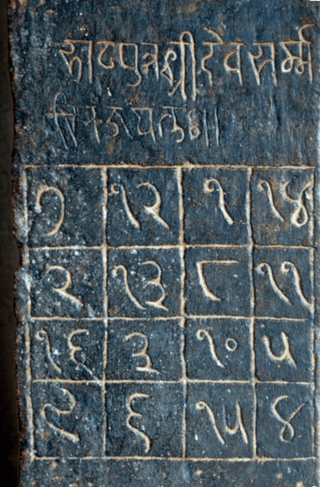

As far as is known, the first systematic study of magic squares in India was conducted by Thakkar Pheru, a Jain scholar, in his Ganitasara Kaumudi (c. 1315). This work contains a small section on magic squares which consists of nine verses. Here he gives a square of order four, and alludes to its rearrangement; classifies magic squares into three (odd, evenly even, and oddly even) according to its order; gives a square of order six; and prescribes one method each for constructing even and odd squares. For the even squares, Pheru divides the square into component squares of order four and puts the numbers into cells according to the pattern of a standard square of order four. For odd squares, Pheru gives the method using horse move or knight’s move.
“Every good mathematician is at least
half a good philosopher
and every good philosopher is at least
half a mathematician.”
Gottlob Frege
The order 8 square is interesting in itself since it is an instance of the most-perfect magic square. Incidentally, Narayana states that the purpose of studying magic squares is to construct yantra, to destroy the ego of bad mathematicians, and for the pleasure of good mathematicians. The subject of magic squares is referred to as bhadraganita and Narayana states that it was first taught to men by god Shiva.
“At each increase of knowledge
as well as on the contrivance
of every new tool, human labour
becomes abridged.”
Charles Babbage
Due to the shortage of space, I am unable to cover all of the Ancient Indian Mathematicians, but at least I acknowledge their immense contribution to the world’s progression from a caveman to a spaceman.
“Vande Mataram”, performed by Lata Mangeshkar (courtesy of Leena Draviam):
The oldest known mathematical texts in existence are the Sulbasutras of Baudhayana, Apaasstamba, and Katyayana of the Vedic age. The Sulbasutras had been estimated to have been composed around 800 BC, but the mathematical knowledge existing in India is much more ancient dating from 3000 BC. The Sulbasutras had been used for the constructions of the elegant Vedic fire-altars with precision. The altars had rich symbolic significance and were constructed depicting a falcon in flight with curved wings, a chariot-wheel with spokes, or a tortoise with extended head and legs. Ancient Indians thought that it would be a sin if altars were not made in precision and religious rituals were not performed in accurate time. For this reason, geometry, trigonometry, and astronomy were included in Indian religions, mainly Hinduism from time immemorial. Ancient Indians had an idea of a geometric theorem which is known as “Pythagoras theorem” long before Pythagoras (580 – 500 BC), the Greek philosopher and mathematician was born. They used to apply this theorem in various geometric constructions.

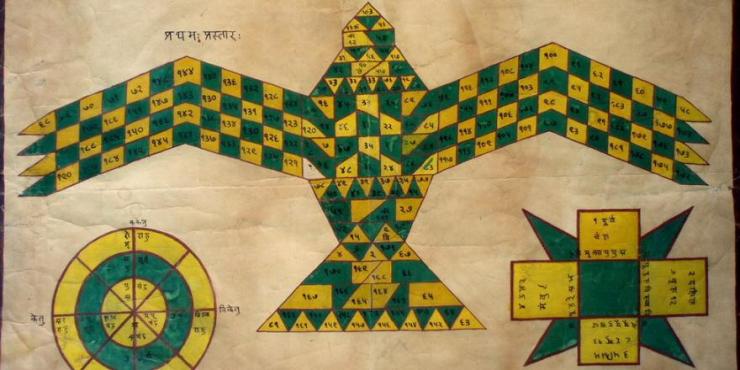

Other ancient mathematicians include those names below. I am already thinking of Part 2, as their contribution to the world’s scientific knowledge is too immense to leave untold.
Manava (750 – about 690 BC )
Apastamba ( 600BC – 549 BC)
Panini ( 520 – about 460 BC )
Katyayana
Varahamihira ( 505 – 587 AD )
Bhaskara I ( 600 – 680 AD )
Sridharacharya ( 870 – 930 AD )
Bateswar
Aryabhata II (920 – 1000 AD )
Bhaskara II (1114 – 1185 )
Madhava (1340 – 1425 )
Nilakantha Somayaji ( 1444 – 1545 )
Radhanath Sikdar (1813 – 1870 )
“Vivitur Ingenio Caetera Mortis Erunt”
“GENIUS LIVES ON, ALL ELSE IS MORTAL.”
Andreas Vesalius

THE MAN WHO KNEW INFINITY
SRINIVASA RAMANUJAN
22 December 1887 – 26 April 1920
Courtesy of History:
When I have the honour to write about the greatest mathematical genius, Srinivasa Ramanujan Iyengar, the first thing that is of importance is to mention that he was born in India. This wasn’t just an ordinary occurrence since Ramanujan grew up on the shoulders of many genius mathematicians that India gifted to the world over the millennia. Reading about his short tragic life, it struck me how similar was his life to that of the greatest musical genius, Mozart.
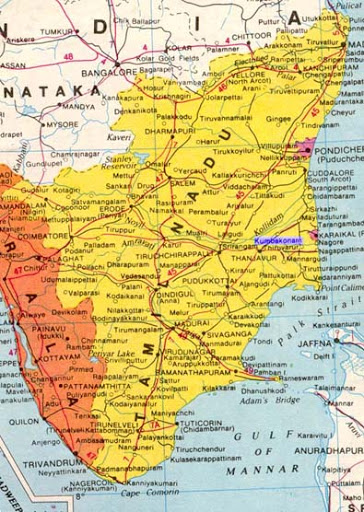
The childhood home of Ramanujan in Kumbakonam

“Concerto for Flute and Harp in C Major, K.299 II. Andantino” by Mozart, performed by Emmanuel Pahud, Marie-Pierre Langlamet and Berlin Philharmonic Orchestra:
Ramanujan was born on 22 December at Kumbakonam. The town is situated about 160 miles south of Cauvery, the Ganges of the South. His mother was Komalatammal and his father was Srinivasa Iyengar. In south Indian tradition, the father’s name is passed on to a son. On the eleventh day, the baby boy was christened in a temple. The name Ramanujan came from the 11th-century saint Ramanuja, a great spiritual reformer, who rejuvenated Hinduism. He was also born on a Thursday, had the same astrological identity, and so for that reason he became his patron.
the saint Ramanuja

Ramanujan’s father was a clerk in a cloth shop but his salary wasn’t enough to maintain the family properly and so Komalatammal earned a small amount of money singing bhajans or devotional songs in the temple. She was never absent, and so when she didn’t come for a few days in December 1889, the head of the singing group came to her house to check why she was absent. When she came in she saw that Komalatammal was rubbing gently her baby with margosa (neem) leaves mixed with turmeric (haldi) while chanting devotional songs. Baby Ramanujan had smallpox. His mother was trying to give him some relief from itching and fever. He was lucky to survive this dreadful disease but was marked with smallpox scars. The child mortality rate was very high then, and Ramanujan lost one sister and two brothers to smallpox.
Neem leaves

As some very gifted people in history have been known to be, Ramanujan did not speak until the age of three, and their neighbours thought he was dumb. Ramanujan didn’t like any school, or teachers and was sent to many different ones, to no avail. When he was five years old, a sacred thread ceremony or Upanayanam was performed, after which he became a confirmed Brahmin and had the right to perform rites of Hinduism. It is at that time that he became very interested in maths.
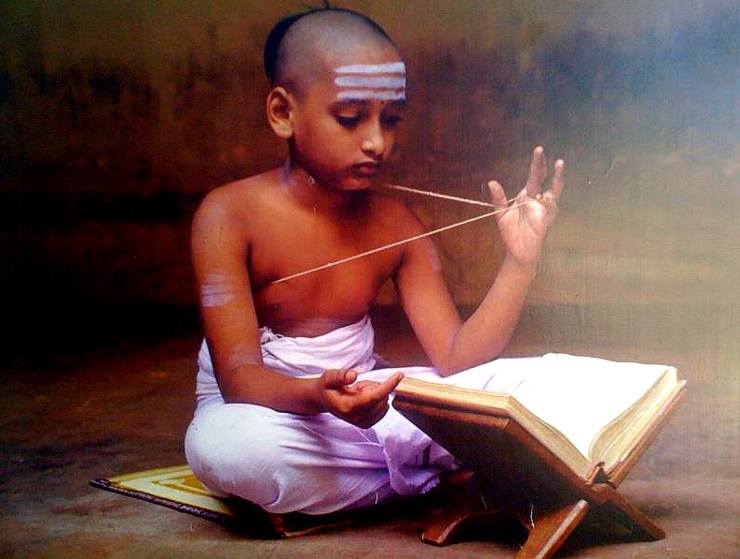
When he was ten, his parents’ effort to keep him at school paid off and he passed with very good results in all subjects. This success allowed Ramanujan to join the local elite school which was to guarantee a successful future. High school and then college was a happy time for Ramanujan, as he was liked by other students for helping everyone who asked. His interest in maths was taking over all his time and other school subjects suffered. When he sat for his exams, he got full marks for maths but failed everything else. This upset him so much that he ran away from home in August 1905, with an unsound mind, on a train heading to Vizagapatnam. Unable to find a job there, he was returning home, when something unusual happened. When he was sleeping in a railway waiting room, a kind stranger woke him up, took him home, and after learning of Ramanujan’s problems sent him to Pachaiyappa’s College in Madras.
Pachaiyappa’s College

City of Madras

This became a pattern – he would score the highest marks in maths but failed all other subjects. Although the principal and the teachers recognised that he was a prodigy, the rigid rules prevented making Ramanujam an exception. The education system would not change its rules even for a genius. Without formal qualifications, he would remain unemployed, his obsession with maths growing. He had no money for paper but used instead a large slate and chalk, wiping it with his elbow when it got full. The kind women in the neighborhood fed him, while he led an ascetic life wholly absorbed by maths. It from this time that he is quoted as saying to a friend: “An equation for me has no meaning unless it expresses a thought of God through mathematics.”
Komalatammal, mother of Ramanujan
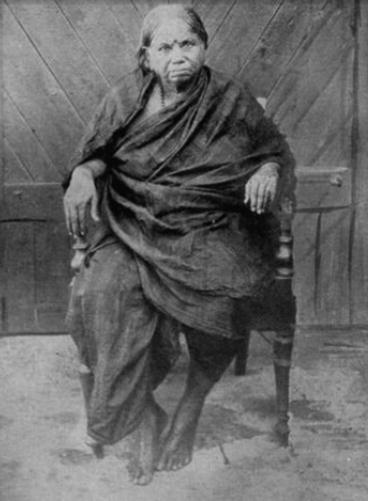
Komalatammal, his mother was advised to marry Ramanujan to bring him to his senses and to start looking for a job. She went to a village about sixty miles from home where she had family and chose a 9-year-old girl, after checking that her horoscope was a good match to Ramanujan’s. The marriage rituals were completed on 14 July 1909, and afterwards his wife, Janaki would stay with her parents while Ramanujan was going to search for a job. For the next few years, Ramanujan moved around finally arriving in Madras. One of his colleagues from early school, now a lawyer, befriended him and even gave him money every month to allow him to “follow his dream”. Though he continued his mathematics without worry about money, he was in constant anxiety as he was taking financial help from his friend without doing any work for him.
Delhi

The year 1911 was a remarkable time in the history of India. The capital Calcutta (now Kolkata) was changed to Delhi. In that year Ramanujan’s paper first appeared in the Journal of the Indian Mathematical Society, which gave him an opportunity to be acquainted with many mathematicians in India and abroad. Not wanting to rely on his friend’s generosity, he applied for the post of a clerk in the Port Trust in Madras. He was selected and started work on 25 February 1912. His boss, a mathematician himself, became his friend. They discussed maths problems and solutions. The boss of the company, Sir Francis Spring, became aware of Ramanujan’s exceptional ability. It was with his help that Ramanujan drafted and then sent a letter to H.F. Barker, the renowned mathematician who was an FRS and a President of The London Mathematical Society. There was no response. Ramanujan wrote another letter to E.W. Hobson, FRS, and an eminent mathematician holding the Sadlerian Chair in pure mathematics at Cambridge University. There was no reply.
Cambridge University
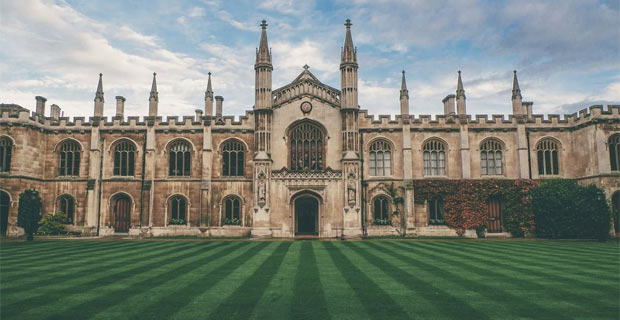
It was obvious that after reading Ramanujan’s letter where he in his innocent honesty wrote of being a clerk after failing his exams, the thought was how could a clerk who couldn’t pass college examinations several times, invent any mathematical formula or theorem? The two celebrities of mathematics did not feel any urge or need to respond. The amount of publicity that they got for not responding to Ramanujan was far more than their mathematical achievements received. By then, Ramanujan although disappointed, was unstoppable. He fired another letter to G.H. Hardy, a young mathematician at Cambridge University.
G.H. Hardy, left, and John Edensor Littlewood, the two mathematicians who changed Ramanujan’s life


Courtesy of Tibees:
I have to give you his letter in full here so that you can also fall in love, as I did, with this honest, sweetest of men, and a Genius:
“Dear Sir,
I beg to introduce myself to you as a clerk in the Accounts Department of the Port Trust at Madras on a salary of only £20.- per annum. I am now about 23 years of age. I have had no University education but I have undergone the ordinary school course. After leaving school I have been employing the spare time at my disposal to work on mathematics. I have not trodden through the conventional regular course which is followed in a University course, but I am striking out a new path for myself. I have made a special investigation of divergent series in general and the results I get are termed by the local mathematicians as “startling”.
Just as in elementary mathematics you give a meaning to “a” when n is negative and fractional to conform to the law which holds when n is a positive integer, similarly the whole of my investigations proceed on giving a meaning Eulerian Second Integral for all values of n. My friends who have gone through the regular course of University education tell me that (here is an equation) is true only when n is positive. They say that this integral relation is not true when n is negative. Supposing this is true only for positive values of n and also supposing the definition ( here another equation) to be universally true, I have given meaning to these integrals and under the conditions I state the integral is true for all values of n negative and fractional. My whole investigations are based upon this and I have been developing this to a remarkable extent so much so that the local mathematicians are not able to understand me in my higher flights.
Very recently I came across a tract published by you styled Orders of Infinity in page 36 of which I find a statement that no definite expression has been as yet found for the number of prime numbers less than any given number. I have found an expression which very nearly approximates to the real result, the error being negligible. I would request you to go through the enclosed papers. Being poor, if you are convinced that there is anything of value I would like to have my theorems published. I have not given the actual investigations nor the expressions that I get but I have indicated the lines on which I proceed. Being inexperienced I would very highly value any advice you give me. Requesting to be excused for the trouble I give you.
I remain,
Dear Sir,
Yours truly,
S. Ramanujan
Below is shown the cover of Ramanujan’s first letter to Hardy:
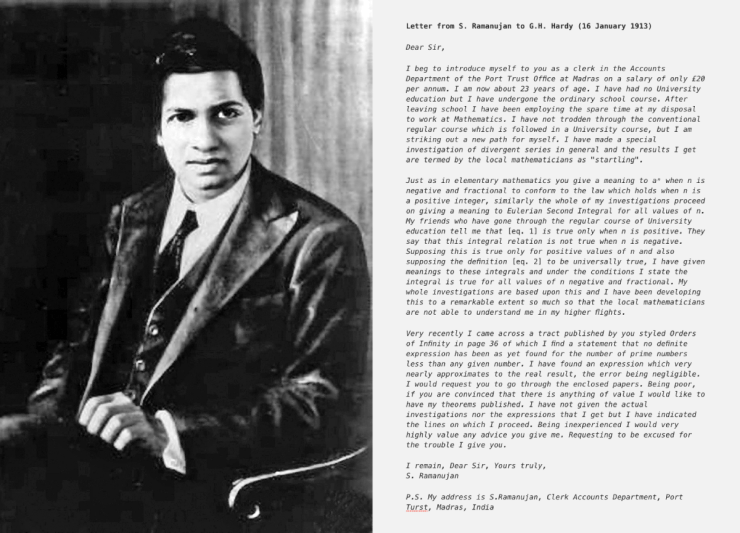
The letter, coming in those days by ship, reached Cambridge at the end of January. G.H. Hardy had a habit of reading the newspaper and his post during breakfast. When that morning he received Ramanujan’s thick letter of ten pages, he read the letter and had a quick look at the samples of mathematical results but could not comprehend. He could not decide within that short time whether that was a letter from an eccentric person or a genius from India. He kept the letter aside and engaged himself in his daily routine. Somehow, the letter haunted him all day. He arranged to meet after dinner with his friend John Edensor Littlewood, also a mathematician. They spread out the letter and the formulas; after 3 hours of discussing Ramanujan’s findings, they came to the conclusion that the letter and the samples had been sent by a mathematical genius.
Hardy responded to Ramanujan thus:
Letter from G.H. Hardy to S. Ramanujan (8 February 1913)
Dear Sir,
I was exceedingly interested by your letter and by the theorems which you state. You will however understand that, before I can judge properly the value of what you have done, it is essential that I should see proofs of some of your assertions.
Your results seem to me to fall into roughly 3 classes:
(1) there are a number of results which are already known, or are easily deducible from known theorems;
(2) there are results which, so far as I know, are new and interesting but interesting rather from their curiosity and apparent difficulty than their importance;
(3) there are results which appear new and important, but in which almost everything depends on the precise rigour of the methods of proof which you have used.
As instances of these 3 classes I may mention
(1) [Hardy next provides examples of results of the first class]
I need not say that, if what you say about your lack of training is to be taken literally, the fact that you should have rediscovered such interesting results is all to your credit. But you must be prepared for a certain amount of disappointment of this kind.
There are also of course known theories of divergent series, fractional orders of differentiation and integration, and so on. I should be extremely interested to compare your theories with these.
In this class also come some of your theorems about numbers. […] But I would want particularly to see your proofs of your assertions here. You will understand that, in this theory, everything depends on rigorous exactitude of proof.
I should add that theorems of this character are not only interesting, but very difficult and important. If you have some sound and independent proofs of them, it would be, in my opinion, a very remarkable achievement.
(2) [Hardy next provides examples of results of the second class]
(3) In this class I should put (assuming the proofs to be rigorous) some of your theorems about prime numbers – e.g. the expression you say you have for the number of primes < x, which is nearly exact.
It is of course possible that some of the results I have classed under (2) are really important, as examples of general methods. You always state your results in such particular forms that it is difficult to be sure about this.
I hope very much that you will send me as quickly as possible at any rate a few of your proofs, and follow this more at your leisure by a more detailed account of your work on primes and divergent series. It seems to be quite likely that you have done a great deal of work worth publication; and, if you can produce satisfactory demonstrations, I should be very glad to do what I can to secure it.
I have said nothing about some of your results–notably those about elliptic functions. I have not got them to refer to, as I handed them to another mathematician more expert than I in this special subject.
Hoping to hear from you again as soon as possible.
I am
Yours very truly,
G.H. Hardy
[Hardy finally adds “further notes suggested by Mr. Littlewood”]
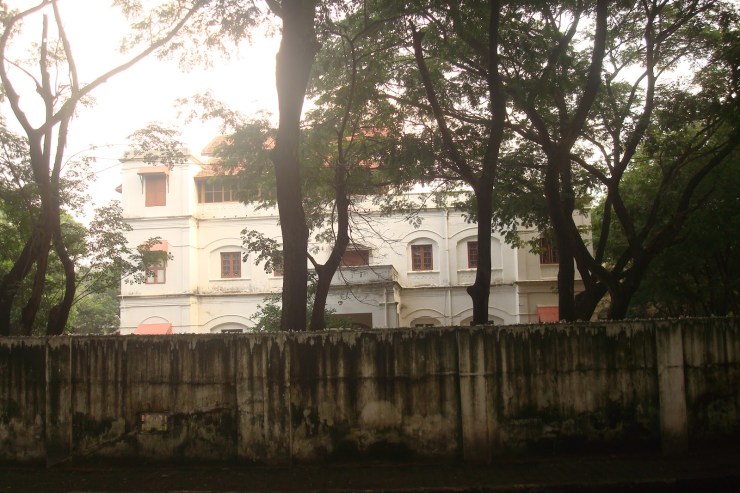
After receiving Hardy’s letter, the higher education department of Madras began their activity to do something for Ramanujan. After many heated discussions, the rule was relaxed for Ramanujan as a special case and a scholarship of seventy-five rupees per month was arranged for two years. To his delight, Ramanujan became the first mathematics researcher at Madras University. He received unpaid leave from the Port Trust. He rented a spacious house in a lovely location to accommodate his mother, grandmother, and wife. The house was not far from the Presidency College, about one and a half miles.
One of Ramanujan’s homes after his life changed for the better
Janaki, his wife, had primary knowledge of the Tamil language and could read and write. Ramanujan taught her the basics of daily life science through experiments. One day he took two pans and a tube to teach her the principle of siphoning. Her reminiscences provide more information about Ramanujan’s life. As he didn’t want to waste time eating which he felt interrupted the continuity of thought, she fed south Indian food morsel by morsel while he remained working on his mathematical research. When she would awake in the middle of the night, she could see him working, the stylus scratching the slate.
G.H. Hardy realised from the beginning that Ramanujan should be brought to England to acquaint him thoroughly with the entire progress of the latest modern mathematics. In 1913, Bertrand Russell wrote to a friend: “In Hall I found Hardy and Littlewood in a state of wild excitement because they believe they have found a second Newton, a Hindu clerk in Madras on £20 a year.” Hardy also knew that Ramanujan should have an education according to the best university-level syllabus which was possible only in England for a genius like him. Hardy urged several influential people in Madras to send Ramanujan to England.
I will continue next week in Part 2 with more fascinating tales of Ramanujan, his life in England, and also his fellow ancient mathematicians including one who, would you believe, invented the measuring tape in the seventh century.

Courtesy of Infinity Inside:


 naturetails
Very impressive, Joanna. I barely understood half of what you wrote and need to reread it on my PC so I do nit have a scroll so much. This must have taken hours to put together.
LikeLike
Thank you, Pat, for your kind comments, which are greatly appreciated! Yes, it takes a little more time than usual.
Joanna
LikeLiked by 1 person
Wonderful…wonderful! Even though it is an established fact that ancient Indian mathematicians propounded the basics of mathematics, Wester world has taken all the credits….
LikeLike
Thank you, Indira, for your wonderful comments! When we write about the history of maths , and about the greatest inventor of all time, Ramanujan, and my readers read and comment, we make the case against the Western ideas that are based not on facts.
Joanna
LikeLiked by 1 person
Probably an understatement.
LikeLike
Not quite, Pat, because without maths, you would not have a salary or a pension.
Joanna
LikeLiked by 1 person
A fascinating read on the history of maths, Joanna. Where would we be without numbers and counting and measurements and the ability to quantify. Thanks for giving credit where credit is due. Have a wonderful day. Allan
LikeLike
Thank you, Allan, for your wonderfully perceptive comments, which are much appreciated!
Joanna
LikeLiked by 1 person
You maybe have outdone yourself. This is a detailed, well-explained article about a challenging subject.
LikeLike
Thank you, Neil, for the wonderful comments, which are greatly appreciated!
Joanna
LikeLiked by 1 person
Yes, yes, yes Joanna. “To read is a voyage through time for sure.” Thank you for sharing the fascinating tales of Ramanujan with this well-researched post my friend. 🥰🙏🏼🤗
LikeLike
Thank you, Kym, for your wonderful comments, which are much appreciated!
Joanna
LikeLiked by 1 person
It always impresses me, Joanna, how much work you put into your posts, with so much information, illustrations and appropriate music. When it comes to math, I have to admit that it is beyond my comprehension though not beyond my appreciation. Perhaps if my education had not been rather fractured, I might have pursued the subject. In any event, I understand perfectly why some people are impassioned by math and I can see that everything comes down to a mathematical equation. It is stunning that Indian geniuses mastered it so long ago. It makes me wonder what could be accomplished by mankind if we were not such a flawed species, if we could abandon war! Perhaps one day our intelligence will evolve morally. We can only hope so. Thank you for always being so positive and for all the work you do here!
LikeLike
Thank you so much, Carolyn, for your wonderful comments! I cannot find words to tell you what your praise means to me. The perceptive thought of what humanity could have achieved if not for wars is the most important message one can derive after reading the history of maths. Thank you again, Carolyn, your wise thoughts are greatly appreciated! Part 2 of this post will be next week.
Joanna
LikeLike
Dear Joanna, I am truly grateful for your remarkable post that so meticulously traces the rich tapestry of Indian civilisation and the evolution of mathematics, beginning with the great Brahmagupta, dating as far back as 3000 BC. The depth and detail you’ve provided are absolutely fascinating and unparalleled. I believe many readers — including those from India — might be surprised to learn about the extraordinary heritage we possess.
The fact that the decimal system and the concept of magic numbers originated in India is indeed a matter of immense pride. It speaks volumes of your love for India that you’ve chosen to explore and present the achievements of Indian mathematicians with such reverence and clarity.
Your mention of magic squares, especially those linked to Jain scholar, Thakkar Pheru and the Parsvanath Temple in Khajuraho, was particularly enlightening. Likewise, Brahmagupta’s references to positive and negative numbers as “fortune” and “debt” are both intellectually rich and culturally resonant. His introduction of zero, his understanding of eclipses, quadratic equations, and even gravity are phenomenal. Aryabhatta, too, deserves immense respect for calculating the time of the Earth’s sidereal rotation and stating that the Earth spins on its axis — a groundbreaking insight for the era. Their approximations of Pi were also accurate.
I completely agree with your observation that despite deep knowledge in physics, mathematics, and astronomy, these visionary scholars were rarely given the recognition they truly deserved. Perhaps it was because they never worked for personal fame, it was about the pursuit of truth. Even today, Indians tend to undervalue the importance of securing patents and formal recognition for their innovations.
There remain countless ancient Indian scriptures still waiting to be explored and properly interpreted. While NASA today predicts eclipses with great accuracy, it’s fascinating to recall how our ancestors in Vedic times determined such phenomena with astonishing precision, even if some associated precautions taken during eclipses might seem outdated now.
Your description of Shanku (gnomon) brought back vivid memories of my visits to all five observatories. It’s incredible to see how instruments built as early as 1725 could measure time and celestial movements so accurately. I was also pleasantly surprised to see you mention the Sun Temple at Taregana, Bihar, a lesser-known place with a very small railway station where few trains stop.
Your tribute to Ramanujan was deeply moving. His life, though short and filled with struggle, was marked by unparalleled brilliance. The anecdote about his mother treating smallpox with neem leaves reminded me of my own mother. I, too, was once considered a dumb and often relied on sign language to communicate. Out of concern, my mother would feed me chillies. It makes me smile now, but love knows no bounds. Ramanujan’s humility and conviction are so beautifully reflected in his correspondence with G.H. Hardy — thank you for putting the same verbatim.
Thank you once again, Joanna, for such an extraordinary post — enriched with evocative images, audio-visual elements, and meaningful quotes. It was truly enlightening and made my day. I’m eagerly looking forward to the second part of your article.
LikeLike
Thank you so much, dear Kaushal, for the wonderfully analytical comments! I felt that we in the West take the credit for the history of maths discoveries, and writing about it was necessary. Ramanujan was such a wonderful, modest, and unassuming man; you just have to love him and write about his amazing but tragic life and extraordinary achievements. Thank you again, Kaushal, your thoughts are deeply appreciated!
Joanna
LikeLiked by 1 person
Oh my dear Joanna, you’re so very welcome. It’s my pleasure as always my friend. Have a wonderful weekend! 🌞💖🤗
LikeLike
Thank you, Kym, and likewise!
Joanna xx
LikeLiked by 1 person
It’s always a pleasure to read your well researched posts, Joanna. You’re welcome!
LikeLike
Thank you, Kaushal!
Joanna
LikeLiked by 1 person
😍💖🥰🙏🏼🤗
LikeLike
XXX!
Joanna
LikeLiked by 1 person
Joanna, while much of this post is beyond my comprehension, I found it an interesting history. I come away with more knowledge than I had before reading it, and with great respect for the early Indian geniuses who have not gotten the credit their discoveries deserved. I enjoyed the music you have included.
LikeLike
Thank you so much, dear Cheryl, for your wonderful comments, which are greatly appreciated! This Thursday there will be Part 2, and you will find this post intereting!
Joanna
LikeLiked by 1 person
Another very interesting post. I feel that scholars in fields such as mathematics are as creative as any poet for, they are able see things others cannot.
LikeLike
Thank you, Diana, for your wonderful comments, which are spot on in your observations!
Joanna
LikeLiked by 1 person
Ramanujan was a man way ahead of his times. You do him and your readers a great service by going back in history and tracing the mathematical journey of him and other unsung Indian mathematicians.
Thank you for this enriching post, which as always, has excellent quotes, images and audio-visuals.
LikeLike
Thank you, Punam, for your wonderful comments, which are greatly appreciated! Please, look when you can at Part 2, just published.
Joanna
LikeLiked by 1 person
You are welcome, Joanna. Just finished reading it and commented. Thank you.
LikeLike
Joanna ,that was a classical & exhaustive presentation of some glorious contributions of some eminent Indian mathematicians & astronomers thanks to your painstaking research & assimilation of knowledge on the subject!You started your post with the description about the greatest mathematical genius Mr Srinivas Ramanujan Iyengar glorifying his contribution in the field & again towards the end of your post promising to complete the unfinished storyin your upcoming Part 2 !Also you have presnted ,quite meticulously ,the contribution of great Indian Astonomer & mathemtician Aryabhat (474-550AD),who continued using the sanskrit alphabets instead of Brahmi numerals to express numbers on the decimal place value model !You also gave a good account of the contribution of famous Astronomer & mathematician Brahmgupta(598-660AD) who devised the rules for calculating the positive & negativenumbers which are still cited today !His most known books were Brahmasputa Siddhanta & Khandakhadyaka !Joanna,thanks for sharing such glorifying achievements by such eminent persons paving way for future inventions & progress in this field the world over!
LikeLiked by 1 person
Thank you so much, Dhirendra, for your wonderfully analytical comments, which are greatly appreciated! There are more interesting details about the great science heritage of India in Part 2, post 9.
Joanna
LikeLiked by 1 person
Yes, I Aam quite sure there will be more interesting details about great Science heritage of India in part 2 I will go through it & offer my comments , Joanna! Namastey! By the way, I would like to have your comments on my “ Iceland blog” on the recently erupted Volcano! I have sent you the link ! You can take your time, please 🙏
LikeLike
Thank you, Dhirendra! I have already read and commented on all seven days of your visit to Iceland. Today, I read and commented about your brilliant post of walking in the park.
Joanna
LikeLiked by 1 person
U fully believe that you must have comment ed on my Volcano/ Iceland blog but due to some WordPress problem, it’s not appearing in the comments section!If you can find time , Pl resend it! I will like to view it 🙏
LikeLike
Please read I in place of U , Joanna 🙏
LikeLike
Apologies, Dhirendra, but I don’t keep copies of my comments, but I know that it started with an aerial view of Warsaw, and then all the visits to many parts of Iceland, with your family. As it was interesting, it should make you happy, as I wouldn’t have time to read and comment again.
Joanna
LikeLiked by 1 person
Quite Ok with me as it’s understandable, Joanna ! I am so happy that you heartily liked & praised my Iceland trip so much 🙏🏻Have nice evening , Joanna! Namastey
LikeLike
Thank you, Dhirendra, for your gracious reply! Namaste!
Joanna
LikeLiked by 1 person