

“Wonderful World” by Sam Cooke (courtesy of the rockabillie):
“The aim of every artist is to arrest motion, which is life,
by artificial means and hold it fixed so that
a hundred years later when a stranger
looks at it, it moves again…”
William Faulkner
On Good Writing (courtesy of Oolong Tea for the Mind):
“Wish You Were Here” by Pink Floyd (courtesy of Blissful Channel):
It is a rare occasion indeed, that I am introducing a writer whose works I won’t urge you to read, as I normally would do, but purely because he is known as one of the great American authors one should know about. As always, I will provide all the information, and you can judge for yourself. Faulkner’s vision of life is less dreadful than Hemingway’s but more mythic and melodramatic. He writes as if he were bringing some wild life-form out of dense fog. Or not. Sometimes it is just fog. His stories are not about individuals, or about society, but about enduring nature – human and other – and the culture it engenders. Many writers were inspired by his unusual style of writing, especially South America, as an empowering influence. There is a sense of noble suffering in Faulkner – “They endured”, the last words of his masterpiece, The Sound and the Fury – that is akin to beauty. Hemingway said of him, “How beautifully he can write and as simple and as complicated as autumn or as spring.” And, somehow, as inscrutable as both.
William Faulkner

William Faulkner is well known for masterfully creating sentences that could easily extend to half a page of text. This is why I didn’t recommend buying his books as truthfully they are challenging. But here is something that is contradicting my advice. Scientists discovered that reading challenging works by the greatest writers in English language provides a ‘rocket-boost’ to the brain that cannot be matched by more simplistic modern books. And trying to understand the complex language used by poets triggers self-reflection, providing better therapy than self-help guides. Using scanners to monitor brain activity, researchers at Liverpool University examined how 30 volunteers responded to literature by Wordsworth, William Shakespeare, and T S Eliot (all poets), among others. They compared how readers’ brains responded when they were given simpler, modern translations. Electrical activity jumped when they read Shakespeare because they had to decipher so many unusual words. When reading poetry, the volunteers showed increased activity in the part of the brain that deals with ‘autobiographical memory’. The researchers believe this is because poetry encouraged readers to reflect on their experiences.
William Shakespeare in 1609

WILLIAM FAULKNER
25 September 1897 — 6 July 1962
Courtesy of Biography:
New Albany, Mississippi

Oxford, Mississippi

Courtesy of Expansive Worlds:
Born in New Albany, Mississippi, William Faulkner was the son of a family proud of their prominent role in the history of the South. He grew up in Oxford, Mississippi, and left high school at fifteen to work in his grandfather’s bank. Rejected by the US military in 1915, he joined the Canadian flyers with the RAF, but was still in training when the war ended. Returning home, he studied at the University of Mississippi and later visited Europe briefly in 1925.
University of Mississippi

His poem was published in The New Republic in 1919. His first book of verse and early novels followed, but his major work began with the publication of The Sound and the Fury in 1929. As I Lay Dying in 1930, Sanctuary in 1931, Light in August in 1932, Absalom, Absalom! in 1936, and The Wild Palms in 1939. Those are the key works of Faulkner’s great creative period leading up to Intruder in the Dust in 1948. During the 1930s, he worked in Hollywood on film scripts, notably The Blue Lamp, co-written with Raymond Chandler. William Faulkner was awarded the Nobel Prize for Literature in 1949 and the Pulitzer Prize for The Reivers just before his death in July 1962.


The Blue Lamp used to be outside every police station, lit at night, in England.
Where to start with Faulkner? (courtesy of The CodeX Cantina):7
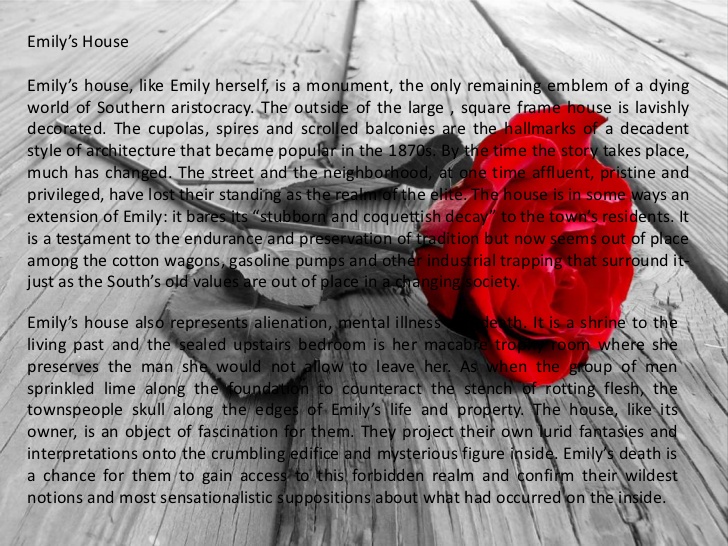
To illustrate how good Faulkner’s writing is, here is an extract from one of his famous short stories “A Rose for Emily.” It is a story of Emily, a woman living in a small town. Due to her exalted position inherited from her father, she lives a solitary life. When the town has the roads renewed, the man in charge of the works becomes acquainted with Emily. Everyone expects them to marry. When works are finished, he comes back one more time, but then disappears. Years later:
“And so she died. Fell ill in the house filled with dust and shadows, with only a doddering servant man to wait on her. We did not even know she was sick. She died in one of the downstairs rooms, in a heavy walnut bed with curtains, her grey head propped on a pillow yellow and moldy with age and a lack of sunshine. They held the funeral on the second day, with the town coming to look at Miss Emily beneath a mass of bought flowers.”
“Already we knew that there was one room in that region above stairs which no one had seen in forty years, and which would have to be forced. They waited until Miss Emily was decently in the ground before they opened it. The violence of breaking down the door seemed to fill this room with pervading dust. A thin, acrid pall as of the tomb seemed to lie everywhere upon this room decked and furnished as for a bridal: upon the valance curtains of a faded rose colour, upon the rose-shaded lights, upon the dressing table, upon the delicate array of crystal and the man’s toilet things backed with tarnished silver, silver so tarnished that the monogram was obscured. Among them lay a collar and tie, as if they had just been removed, which, lifted, left upon the surface a pale crescent in the dust. Upon a chair hung the suit, carefully folded, beneath it the two mute shoes and the discarded socks.
The man himself lay in the bed.”
Miss Emily’s house

“Resta Con Me (Stay with Me)” (Remastered 2020) by Ludovico Einaudi:
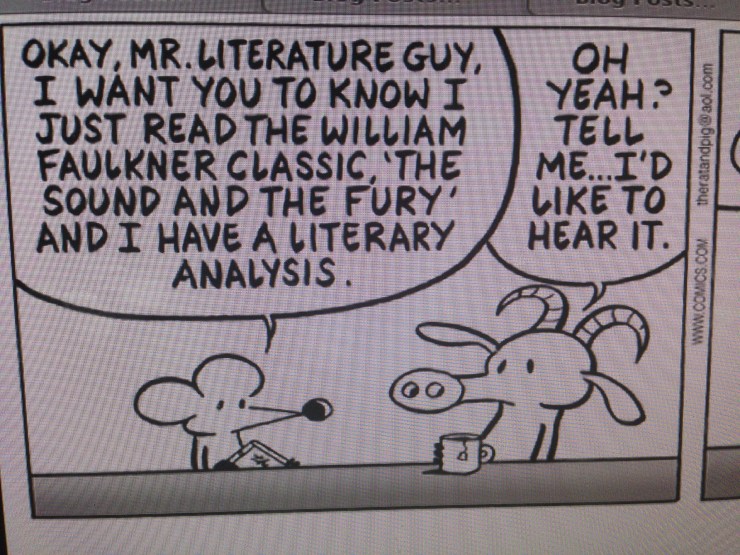
William Faulkner’s fourth novel, The Sound and the Fury was a modern milestone. In it he bravely indulged the experimental impulse that under the guidance of his editors, he had kept in check in his previously published work, creating one of the landmarks of modern fiction. At the start, The Sound and the Fury takes literally the tale-telling metaphor from Macbeth that gives the novel its name: “Life’s but a walking shadow,/… a tale / Told by an idiot, full of sound and fury,/ Signifying nothing”. The novel is not easy reading, for the four parts have distinct styles, none of which is straightforward. Faulkner’s ingenious portrayal of the characters offers a cryptic depiction of the family’s decline and fall. Reading it is like being lost in a wood. We come to feel the nature of the forest in a way we never would if we were following a clearly marked path. The brilliance of this novel is the way it makes us feel that we are emerging from danger through the grace of some guiding hand, albeit one that is extended without any assurance or explanation. Faulkner once made the distinction between books you can read fast and those you must read slowly. You read The Sound and the Fury aware that you will have to re-read every line. When you read Faulkner, it is not a case of liking or hating him. It does not matter. He’s coming through.

“Wicked Game” by Chris Isaak:
Here is an extract from The Sound and the Fury:
“There were about a dozen watches in the window, a dozen different hours, and each with the same assertive and contradictory assurance that mine had, without any hands at all. Contradicting one another. I could hear mine, ticking away inside my pocket, even though nobody could see it, even though it could tell nothing if anyone could.

And so I told myself take that one. Because Father said clocks slay time. He said time is dead as long as it is being clicked off by little wheels; only when the clock stops does time comes to life. The hands were extended, slightly off the horizontal at a faint angle, like a gull tilting into the wind. Holding all I used to be sorry about like the new moon holding water, as blacks say. The jeweler was working again, bend over his bench, the tube tunneled into his face. His hair was parted in the center. The part ran up into the bald spot, like a drained marsh in December.
I saw the hardware store from across the street. I didn’t know you bought fat-irons by the pound. The clerk said, “These weigh ten pounds.” Only they were bigger than I thought. So I got two six-pound little ones because they would look like a pair of shoes wrapped up. They felt heavy enough together, but I thought again how Father had said about the reductio absurdum of human experience, thinking how the only opportunity I seemed to have for the application of Harvard. Maybe by next year; thinking maybe it takes two years in school to learn to do that properly.”
“A Change Is Gonna Come” by Sam Cooke, performed by Jay Howie:
A poll of well over a hundred writers and critics, taken a few years back by the Oxford American magazine, named William Faulkner’s Absalom, Absalom! the ‘greatest Southern novel ever written’, by a dramatically clear margin. His writing is of exceptional vividness and what Faulkner like all good writers wants from us is intelligence, good faith, and time. First published in 1936, Absalom, Absalom! is William Faulkner’s ninth novel and one of his most admired. It tells the story of Thomas Surpen and his ruthless, single-minded attempt to forge a dynasty in Jefferson, Mississippi, in 1830.
“Faulkner’s novels have the quality of being lived, absorbed, remembered rather than merely observed,” noted Malcolm Cowley. It is structurally the soundest of all the novels and it gains power in retrospection.

Here is an extract from Absalom, Absalom! –
“From a little after two o’clock until almost sundown of the long still hot weary dead September afternoon they sat in what Miss Coldfield still called the office because her father had called that – a dim hot airless room with the blinds all closed and fastened for forty-three summers because when she was a girl someone had believed that light and moving air carried heat and that dark was always cooler, and which (as the sun shone fuller and fuller on that side of the house ) became latticed with yellow slashes full of dust motes which Quentin thought of as being flecks of the dead old dried paint itself blown inward from the scalding blinds as wind might have blown them. There was a wisteria vine blooming for the second time that summer on a wooden trellis before one window, into which sparrow came now and then in random gusts, making a dry vivid sound before going away: and opposite Quentin, Miss Coldfield in the eternal black which she had worn for forty-three years now, whether, for sister, father or not husband, none knew, sitting so bold upright in the straight hard chair that was so tall for her that her legs hung straight and rigid as if she had iron shinbones and ankles, clear of the floor with that air of impotent and static rage like children’s feet, and talking in that grim haggard amazed voice until at last listening would renege and hearing-sense self-confound and the long-dead object of her impotent yet indomitable frustration would appear, as though by outraged recapitulation evoked, quiet inattentive and harmless, out of the biding and dreamy and victorious dust.
Her voice would not cease, it would just vanished. There would be the dim coffin-smelling gloom sweet and oversweet with the twice- bloomed wisteria against the outer wall by the savage quiet September sun impacted distilled and hyper-distilled, into which came now and then the loud cloudy flutter of the sparrows like a flat limber stick by an idle boy,..”
I better stop here, otherwise you might faint, and not even remember how the sentence started. The first paragraph is one sentence only! But at least you might rush out and get a copy; if so, please do!


“You Are My Sunshine” performed by Kinna Granis:
Faulkner’s last novel, The Reivers: A Reminiscence (1962), distinctively mellower and easier to get absorbed in than some of his previous works, is a picaresque adventure that evokes the world of childhood with a final burst of comic energy.
Here is an extract from The Reivers, and you can make your own judgment as to whether to read the whole story:
“It was Saturday morning, about ten o’clock. We – your great-grandfather and I – were in the office, Father sitting at the desk totting up the money from the canvas sack and matching it against the list of freight bills which I had just collected around the Square; and I sitting in the chair against the wall waiting for noon when I would be paid my Saturday (week’s) wage of 10 cents and we would go home and eat dinner and I would be free at last to overtake (it was May) the baseball game which had been running since breakfast without me: the idea (not mine: your great-grandfather’s) being that even at eleven a man should already have behind him one year of paying for, assuming responsibility for the space he occupied, the room he took up, in the world’s (Jefferson, Mississippi’s anyway) economy. I would leave home with Father immediately after breakfast each Saturday morning, when all other boys on the street were merely arming themselves with balls and bats and gloves – not to mention my three brothers, who being younger and therefore smaller than I, were more fortunate, assuming this was Father’s logic or premise: that since any adult man worth his salt could balance or stand off four children in economic occupancy, any one of the children, the largest certainly, would suffice to carry the burden of the requisite economic motions: in this case, making the rounds each Saturday morning with the bills for the boxes and cases of freight which our drivers had picked up at the depot during the week and delivered to the back doors of the grocery and hardware and farmer’s supply stores, and bring the canvas sack back to to the livery stable for Father to count and balance it, then sit in the office for the rest of the morning ostensibly to answer the telephone – this for the sum of ten cents a week, which it was assumed I would live inside of.”
Steve McQueen in the film The Reivers

Contrary, to what you are thinking after reading this post, I thought that (in my teenage years) Faulkner was the greatest of writers. But that was before I became acquainted with Hemingway and others.
The PEN/Faulkner Foundation is an outgrowth of William Faulkner’s generosity in using his 1949 Nobel Prize winnings to create the William Faulkner Foundation; the aim was “to establish funds to support and encourage new fiction writers.” The Award for Fiction is awarded annually to the author of the year’s best works of fiction by American citizens.

The presentation ceremony is in the Great Hall of the Folger Shakespeare Library in Washington, D.C. The organisation claims to be the “largest peer-juried award in the country. The award is $15,000.
Folger Shakespeare Library


Courtesy of Words that light my way:

 naturetails
Thank you 👍🙏
LikeLike
You are more than welcome, Morag!
Joanna
LikeLiked by 1 person
A great post on the masterful writings of William Faukner ,Joanna !He was known for his artful wriyins comprising and complex sentences !Many of his famous works were ,’The Sound & the Fury”, A Rose for Emily.Emily house,& one of his greatest novels.”Absalom,Absalom(1936).His last novel was ,”The Reivers:A Reminiscent (1962).“Faulkner’s novels have the quality of being lived, absorbed, remembered rather than merely observed,” It was quite a rewarding & enriching post on the great writer,Joanna!Thanks!Namaste.
LikeLike
Thank you so much, Dhirendra, for your wonderful comments, which are greatly appreciated! I love the great writers because their works stimulate and expand our understanding of the world.
Joanna
LikeLiked by 1 person
Namastey
LikeLike
Thank you, Dhirendra, Namaste!
Joanna
LikeLiked by 1 person
Please find time for my latest blog created specially for my dear valued readers 🙏
LikeLike
Absolutely true, Joanna 🙏
LikeLike
Yes, I will, Dhirendra!
Joanna
LikeLiked by 1 person
🤗💖😘
LikeLike
This is another of what I’ve come to think of as “Joanna’s Treasure Troves.” I marvel at the time and care you put into these posts. I’ve read some of Faulkner’s works, but I’d never read “A Rose for Emily,” and the excerpt made me gasp aloud!
I’ll now have an opportunity to decide with some new-found knowledge which of Faulkner’s works to tackle next.
LikeLike
Thank you so much, Annie, for the wonderfully delightful comments, which I will treasure! Having readers like you makes me feel uplifted and makes my day! You are a gem, Annie!
Joanna x
LikeLiked by 1 person
Thank YOU, Joanna—for your diligent and thoughtful work!
LikeLike
You are more than welcome, Annie! You will like next week’s post!
Joanna x
LikeLiked by 1 person