This week we are visiting the deserts of Asia.
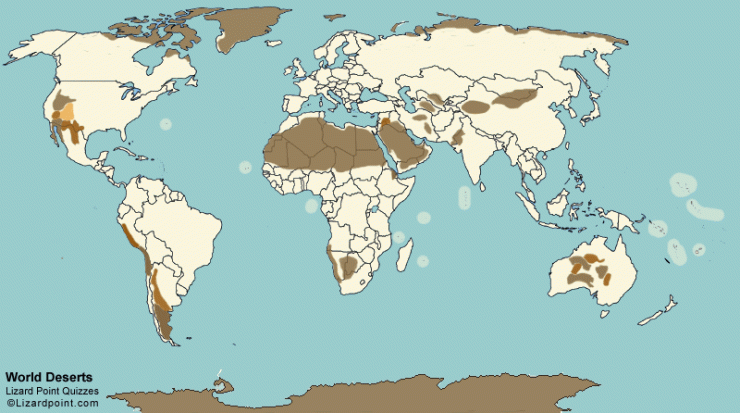
For thousands of years, deserts had power over our imagination as a vast and barren terrain, leading into the unknown and unseen distance. Those who live in the desert, both humans and wildlife, have to be extremely well-adapted, even specialised to withstand the extremities of temperature and environmental obstacles. Deserts cover a fifth of the world’s surface but it was only in the twentieth century that some of the greatest of them were scientifically surveyed and mapped. The true desert receives less than 10 inches (250 millimetres) of rain annually. Such deserts cover about 40 percent of the global landmass and their conditions vary widely. As rainfall patterns are important, so is the character of the precipitation. In some deserts, like the Arabian Peninsula where rain hardly ever falls, instead, regular fogs deposit enough moisture to sustain forms of plant life and the various species of wildlife. In high-altitude deserts such as the Tibetan Plateau, much of the annual precipitation falls in the form of snow. In the Sahara desert permanent lakes and watercourses, although rare, are of great importance as they create the oases that are valuable to many millions of migrating birds.
An important aspect of desert conditions is temperature; hot and in many locations even exceeding 50 degrees Celsius, in their hotter months. Yet at night it becomes cold very quickly, and the difference between the heat of the day and the cold of the night is significant. The elevated deserts like the Gobi and the Great Basin Desert, during the winter months, can have temperatures drop to minus 30 degrees Celsius. The accompanying high winds add to the exceptionally harsh conditions, and frost is quite common. The real point of the deserts is their diversity; from the famous hot dunes with the occasional oasis with date palm trees to salt-pans at the second-lowest point on the planet in Djibouti to the Tibetan Plateau, which has an average elevation of over 4,500 metres. All deserts have in common many striking natural features, created by the action of sun, wind, and water during millennia of continuing processes of erosion and deposition. For example, the sand dunes are formed by the deposition of wind-blown sand that has been eroded from rocks by the wind and rain. Sometimes, this forms vast sand seas and the phenomenal dunes in the Namib Desert are the highest anywhere, reaching heights of 300 metres or more.
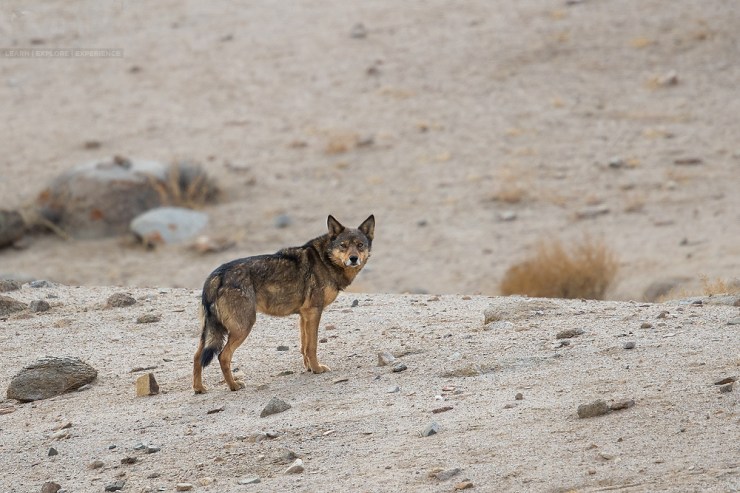
It is surprising that, given these facts, deserts sustain a large range of plants and creatures but generally, they are small in size. A notable exception is the camel and the largest of all is the African Elephant that can be found on the fringes of the great Sahara in Mali. Otherwise, the largest desert-dwelling animals are wild asses, antelopes such as oryx, and gazelles. Their main predators are leopards and wolves, although in some deserts venomous snakes such as cobras and pythons are also present. Most desert wildlife does not need to drink regularly, deriving enough moisture from its food, be it plants or other animals, and they are adapted to survive long periods of drought and lack of food by having inbuilt water and fat storage.

To withstand hot temperatures, animals of the deserts evolved to have pale skin and increased surface areas of the body, such as long ears, extended necks, and limbs. For the larger animals to be able to move with ease across the desert terrain, ranging from sand to gravel to rock, it is essential to have wide hooves or paws. Others, such as lizards or snakes, are able to ‘swim’ through the sand and bury themselves in the cooler layers below. Life cycles, both for plants and animals, are often accelerated, and courtship, mating gestation, birth and rearing of young is condensed into a brief period of cooler or wetter conditions. It is difficult to study the desert’s wildlife as the animals are unobtrusive, shy and hidden for much of the year. As the world’s arid lands are more and more encroached by humans due to the technology that allows travelling across the deserts and even building on them, we should remember that deserts are full of life and deserve to be protected and preserved for their unique beauty and diversity.
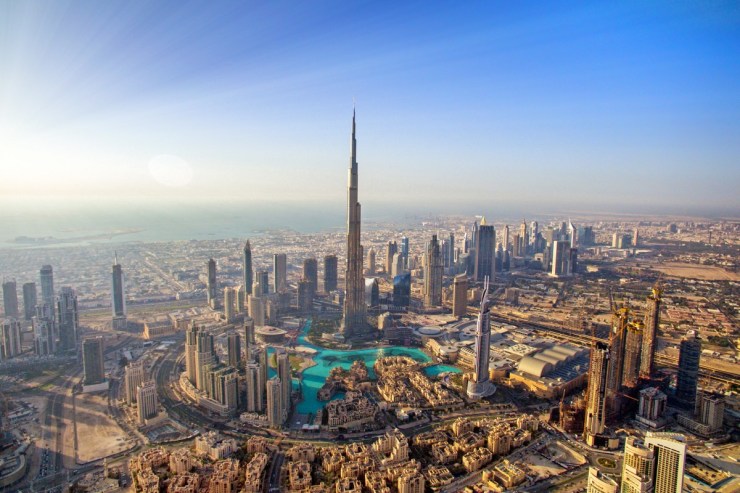
Recent examples are the glass city of Dubai, a place of cement, metal, and concrete that took over the once serene desert where Bedouins used to live peacefully for generations alongside the wildlife. The other case is the ‘Davos in the desert’ in Saudi Arabia, an event that hosted hundreds of heads of big firms. It included the heads of the London Stock Exchange, Standard Chartered, S4 Capital, Standard Life Aberdeen, HSBC, Schroders, and CQS, among many others. Needless to say, they didn’t stay under canvas.

Asia’s deserts are very interesting because they cover every aspect of the extreme environment: from the burning heat of the sand dunes in the Thar in north-west India to the freezing cold of ice and snow of the Tibetan Plateau and the gravel plains of the Gobi in Mongolia. Equally matching is the extraordinary wildlife of these deserts; the Snow Leopard in Tibet, the wild camels, Brown Bears and the herds of wild horses in the Gobi Desert. On the fringe of the Thar’s grassland graze antelopes with spectacular ringed horns, called the Blackbuck. They once had iconic status in India and were often featured in art and literature. Now, due to being hunted for their ringed horns, they live only around the settlement of Bishnoi people, who protect them. More about these special people later.

The Thar Desert extends from the Indus River in Pakistan eastwards as far as Aravalli Hills in the Indian state of Rajasthan, covering some 220,000 square kilometres. It contains a vast range of diverse landscape types and habitats and is one of the world’s least arid deserts.
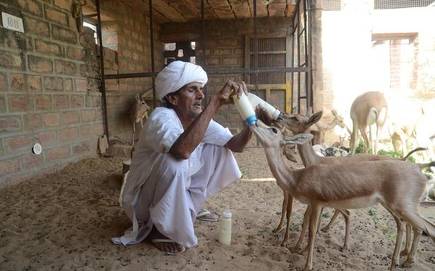
The Thar desert is my great favourite because of certain extraordinary communities, one of these, notably the Bishnoi people of Rajasthan who live in harmony with their environment and with the desert wildlife. They settled around Jodhpur and the Bishnoi derive their name from the words ‘bish’ meaning 20 and ‘noi’ meaning nine, a reference to the 29 principles of their faith which is a sect in Hinduism. Those are the principles of great reverence for all forms of life. The killing of animals is forbidden, as well as cutting leaf-bearing trees and even firewood is closely examined for any insects inside. The Bishnoi feed the local wildlife and will bury the dead animals and erect gravestones to them. There were even cases of Bishnoi women breastfeeding orphan fauns.

The protection provided to wildlife attracts many animals such as the Blackbuck and Chinkara gazelle. The Blackbuck is particularly revered by the Bishnoi being considered to be the reincarnation of one of their spiritual leaders. After being hunted for their magnificent ringed horns close to extinction everywhere else in India, the numbers of the Blackbuck rose significantly around the Bishnoi settlements.
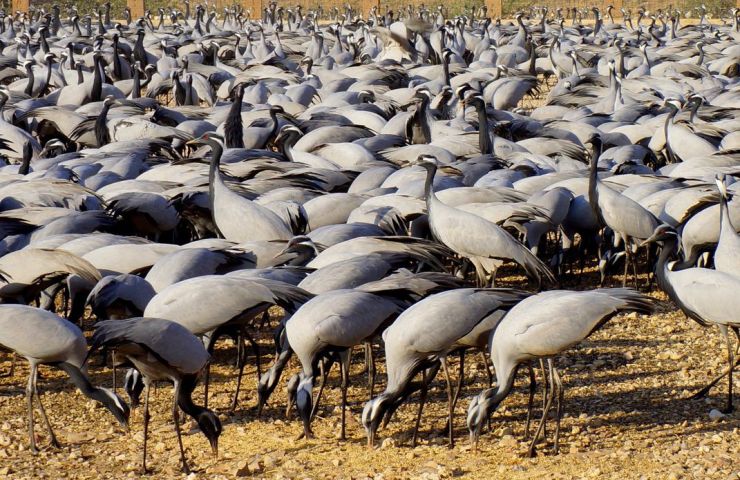
The other remarkable community is the village of Khichan in Rajasthan, famous for the thousands of migratory Demoiselle Cranes that arrive there for the winter months. They are being fed by the villagers who admire them for their fidelity (the birds pair for life) and their vegetarian habits.

There are 10,000 cranes gathering in a specially created field and the birds are served twice a day 500 kilograms of millet, sorghum and barley mixture. The food is put out at dawn, and after a meal, the birds retreat to the huge sand dunes surrounding the village. They return for their supper in the late afternoon.
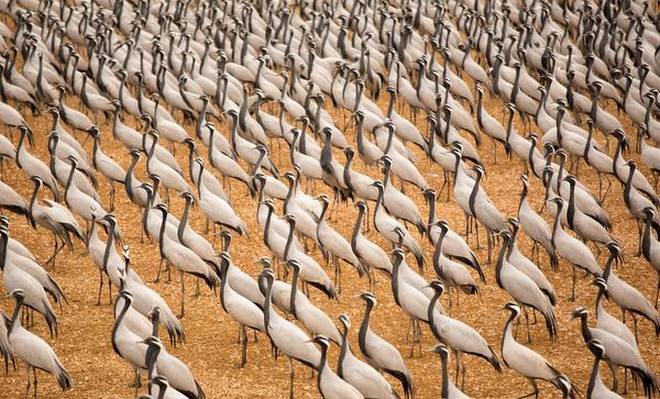
They arrive from August onwards and stay until March when they fly north to their breeding grounds in Central Asia. This spectacular display of positive interaction with wildlife attracts tourists and nature documentary makers from all over the world. I saw this event a few times on TV already and it never fails to lift my spirits and restore my faith in human goodness. So much for the absurdity of the rule ‘do not help wildlife in need’.
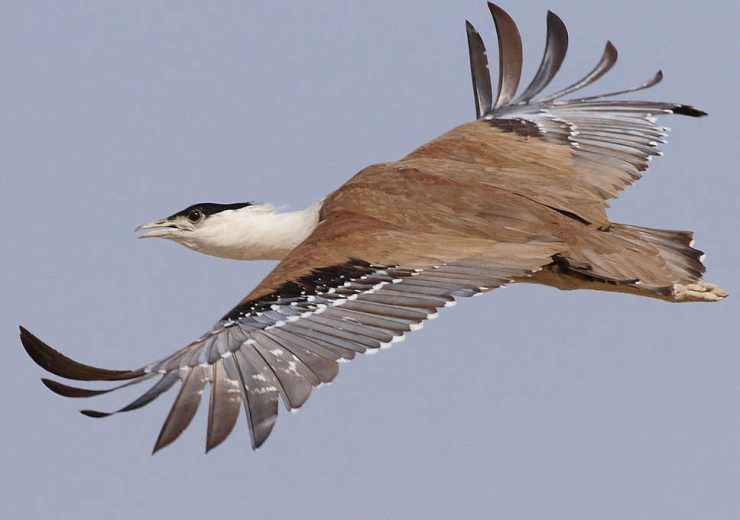
The Thar desert is prolific with birdlife and among 300 species there are the Imperial Eagle, the Great Indian Bustard, Greater and Lesser Flamingos, Indian Courser, wheater and lark. Almost all of the Great Indian Bustards found in India live in Thar, pictured above.
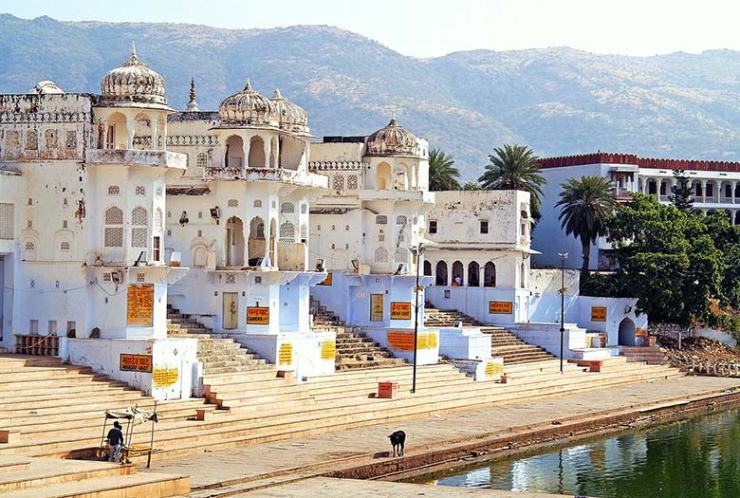
India’s largest camel festival is the Pushkar Camel Fair. Thousand of people travel across mountains and through the Thar Desert to take part in the fair. Camels are known as ‘ships of the desert’ and are held in such high esteem that there are even contests for the most ornate decorations of them. At the edge of the desert, they remain a mode of transport for nomads. Another reason for so many people attending (over 400,000) each November is that the Fair coincides with the holy festival of Kartik Pumina, held in the Hindu lunar month of Karik. The 8th-century desert town is a beautiful example of medieval architecture. It has fifty whitewashed ghats-stairs that descent into Pushkar Lake. Pilgrims consider the lake’s water to be holy, especially during Kartik’s full moon when they believe their sins can be washed away. The fair lasts for about fourteen days.

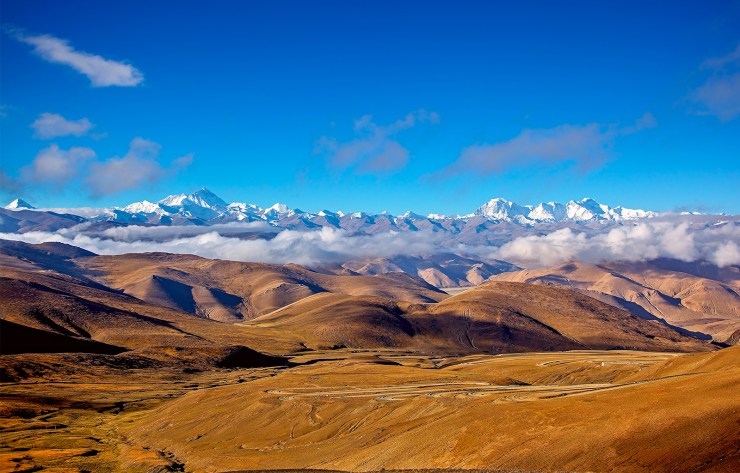
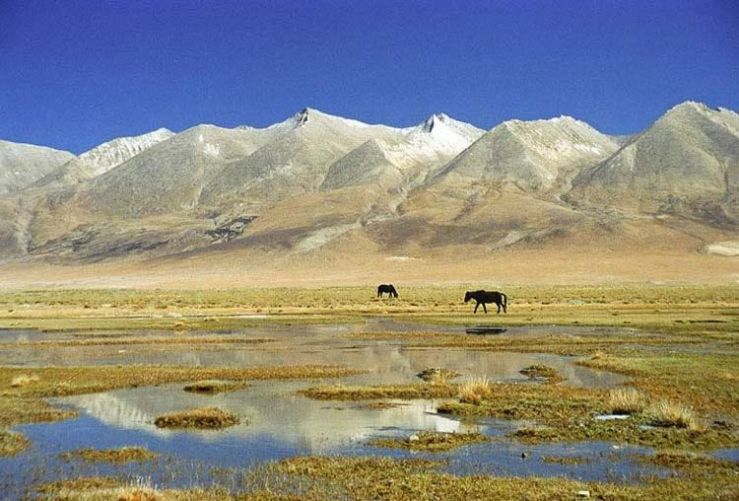
The World’s highest and the most inhospitable desert is The Tibetan Plateau. Spread over 2 million square kilometres (the size of Western Europe) it is the world’s last great wilderness. Surrounded by the Himalayas to the south and the Kunlun range to the north, the plateau is a vast crust sitting on top of what was once molten rock, forced upwards by India as it collided into the rest of Asia millions of years ago. Even now the Himalayas continue to grow at a rate of 3 millimetres a year. The plateau is positioned in the rain shadow of the Himalayas and it results in very low precipitation, in winter taking the form of snow. In summer it heats up like a giant frying pan which draws moist and warm winds from the Indian Ocean.

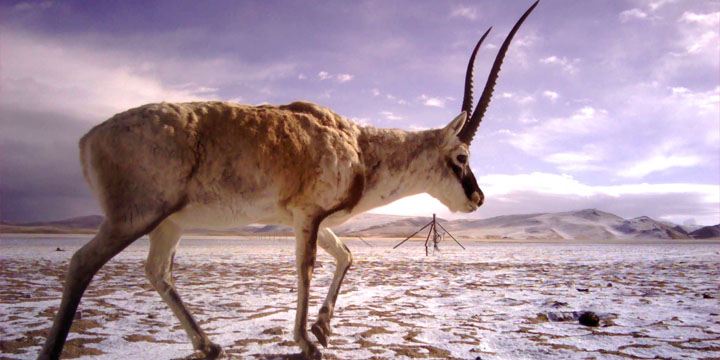
The spectacular and diverse scenery of Tibet attracts a wide range of wildlife. From wild Yak, Kiang – a wild ass, Chiru, an antelope, Bharal -Blue Sheep, wolf, Snow Leopard, Marmot, Black-necked Cranes, Bar-headed Geese, the Pika, and many others. By far the most significant is Pika, a small, oval-shaped mammal, and its numbers are estimated at 1.5 billion. It is greatly important to the plateau ecosystem because of Pica’s excavation of underground burrows which aerates the soil and breaks it up, which in turn allows vegetation to establish roots. This provides the grasses on which the antelopes, gazelles and other animals feed.
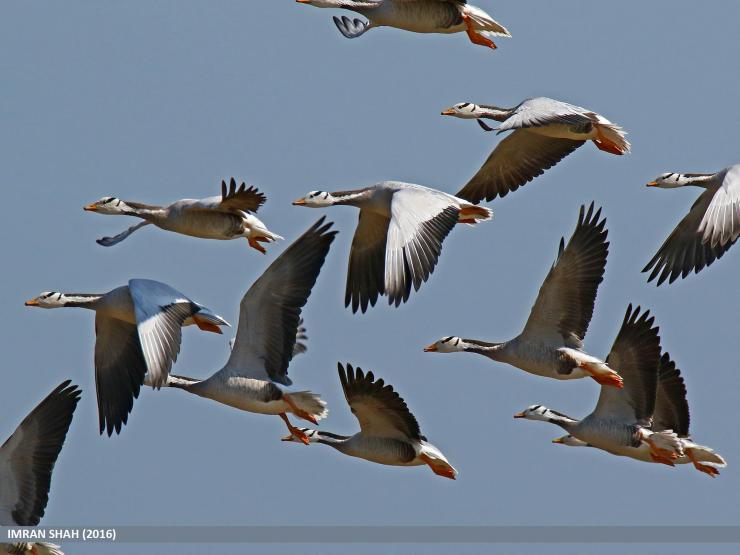
The most remarkable species in the world are Bar-headed Geese. After spending winter in India’s lowlands, they head north on a journey that takes them over the Himalayas at a height of more than 10,000 metres, higher than Mount Everest. The birds survive in an atmosphere with such low oxygen levels because of the presence of sacs in their bodies, enabling the recycling of inhaled air and the extraction of more oxygen from it, and by special haemoglobin in their blood which absorbs oxygen more efficiently than that of other bird species.
The Gobi Desert is Asia’s largest desert and the world’s most extreme environment. In summer the temperature rises to 45 degrees Celsius and in winter plunges to -40 degrees Celsius. As in midwinter come incessant strong winds and there is hardly any rainfall, it is difficult to imagine what wildlife can survive such inhospitable conditions. Yet, these vast expanses of sand, rock, and gravel – that cover 1.3 million square kilometres – support a large diversity of wildlife. The Gobi Desert is the last refuge of the wild Bactrian Camel. The desert has hardly any rainfall, yet its iconic plant, Saxsaul, a woody shrub that grows to 4 metres high, is drought resistant and not only provides forage for animals but its roots help stabilise the sand and reduce levels of wind erosion and evaporation. Saxsaul is almost the only tree-growing species in Gobi.

Bactrian Camels are highly endangered and elusive, driven into the most remote corners of the desert because of being relentlessly hunted. Their numbers continue to decline. Those animals are genetically different from domesticated camels and they differ in their appearance, with more slender legs, smaller, more pointed humps, different, darker colour coats, and smaller bodies. They can go without drinking for a long time but when they come across some water they can take in as much as 50 litres in one go. In winter they eat snow for moisture.
The Gobi Bear is the rarest species of brown bear in the world, and difficult to find. They forage for food and are omnivorous, eating fruit, roots, lizards and other small animals.
There may be as few as forty-five Gobi Bears surviving today. Conservationists are providing food in spring to assist the bears as they emerge from their winter hibernation, as they are a critically endangered species.
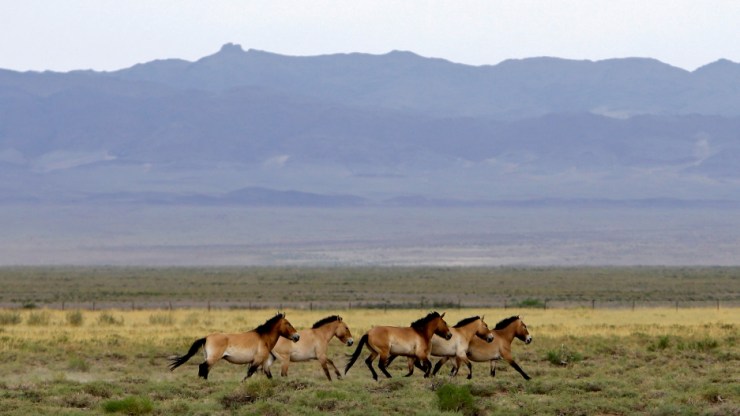
Other wildlife in the Gobi Desert includes wild asses and wild horses. The importance of the Gobi Desert for wildlife is now recognized on an international level and a network of protected areas has been established, the main priorities being the wild Bactrian Camel and Gobi Brown Bear. The authorities have a tough job policing such a vast and remote area, and perhaps sheer inhospitable nature of the Gobi Desert will prove to be the ultimate salvation of its wildlife.

 naturetails
Thank you, it was an interesting read. It’s nice hearing about all the animals too and seeing the images.
LikeLike
Joanna, I had never imagined wildlife of desert could be so varied. Bishnois are certainly an extraordinary community. As always an interesting and informative post.
LikeLike
You always choose such magnificent photos Joanna!
LikeLiked by 1 person
Interesting, that women would breastfeed a faun! Or perhaps they express their milk and put in bottles for horned animals.
LikeLiked by 1 person
Thank you, Joanna. I needed this today. It is good to remember that there are still people on the planet who live in harmony with Nature and her many other far more precious creatures. The roof of the world has always been extra special to me and I loved seeing the wonderful photos you selected. This is another of your great offerings for which I am grateful!
LikeLike
Each of your desert articles has been filled with interesting details.
By the way, I wonder if the brown bears in the Gobi are endangered because of human activities, or if there have been natural causes.
LikeLike
What amazing animals! It’s remarkable how they adapted to survive in such hostile environments. It is sad that even in the deserts some of the animals are facing extinction.🐫
Kudos to the Bishnoi, who help to protect endangered desert wildlife!
Thank you, Joanna, for this fascinating series on the deserts of the world! The photos are gorgeous! 💕
LikeLike
Thank you, Neil, for your wonderfully thoughtful comments! Brown bears are endangered for many reasons; climate change, habitat loss, human activities, and some genetic problems. There are projects to save them, and I hope they will be successful.
Joanna
LikeLiked by 1 person
Thank you, Cheryl, for your wonderful comments! As I wrote to another reader there are projects to save the brown bear, and I hope they will be successful. Your thoughts are deeply appreciated!
Joanna x
LikeLike
I have not spent much time in deserts. You posts have been inspiring! Thanks!
LikeLike
Thank you, Carolyn, for your wonderful comments! Your words are greatly appreciated!
Joanna
LikeLike
Thank you, Chen Song Ping, for your interesting comments! I think you might be right!
Joanna
LikeLiked by 1 person
Dear Joanna, thanks so much for pointing out how deserts sustain a large range of plants and creatures. I am just blown away by the cities that are built on deserts, like Dubai. I didn’t know about India’s largest camel festival (the Pushkar Camel Fair.) The ornate decorations draped on camels is such a festive sight. Thanks so much for sharing your fascinating research my friend. Have a wonderful weekend! 🤗🐫💖🐪🌞
LikeLike
Wonderful photos and information. The earth has such varied lands. I agree completely with your point: ” . . . we should remember that deserts are full of life and deserve to be protected and preserved for their unique beauty and diversity.” Thanks for a great post!
LikeLiked by 1 person
Thank you, dear Kym, for your wonderfully thoughtful comments! With kind readers like you it is pleasure to do my research, and present the facts in my posts. Your kind words are much appreciated!
Joanna x
LikeLiked by 1 person
Thank you, Diana, for your wonderful comments! Your kind words are greatly appreciated! I am happy that there are people committed to saving the wildlife of Gobi, and I hope they will be successful.
Joanna
LikeLiked by 1 person
Oh my dear Joanna, you are so very welcome. Your research is greatly appreciated just as I appreciate you my friend. Thank you and have a wonderful weekend. 😊💖🤗
LikeLike
Thank you, dear Kym, and likewise!
Joanna x
LikeLiked by 1 person
Thank you, Joanna, for yet another captivating post on deserts—this time, focusing on those of Asia. You begin with a comprehensive overview, covering desert conditions, wildlife, plant adaptations to extreme climates, and the importance of preserving their beauty and diversity.
Your discussion of the Thar Desert and the unique bond between Blackbucks and the Bishnois clan is particularly fascinating. The Bishnoi community is renowned for its unwavering dedication to protecting the region’s flora and fauna. Their belief in reincarnation as Blackbucks after death, along with the astonishing practice of Bishnoi women breastfeeding orphaned fawns, is truly remarkable.
The winter migration of cranes to Khichan village and their loyalty to the site is another compelling aspect. I believe you have seen the video of a man calling the gathered birds to feed them in a field—an incredible sight. However, one of the Thar Desert’s greatest attractions remains the majestic Great Indian Bustard.
Regarding the camel fair, as you mentioned, it coincides with a religious occasion, much like the famous animal fair in Sonepur, Bihar. The magnificent Pushkar Lake, near Ajmer, is home to India’s only Brahma Temple, a site cherished by foreign tourists for its old-world charm and mystical ambiance.
Your section on bar-headed geese and their survival strategies is outstanding. Learning about Bactrian camels and the rare Gobi bear of the Gobi Desert was equally intriguing. It is reassuring to know that global conservation efforts are in place to protect these species.
Even though I had read this before, revisiting it was a wonderful refresher. Thank you, Joanna, for a detailed and visually rich account of Asia’s deserts, including those in India.
LikeLiked by 1 person
Thank you so much, Kaushal, for your wonderfully analytical comments! Although, I couldn’t write about all wildlife support in India due to lack of space, you very kindly concentrated on my research only. Your kindness when writing about my work is deeply appreciated! Thank you!
Joanna
LikeLiked by 1 person
Correct me if I’m wrong Joanna, but have you amended the content of this fabulous post. Maybe it’s my memory that’s fading, but there’s so much to take in with this stupendous article that it’s more than possible that I didn’t take it all in the first time around. Either way, it’s fantastic.
LikeLike
Thank you, Malc, for your wonderful comments! Your kind words are much appreciated!
Joanna
LikeLiked by 1 person
It’s truly my pleasure, Joanna to read your well researched articles. You’re always welcome!
LikeLike
Thank you, Kaushal, you are very kind!
Joanna
LikeLiked by 1 person
Somehow I wouldn’t have thought about regular fogs on the Arabian Peninsula. Live and learn. I also didn’t know till now how the bar-headed geese survive when flying at such high altitudes.
LikeLike
Thank you, Steve, for your thoughtful comments which are much appreciated!
Joanna
LikeLike
Thanks Joanna ,for your very well researched & outstanding article on the Asian Deserts including those in India!You have given a detailed account of the extreme desert conditions, human & wildlife & their adaptations to extreme climates, and the importance of preserving plant & animal diversity.You have complemented your descriptions with beautiful photos of the mesmerising landscapes & wildlife in the desert!The post was quite enlightening for the precious information it presented for the readers !
LikeLike
😘💖🥰💋😁
LikeLike
Thank you, Dhirendra, for your wonderfully analytical comments! As I mentioned before, there isn’t enough space to include all the interesting facts but the ones included are important. Your kind thoughts are greatly appreciated!
Joanna
LikeLiked by 1 person
My pleasure, Joanna 🙏Namastey
LikeLike
Thank you again, Dhirendra, Namaste!
Joanna
LikeLiked by 1 person
An excellent article Joanna. Amazing how only the hardy can survive such climate extremes. It is comforting to know that diverse life can live anywhere, as long as it is given time to adapt. These climatic areas, as well as others need to be preserved for the future health of our world. Happy Monday Joanna. Allan
LikeLiked by 1 person
Thank you, Allan, for your wonderfully thoughtful comments! Your kind words are greatly appreciated!
Joanna
LikeLiked by 1 person
This is incredible, this wildlife and adaptations that have evolved to survive in these extreme environments. I was recently watching a documentary ‘Planet Earth’ and it totally blew my mind away. And then I’m reading this, it’s just amazing. And I’m so inspired by the Bishnoi people’s dedication to protecting the environment and wildlife
LikeLike
Thank you, Ritish, for your thoughtful comments! I too have fallen in love with the Bishnoi people and their superior intellect which makes them understand what is important for our planet and devote their lives to do it.
Thank you again, Ritish, your thoughts are much appreciated!
Joanna
LikeLiked by 1 person
Absolutely Joanna, their dedication to living in harmony with nature is truly inspiring, and we can all learn from their examples.
LikeLike
Thank you, Ritish, for your wise thoughts which wholly resonate with my view.
Joanna
LikeLike