
“Two Trees” by Ludovico Einaudi (courtesy of Pianodreams mother&son):

“In some Native languages,
the term for plants translates
to “those who take care of us.”
Robin Wall Kimmerer
“Chi Mai” by Ennio Morricone (courtesy of Krzysztof – Fairyland):
“Plants are agents of nature’s self-organising intelligence.”
David Crow
Courtesy of M Zeki Althunhisar:
This week I am republishing my post about plant intelligence as I think many new blog readers will find it of interest. Moreover, a new book was recently published which gathers the latest findings on this topic: “The Light Eaters: The New Science of Plant Intelligence” by Zoe Schlanger.
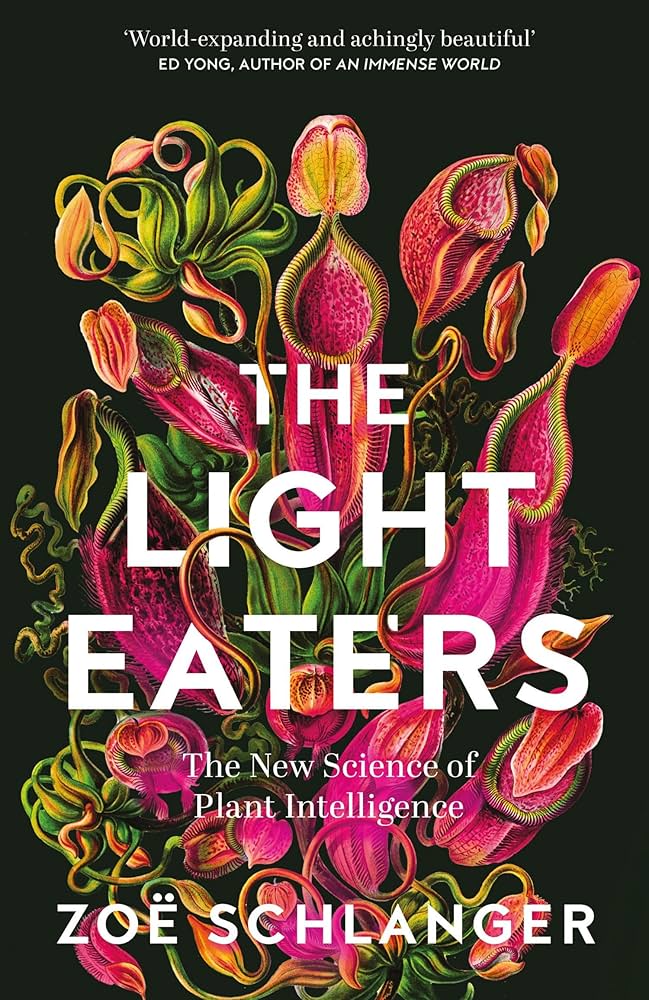
Courtesy of NewsNation:
Dr. William Lauder Lindsay, a physician and botanist wrote in 1876: “It appears to me that certain attributes of mind, as it occurs in Man, are common to plants.” Other scientists have since come to the conclusion that while we are the most intelligent among all animals, humans are not the only ones that display this biological property. The precursor to plants and animals had already genetics that during evolution were shared by both plants and animals.
Kingdoms in Another Time – Plants and Fungi (courtesy of Atheos Nous):
The implications of the studies described below in this post, and many others, show that evolution was based on the inheritance of acquired characteristics, as claimed by Jean-Baptiste Lamarck. Biological intelligence is a part of our genetic make-up, like the shape of our body, and is present in similar, but not in the same form, in all creatures. In his ‘Power of Movement in Plants’, Darwin wrote: “It is hardly an exaggeration to say that the tip of the radicle (root) thus endowed, and having the power of directing the movement of the adjoining parts, acts like the brain in one of the lower animals.”
The Roots of Exploring Plant Intelligence (courtesy of World Science Festival):

Scientists say that trees are social beings. They can count, learn, and remember. They nurse sick members, warn each other of danger by sending electrical signals across a fungal network, and for reasons unknown, keep the ancient stumps of long-felled companions alive for centuries by feeding them a sugar solution through their roots.
“How Trees Secretly Talk to Each Other in the Forest” (courtesy of National Geographic):
By the way, a couple of interesting asides. There are communities in India that have learned how to train the roots of rubber fig trees to form natural suspension bridges that can span over 100 feet and last five hundred years.
Courtesy of Mike Marlowe:


The living root bridges of Meghalaya (courtesy of Thirsty Universe):
In the late 1980s, NASA studied house plants as means of providing clean and pure air for their space stations. They found Peace Lilies and Chrysanthemums to be the best all-rounders at air filtering.
“Crisantemi” by Giacomo Puccini (courtesy of Mikel Toms):
Today scientists from various universities, working on developing Darwin’s root-brain hypothesis, use the term ‘plant neurobiology’ that points to the similarities between plants and animals. Of course, we must remember that evolution created specific sets of cells, tissues and organs. While animals developed weight-supporting skeletons, plants have developed woody trunks. The issue of the degree of plant intelligence is not as yet fully understood and needs more studies. What we know now is that plants are able to differentiate between red, blue, far-red and UV lights and respond to them. They know that they are being touched, can respond to compounds in the air and they can hear. They know gravity and respond by growing up, but putting roots down. They are aware of their past and accordingly modify their present physiology as they remember their previous experiences, like infections.
Professor Stefano Mancuso describes how plants interact with each other (courtesy of Gottlieb Duttweiler Inst):

How plants see and experience the world (courtesy of Next Observer):

“Nuvelo Bianche” by Ludovico Einaudi (courtesy of Levente Lucza):
As yet, we don’t have the knowledge to prove if plants can suffer or be happy in our understanding of the term, but it also means that we cannot disapprove of the terms being used. Most good gardeners think that well-looked after plants do look happy, and wilting ones do not, but it is still an unanswerable question. Darwin’s experiments to establish whether the tip of the plant senses gravity, then passes this information along, instructing the plant to grow the roots down, and the top towards the light and up, was successful in positively answering this particular question. But even this issue is much more complex when looked at today. Advanced studies using advanced microscopes revealed the complex subcellular structure of roots. Part of the root cell contains a heavier than the rest of the cell structure that researchers call statoliths, from the Greek, meaning ‘stationary stone’. Further research, including taking plants under weightless conditions (effectively zero gravity) in spacecraft, has confirmed that the presence of statoliths is necessary to react to gravity and grow roots down. In spacecraft, roots were growing in every direction.
How plants adapt to growing in space (courtesy of VideoFromSpace):

It is extraordinary and inspiring to think what is going to be discovered in the next century. When Darwin designed his experiment to find which part of the plant can see the light, and found it was the tip, which then passes the information to the stalk and which then bends towards the light, he didn’t know that years later a Danish plant physiologist Peter Boysen-Jensen would use this knowledge to expand the findings. Like Darwin, he cut the tip of two plants and then used a piece of glass between one tip and its stump, and a thin slab of gelatin between another tip and its stump. The plant that had the gelatin reacted to the light by bending, while the one with glass did not. It was obvious that the bending signal coming from the tip must be soluble since it could pass through the gelatin but not through glass. Later on, in the 1930s, it was discovered that it was a growth-promoting chemical called auxin (Greek for ‘increase’). It is a very prevalent hormone as it has a major function of making a plant to bend towards the light and grow better and faster.
Courtesy of National Geographic:

Do plants have memory? In an experiment in 1977, a scientist, Mark Jaffe, wanted to prove that plants have procedural memory, that is they are capable of sensing and reacting to external stimulation. He cut a tendril of a pea plant, known to coil around anything that would support it, and kept it in a well-lit environment. To get it to coil he rubbed the tendril with his finger. When he put the tendril in a dark place, it would not curl as it needed light to perform. But when he placed the pea tendril in the light, two hours later, it would spontaneously curl without the stimulation of the scientist’s finger. The tendril stored the information of being touched and coiled as soon as it was put in the light. This is a type of procedural memory.

“Walk” by Ludovico Einaudi (courtesy of A Thing of Beauty):
The research into genetics in the Soviet Union was led by the scientist, Lysenko, who was one of the first to establish that some plants need very cold weather to flower. When the winter was mild and various crops would fail, he found a solution. The seeds were put into a freezer, and then planted in the spring, and not as it had been done previously in autumn, and the plants flowered, ensuring good crops. It was clear that the seeds remembered that they had the cold period they needed and flowered as it was April, the time they usually have done so in the spring. Lysenko proved that this most important process could be artificially manipulated, and he was venerated for saving masses from starvation. Later, scientists discovered that the cold treatment triggers a change in plant DNA structure, which is then passed on to the next generation of female cells. It is truly astonishing that plants not only have the memory from season to season, but can also pass it from generation to generation. Recent studies in Switzerland established that plants under stress make a new combination of DNA, that is also passed to a new generation.
The press reported recently that pollinating experts, honeybees, are also adept in maths. The bees were taught to recognise the colours as plus or minus symbols. After achieving this, scientists then taught honeybees to solve basic mathematical problems. It involved addition and subtraction, and the success rate was 75%. Prof. Adrian Dyer from RMIT University in Melbourne wrote: “Our findings suggest that advanced numerical cognition may be found much more widely in nature among non-human animals than previously suspected. If maths doesn’t require a massive brain, there might also be new ways for us to incorporate interaction of both long-term rules and working memory into designs to improve rapid learning of new problems.”
Courtesy of Miranda V.:
The discovery that bees can understand the concept of zero, lead to further research. Fourteen bees were trained to enter a Y-shaped maze consisting of a tunnel with two opposite exits. When they got into a tunnel the bees saw different shapes, coloured either yellow or blue as ‘numbers’ arranged in sums. The bees were trained to follow correct sums to their reward of sugary water. Those that followed a path marked by an incorrect sum only got a bitter solution. After 100 trials the bees learned to get the right solution. The scientists pointed out that to be able to solve even basic maths problems requires the ability to understand abstract rules. Prof. Dyer said “You need to be able to hold the rules around adding and subtracting in your long-term memory, while mentally manipulating a set of given numbers in your short-term memory.”
Honeybees learn how to do simple arithmetic (courtesy of News Direct):
The intelligence of bees (courtesy of National Geographic):
These are true wonders of the natural world; how many more astounding discoveries are we going to find in the future?
Hidden miracles of the natural world by Louie Schwartzberg (courtesy of TED):
“Just For You” by Giovanni Marradi (courtesy of Andreea Petcu):

 naturetails
What a thought-provoking body of research you’ve presented Joanna. I truly believe that my indoor plants, outdoor flowers, and the trees surrounding us possess a level of intelligence we may never understand. Think about it, how would such creation grow and respond to environmental conditions, whether indoors or outside, and survive and thrive as they do. Plus, they are natural filters. 🌳🍃🌲
My husband had problems with his allergies in the past, but when I added more indoor plants, he does not sneeze or react with indoor allergens as he had in the past. Great food for thought my friend. Thanks for sharing! 🥰🙏🏼😊
LikeLike
I remember this post. The additional mention of Zoë Schlanger’s book sent me to the Austin Public Library’s site to put a hold on a copy once it becomes available.
LikeLike
Thank you, Kym, for your thoughtful comments! I talk to my plants in the garden and they respond by growing and flowering.
Joanna x
LikeLiked by 1 person
Thank you, Steve, for making my day with your passion for research! I think that you liked
the post and thought it interesting> Am I right, or am I right?!
Joanna
LikeLike
💜
LikeLike
Thank you, I take it that you like it !Much appreciated!
Joanna
LikeLike
Oh my gosh Maggie, I do too and so did my mom. I truly believe in their intelligence for sure. Great message my friend. 😍🌳🤗
LikeLike
As always I found a wealth of information in your post. The images, music and videos are all absolutely fascinating as well.
I really enjoyed reading it and found it to be a storehouse of knowledge.
PS I confess that I sometimes talk to plants, besides animals
LikeLike
Wonderful post Joanna, I had seen in discovery but your article elaborative and gives information about plant intelligence and there are many things that humans are unaware of or things related to nature and plants.Thanks for sharing incredible writeup.
LikeLiked by 1 person
Thank you, dear Luisa, for your wonderfully thoughtful comments! The plants in my garden do like my praise and respond When I see a neglected plant in the supermarket, I buy it and nurture it to good health. They want to live, and a little care changes their unhappiness, and makes me happy too!
Joanna x
LikeLiked by 1 person
Thank you, Prafulla, for your wonderfully interesting comments! Your kind words are much appreciated!
Joanna x
LikeLiked by 1 person
Your always welcome dear.
LikeLike
Great post, Joanna! Very descriptive and Loved reading it!
LikeLike
Beautiful Joanna. Humans like to think they are superior in intelligence but I think we are only different and we would do well to be more humble and to learn from other life forms. Your choice of music and videos is wonderful, as always. I especially liked the Ted Talk of Louie Schwartzberg. Modern technology gives us so many more options. All we need do is focus on research and abandon war! Thank you once more.
LikeLike
Marvelous, Joanna, Well worth a reblog.
LikeLike
Thank you, dear Pat, for your wonderful and uplifting comments! Your kindness is much appreciated!
Joanna x
LikeLiked by 1 person
Very welcome,dear Joanna.
LikeLike
Thank you, Carolyn, for your words of wisdom comments! I know that the plants in your garden respond to your care and pep talk! I’m happy that you like the music and all the presentation! Thank you again, Carolyn, your thoughts are greatly appreciated!
Joanna x
LikeLike
Thank you!
Joanna x
LikeLiked by 1 person
Thank you, Kym!
Joanna x
LikeLiked by 1 person
Interesting post! Thanks for sharing!
LikeLike
Well done on the science.
LikeLike
I do believe plants are intelligent and some can even communicate. My wife read Finding the Mother Tree that tells how trees can look after each other through the mycelium network. I have yet to read it, but we look for the Mother Trees on our forest walks and the theory seems well born out. Interesting story about Lysenko’s solution to crop failure. Thanks for reposting this Joanna. Very interesting. Have a great weekend. Allan
LikeLike
I would have remembered this post if I had read it before Joanna so I’m pleased that you’ve re-posted it. As soon as I took a look I realised that I needed to find some quality time to do this masterpiece justice – and I was right to do so. The way you put all this together is nothing short of brilliant. Your choice of music and film clips add even more enjoyment to your already amazing knowledge of the subject.
As for the topic itself, it’s nothing short of mind-boggling. You’ve managed to go a long way in explaining why I’ve always known why nature can adapt to its surroundings, but never knew why or how. I’ve often wondered why nature (and wildlife in particular) prefers an unkempt environment to a pristine one, but I guess deep-down I knew the answer to that one, but what I’ve never been able to understand is why the area around Chernobyl has become a haven for wildlife while human beings are largely excluded on safety grounds. For wildlife to be attracted there, plants must have been able to find a way of surviving – so I think they must have intelligence in order to be able to work that out.
LikeLike
The second sentence in the second paragraph will make more sense if I change it to “As for the topic itself, it’s nothing short of mind-boggling. You’ve managed to go a long way in explaining why I’ve always known that nature can adapt to its surroundings, but never knew how.
Sorry! It’s very early in the morning 🤗
LikeLike
Joanna, I am glad you reshared this post. What a treasure trove of information! Love the images and videos.
My few potted plants respond to my love by growing abundantly.
Thanks as always for your thoughtful write and research.
LikeLike
Thank you, Punam, for your beautiful comments! Your words are greatly appreciated!
Joanna
LikeLiked by 1 person
Thank you, Malc, for your wonderfully thoughtful comments! You are right about Chernobyl, nature always wins and overcomes the challenges we put out for her to deal with. Thank you again, Malc, for your time and kindness!
Joanna x
LikeLiked by 1 person
Thank you, Allan, for your interesting comments! I know how accurate your observations are during your forest walks, and you experience gave you the understanding of nature. Thank you for your time, Allan, much appreciated!
Joanna
LikeLiked by 1 person
Thank you so much, Kenne, your comments are greatly appreciated!
Joanna
LikeLike
Thank you, Phil, your comments are much appreciated!
Joanna
LikeLiked by 1 person
Thank you, Jyothi, for your wonderful comments! Much appreciated!
Joanna
LikeLiked by 1 person
Such an extraordinary post honoring the intricacy and life of plants. A wonderful post to share again … each time there are little details to savor! 🩷
LikeLike
Dearest Joanna, I thank you from the bottom of my heart for this wonderful reply, so full of love and compassion for all creation. 🙏💞🙏
LikeLike
You’re welcome Joanna.
LikeLike
Under the current financial circumstances here in the UK, I will have to wait for Zoe Schlanger’s book to come out in paperback but THANK YOU Joanna for highlighting it here.
Of course, the question you pose might be: do humans have intelligence?
An especially thought provoking post, Joanna. Thank you 🤗💌💕🙋♂️
LikeLike
Thank you, Ashley, for your interesting comments! This is a good question but we won’t have the answer in our lifetime. Thank you again, Ashley, your thoughts are much appreciated!
Joanna
LikeLiked by 1 person
Thank you, Joanna, for another delightful and engaging post.
In our first biology lesson, we learned about the differences and similarities between plants and animals, as both are living organisms. You’ve taken it a step further by describing trees as social beings and highlighting the fascinating concept of the tenacity of root tips and the root-brain hypothesis.
When we touch a plant’s leaves, we can sense something in response. Peter Boysen-Jensen’s experiment with plant tips was truly intriguing. Likewise, when we guide tendrils along a rope, they follow a specific direction. I’ve also personally seen the root bridges, as you mentioned, in the Khasi Hills of Meghalaya, where I was once stationed.
I thoroughly enjoyed your insights on plant memory and intelligence. We’re also familiar with how and why insectivorous plants use various mechanisms to trap insects, further suggesting that they exhibit intelligence similar to animals. The studies from Switzerland on plants under stress creating new DNA combinations may even offer clues about how mutations occur in plants.
The experiments that honeybees are adept at maths are quite interesting. The precise hexagonal structure of their hives also prove their mathematical intelligence.
As always, the quotes at the start of your posts set the perfect tone for the topics you explore. The photos and videos you’ve selected enhance the overall quality of your posts. The Chi Mai video had such an atmospheric feel, and the one by M. Zeki was captivating. Thank you, Joanna, for reposting it with added details.
LikeLike
Thank you so much, Kaushal, for your wonderfully thoughtful comments! A long time ago, you wrote about an Indian scientist who experimented with mimosa. It was not accepted at the time but he was right.
Thank you again, Kaushal, for your time and thoughts, all deeply appreciated! In time we will discover more nature’s secrets.
Joanna
LikeLiked by 1 person
Great enlightening post on the intelligence of plants in our nature.I too believe that these beautiful creation of God have intelligence .Thats why they serve us by being natural filters knowing very well how to co-exist on this planet.I love your musical presentation resonating very well with the beautiful nature around us thanks to the plants.Thanks for yet another delightful post,Joanna.
LikeLike
🙏🙏🙏
LikeLike
Thank you, Dhirendra, for your wonderful comments! I wholly agree with your thoughts and deeply appreciate them!
Joanna
LikeLiked by 1 person
Thanks Joanna! Namaste 🙏
LikeLike
Thank you!
Namaste!
Joanna
LikeLiked by 1 person
My pleasure, Joanna! You rightly remember, he was JC Bose, who also invented crescograph. You’re so very welcome, Joanna!
LikeLike
Thank you, Kaushal, I remember everything you have written!
Joanna
LikeLiked by 1 person
That’s what makes you, you. Thank you!
LikeLike
My pleasure Joanna! I hope to return to the post and read again. There is so much in it!
LikeLike
A wonderfully interesting and informative post Joanna. Thank you once again. I have talked to trees and plants for all my life and often thank them for being so beautiful and uplifting.
LikeLike
Thank you, Peter, for your beautiful comments! I do the same and know they understand. Thank you again, Peter!
Joanna
LikeLiked by 1 person