“Birdsong Day 2 Seven Days Walking” by Ludovico Einaudi, performed by and courtesy of Robert Hulse:
Courtesy of Fox Weather:
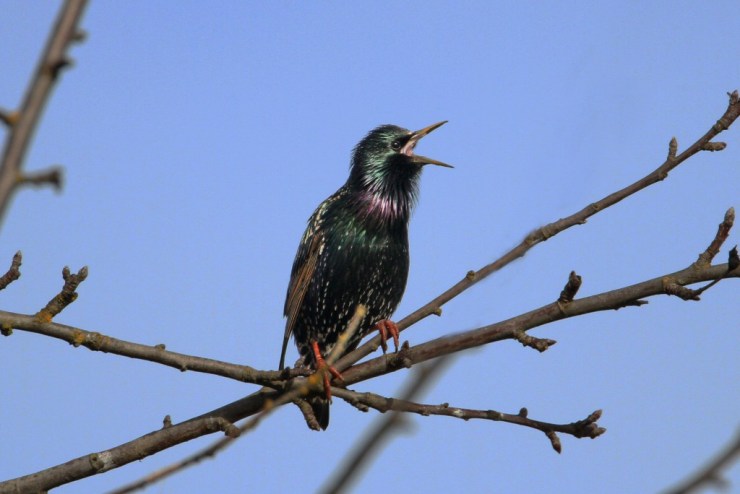
I am republishing this post because some readers asked me to tell them about Mozart’s pet starling, and the starling’s ability to mimic everything. In my garden, the phone would ring in the bushes when they wanted something. One of my neighbours had a little dog that would yap in a crescendo of barks that sounded almost like laughter. This amused the starlings and they would go on yapping in higher and higher shrills until the bemused dog stopped barking, not sure what was going on.
Example of the starlings’ talents (courtesy of Ankes World):
I hope you will find this factual story both interesting and entertaining. Moreover, the greatest effect on heart rate lowering has been observed from listening to Mozart’s music, in addition to lower blood pressure, and no stress, pain or anxiety. Students listening to Mozart’s music have also performed much better during exams.
“Sonata for 2 Pianos in D Major, K. 448: II. Andante” by Wolfgang Amadeus Mozart, performed by Martha Argeric and Gabriele Baldocci:
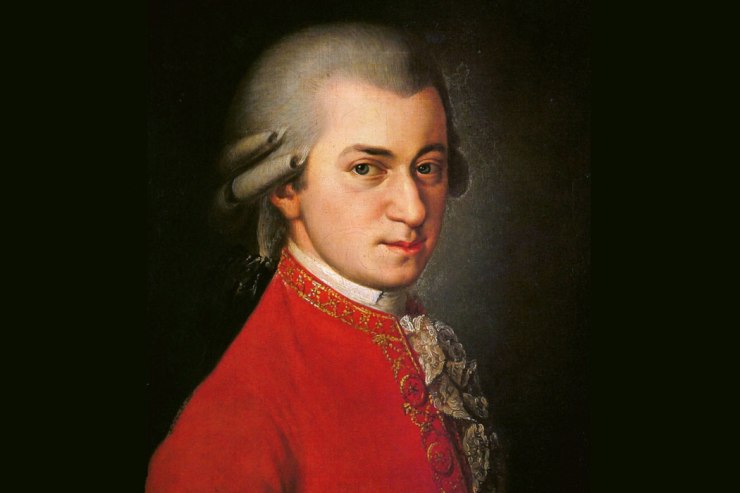
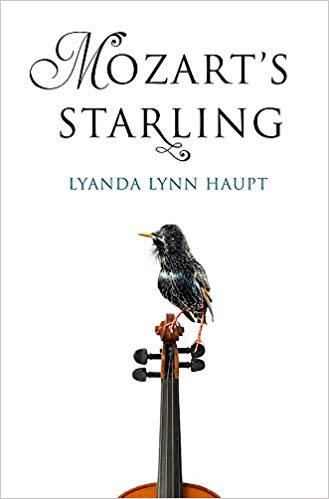
Sometimes a nature book is published that is destined to become a classic. I am convinced that Lyanda Lynn Haupt’s ‘Mozart’s Starling is such a book. On the book’s cover there is an apt description of the content: “In ‘Mozart’s Starling’, Haupt explores the unlikely and remarkable bond between one of history’s most cherished composers and one of Earth’s most common birds. A blend of natural history, biography, and memoir, ‘Mozart’s Starling’ is a tour de force that awakens a surprising new awareness of our place in the world.”
To understand Mozart’s friendship with the starling who inspired some of his music, the author brought up a tiny fledgling to become a member of her family. The grown-up starling, a girl called Carmen, proved to be an excellent and inspiring tutor. As the species are well-known for their great mimicry ability, I could only marvel at Mozart’s delight when his starling pet would whistle whole parts of his Piano Concerto no.17 in G major. He wrote in his pocket notebook his version of the tune and underneath also the starling’s version. His following comment on the starling’s interpretation was – Das war schon! That was wonderful!, writes Haupt.
The starling’s version is shown below and simulated in the audio clip underneath; click on the ‘Play’ arrow.
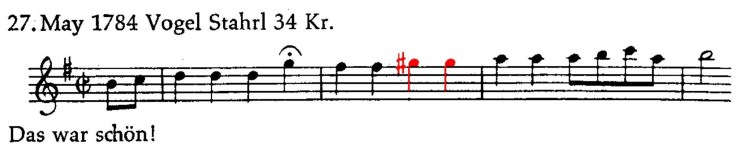
Mozart’s actual composition is shown below and played in the audio clip underneath; click on the ‘Play’ arrow.

Mozart’s favourite place for writing his music was in the open garden with his pet starling on his shoulder, both whistling the notes from his compositions.
Lang Lang explains and plays an excerpt from the Violin Concerto No 17 in G Major:
The inspiration for the book “Mozart’s Starling”:
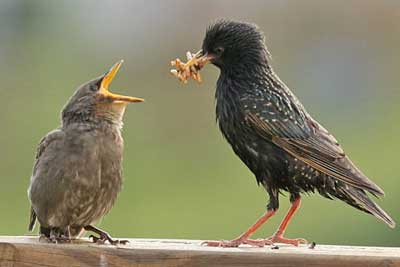
I can relate to this extraordinary tale as I have looked after a large group of starlings that descended on my garden for many years. As my garden companions, they never disappointed as they were amusing and entertaining. Their rendition of a neighbour’s yapping little dog would make me laugh as much as their attempts at faithful copying of my laborious typing efforts, including my start-stop breaks to correct mistakes. Of course, that was in the days when the typewriter was still my reluctant best friend. Today I am at the mercy of the computer whose logic often eludes me, but as my study is now in a different part of the house and away from the back garden, the starlings have to look elsewhere for their amusement.
Courtesy of Sarah Tidwell:

Several years ago, during the fledgling season, my garden was teeming as usual with birds of many species. The window in the kitchen was always open, and one morning I had a young visitor, a baby starling. His intelligence marked him out since despite such a young age and very little experience in the ways of the world outside his nest, he cleverly worked out that instead of sparring with other youngsters for food, he could dine in style on top of the tall fridge that stood close to the open window. And he was right, as on seeing him perched there, waiting, I had to run at the double, filling the large saucer with the best titbits. Placed on top of the fridge, the saucer was soon in need of refilling. For the next two and half months, the young starling would arrive each morning and feed all day long. It was obvious that we had this informal but fully binding understanding; it meant that I would serve good food and he would eat it. A very satisfying arrangement for both of us.
Courtesy of Sarah Tidwell:
What followed was even more wonderful. Each August, after the starlings were fully grown up, their flock departed for their annual ‘holiday’. My young friend left but not for long. The small group of youngsters, led by my protegé, came back and settled in my garden for good. The leader arrived first thing in the early morning to check that I was here, and the food was ready. Only then would he bring the rest of the group down. It looked that this routine would continue as long as I was alive, and I loved to see each spring the new babies being fed close to the kitchen, all trusting that this was their home. Unfortunately, I am not musically gifted, and I could only imagine the joy of both Mozart and his pet starling, whistling tunes to each other, and even ‘working’ together; the composer at his piano or playing a violin, and the starling on his shoulder, whistling approval or ‘corrections’ to the new composition.
What I find most exciting is the constant discovery of exciting and new facts in all nature books, and there are many. Some written by the naturalists, others by literary gifted academics like the palaeontologist Richard Fortey, whose iconic work ‘Life’ is so absorbing in fascinating details that I could not put it down. If it wasn’t for this book, I would not have known that the white sandy beaches of the South Seas are in fact fish poo as local parrotfish feed on algae and bits of coral, which they grind to a fine powder with their prominent teeth. The expelled ‘white dust’ is washed out by the sea’s waves and deposited on the shore to become, over time, layer upon layer of white sand, which we admire so much.


The book ‘Silent Spring’ by Rachel Carson helped to change global policy on using poisonous pesticides, highlighting their adverse effect on environment and our health. As knowledge is power, I will keep on reading as many books about the natural world as I can, and wonder how complex, innately diverse and fascinating is our world, and why we are so careless about its future.
“Song Of The Birds” (arr. Pablo Casals), performed by Sheku Kanneh-Mason:
And perhaps, we should first put right all the ecological disasters we have caused ourselves, before venturing to do the same on Mars?
“Duettino Sull’aria” from “The Marriage of Figaro” by Wolfgang Amadeus Mozart, performed by Edith Mathis and Gundula Janowitz (courtesy of slickerflicker):

Courtesy of Marco Valk Nature & Wildlife Films:

 naturetails
Thank you, Anita, for your lovely comment!
Joanna
LikeLiked by 1 person
Thank you, Anita, again, your thought is much appreciated.
Joanna
LikeLiked by 1 person
I love Mozart and the sound of the Starlings. A beautiful post, Joanna! Thanks for sharing the different videos too.
LikeLiked by 1 person
Thank you, Monica, for your wonderfully insightful comments! Mozart is my favorite composer whose divine music makes me happy!
Thank you again, Monica, for your thoughts and time!
Joanna
LikeLiked by 2 people
Hi Joanna. I don’t know why, but I don’t get your posts, and am subscribed too. I will have to make an effort to search for them more. 🙂
LikeLike
Thank you, Jeanne!
Joanna
LikeLiked by 1 person
You are very welcome. I find your blog very interesting. 🙂
LikeLike
Thank you, Jeanne!
LikeLike