
Courtesy of Jonathan Stanley:
“Indaco” by Ludovico Einaudi (courtesy of Elliott):
It is a well-established fact that the ability to speak using words arranged in rule-bound grammatical order is what distinguishes humans from other species. But apart from our vocal ability, we can also communicate competently through other means – facial expressions, body or sign language. Other species have no proven ability to communicate by anything similar to the human language with all its complexity – this is what we are told time and time again by learned researchers. Since only a relatively small percentage of the global human population is articulate enough to justify this statement, and as we have no universal understanding of other species’ methods of communication, we should continue our research without any preconceptions.
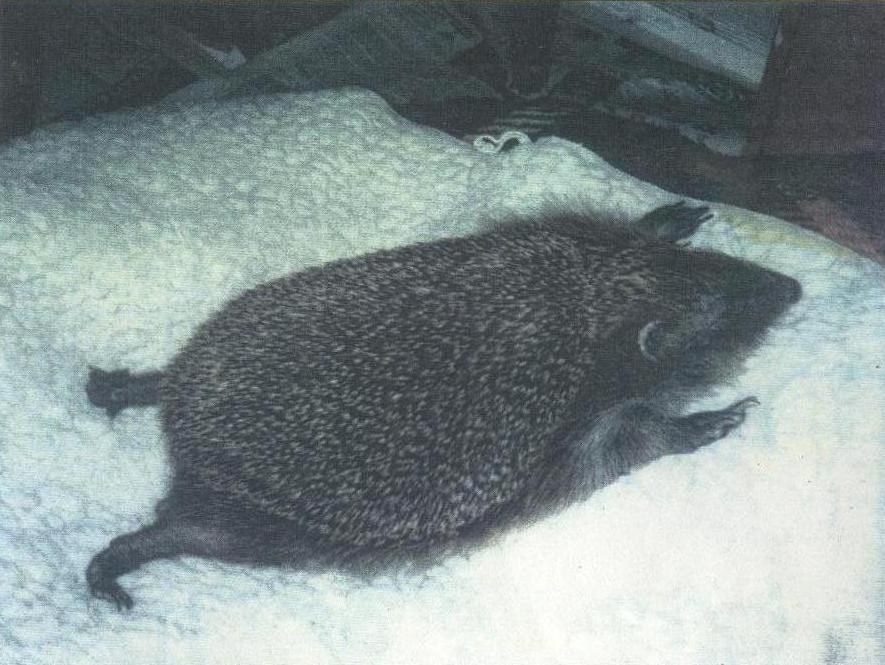
Even the first few weeks of Gaby’s stay with me were exceptionally enlightening as far as his ability to communicate with me was concerned. Continuously maintained eye contact clearly indicated his willingness to understand me and his own eagerness to be understood. In the same intense way that a human baby scans his mother’s face, he watched me all the time without a break and would hold on tightly to my thumb. Since he had the advantage of living in the closest possible proximity to me for the first three months of our life together, it wasn’t surprising that he could recognise my face, voice and scent but reacted in an agitated, and even hostile manner on seeing anyone else approaching.
The first sounds Gaby made were of distress during the clean-up operation after I found him ill and cold in my winter garden. These were a series of sobs and choking sounds repeated rapidly at different notes of the scale ooh, ooh, ooh, and his little voice went straight to my heart. The next few weeks were spent in a haze of furious activity to save Gaby’s life and he made one sound in direct response to my appeal to him to help me and fight. It was an unmistakable expression of assurance and affirmation – a soft clicking sound made by the tip of his tongue folding against the roof of his mouth. As it was made a split second after my passionate address and with our eyes still locked together, it could be safely taken as proof of Gaby’s ability to perceive the general meaning of my speech-sounds and his undertaking to do his best. Apart from the one clear sound, the only other expressions Gaby made during the first three months were sounds of distress and agitation when I had to put him for a few minutes (no more than five at a time) into his day bed. Separated from me, he would give a stream of high-pitched squeak-calls, huffs, sneezes and coughs. Their meaning was clear; he wanted to be back in my arms. As soon as I picked him up, the protests would cease as if cut with an imaginary knife.
 After three months spent on my chest, Gaby’s health improved so much that I began to slowly acclimatise him to accept short spells of time away from me and in his day bed; while for the first time in months I read my paper sitting directly opposite his bed, he would lie on his pillow, covered by a soft blanket. With his eyes firmly on my face, he made himself comfortable by stretching his nose forward and placing his hands by his face. I understood the correct routine of our arrangement very quickly when on the first morning I opened the paper only to be interrupted within seconds by Gaby’s agitated squeaks and scrambling movements. When I held the paper aside to look at him, he lay down appeased but as soon as my face disappeared behind the page, the same stream of agitated squeaks occurred. There was nothing for it but to sit holding the paper to the extreme left of my body. As long as he could fully see my face, Gaby would happily rest on his bed although his eyes remained watchful. As for my eyes, well, I am still surprised that I didn’t develop a squint.
It was at that time that Gaby started making his first language-like sounds. These were made by his tongue curling against the roof of his mouth in rapid succession. This started one evening when I picked him up after his supper to rock him to sleep. As usual, I had the pleasing sensation of fitting a missing part into a jigsaw puzzle. His nose instantly found the pulsating indentation of my throat while his hand took hold of my thumb and his body began to melt into mine in the way plaster bonds to a wall. As was customary, I spoke to him in my softest voice our usual words of endearment. Suddenly he began to “speak” in a quick succession of sounds. The length of the sounds varied and this made his “speech” almost sing-song like and with marked breaks (full stops) in between his “sentences”. It lasted for about three minutes and stopped as suddenly as it had started. His head raised above my shoulder would go back down on my chest and he would nuzzle against my throat as usual. Obviously, it was all that he wanted to tell me for the evening. The next morning the same thing happened and then again that evening. From that day we never looked back.
It is possible that Gaby become a “talker” after being stimulated in a somewhat unusual way – that is, through his nose having been placed on my larynx for three months. He learned the difference in length between simple syllables in the words I had been using. These were the same words arranged in the same simple sentences and spoken softly but in a slightly exaggerated manner. As we were now separated for about four hours each night, he seemed determined to “tell” me all about the time of my absence. Within days he started to copy the sound of my most repeated sentence – “I love you”. It took about two hours every evening to settle Gaby for the night and during each session, there would be plenty of opportunity to use these words. Judging by the intense concentration in Gaby’s eyes, I was sure that he was able to recognise this sentence and understood the words as an expression of my affection for him.
Mélodie (Dance of the Blessed Spirits) (Arr. Sgambati for Piano) by Christoph Willibald Gluck, performed by Nelson Freire:
One night, about five months after his arrival, as I was stroking him after his vocal rejoinder I told him over and over again how much I loved him. Instead of nuzzling up to my neck as usual, he made three sounds which were distinctively different in length and softness. The first sound was one short and single click. It was followed instantly by a prolonged sound made by the folded tip of his tongue and a split second later, another one that was a fraction shorter. He would say this “sentence” only once before setting down for the night.
Over the next year and a half, these three sounds became an integral part of our routine and were made in direct response to my statement “I love you”. Although I was quite amazed by his ability to mimic my speech in his own way, I had no doubt that he understood its meaning and I could see the connection. Since he had spent three months with his nose on my larynx, it was perfectly possible for him to learn the “technicalities” of human speech, that is the length of the words if not actual syllables, and to recognise the subtlety of my tone of voice. As I addressed him in the clear and even exaggerated manner in which one speaks to babies, he had no difficulty in hearing the difference between the sounds. Reproducing my speech in sounds differently made to humans didn’t matter; it was the meaning which was important and this he clearly understood. Although his choice of communication method didn’t include words, either English or otherwise, it still worked perfectly well and was no more strange than the use of sign language by those with impaired hearing or those who for medical reasons have used a computer screen as their means of communication. Nowadays, many travel books include a list of gestures common to all people but having dramatically different meanings in various countries. Bearing all these facts firmly in my mind made the understanding of the language used by Gaby easier and much more adaptable. Apart from the clicking sounds of varied length which he used and developed further as the months and years passed, in the same way that a young child progressed in his speaking ability, Gaby also used other means of expression, most of which were also common in human communication.
As soon as Gaby began an independent existence by sleeping in his own bedroom and in the morning inspecting the rest of the house, we established a simple practice. If I couldn’t see him at once, I would call his name and he would answer back, thus enabling me to locate him easily. What was interesting here was that I didn’t need to teach him this procedure the way we teach a dog or cat their names. He started it himself by calling me with a loud, commanding click of his tongue when he could hear my footsteps nearby. It was quite similar to the way we snap our fingers to attract someone’s attention. His initiative was greatly appreciated, especially when he was buried deep in his bed or hidden in some dark corner under a chest, and the loud signal helped me to locate him instantly.
This arrangement very quickly progressed to my calling Gaby’s name first (if I got the chance!), and then listening for the loud click. It came without fail every single time. There was also an unexpected development here. There were daily instances when I had to do something in the other rooms first, say, deliver fresh towels to the bathroom or a bed change to the bedroom before I would answer his call. This was frowned upon and after the first click, Gaby would call me again in a fractionally louder voice. If I didn’t drop everything and run to see him immediately, his voice would acquire the commanding tone of an Admiral of the Fleet and there was nothing for it but to join him, apologising profusely for my delay. Our communication underwent a further modification about two years after we started conversing when one day Gaby decided to give his tongue a rest and began to use his nose as a means of communication.
The customary click became infrequent and now I found myself being trained to respond to a sneeze. This wasn’t any old snotty sneeze, mind you, but a commanding, short and sharp one, and if I didn’t respond to it fast enough, the next one would be a decibel or two louder. And that was just the beginning. Gaby’s nose section ( as in a trombone section) was unrivaled in the richness of sound and complexity. There was the dry, commanding sneeze which I have just described above, and it meant: “I don’t like it. I won’t have it.” And an audible intake of breath through the nostrils followed by a clearing of the throat, in the same way as we do when trying to interrupt or draw someone’s attention, was used by Gaby for exactly the same purpose. There is nothing unusual in using a ‘dry’ sneeze as a means of communication among animals. African wild dogs, for example, who live and hunt as a pack, are known to use this method. Every morning each member of the group would give a sharp sneeze as confirmation that it is time to go hunting.
A sneezing hedgehog! (courtesy of Beth Chudley):
Villagers in a remote Greek mountain village Antia on the island of Evia, on the slopes of Mount Ochi, communicate by a variety of whistles. The whistles each have a distinct meaning and the villagers learn this language from early childhood. It is useful when you live on a mountain and you have to communicate over long distances. I am sure that Gaby’s sneezes were as communicative as those whistles.
Courtesy of Scientific American:
It was at this time that Gaby had to have one tooth removed on our vet’s recommendation. The whole day was tedious as our routine was completely altered. The 14 mile journey to the surgery, the new faces there, the unfamiliar scent of disinfectant and medicine, the examination – all upset him. He then had to have general anaesthetic before the tooth at the back of his mouth could be extracted. After the operation, we travelled back in silence as Gaby was groggy and, I thought, quite uncomfortable. It took about an hour to get back to the house and I took Gaby to his bedroom. As I opened the door, he suddenly started his “speech”, and the sounds tumbled out, agitated and loud, almost hysterical in intonation and punctuated by short, furious barks, identical to the barking of a small dog. It was obvious that he had recovered sufficiently to be able to complain loudly about the treatment behind the closed door of the the operating room where I wasn’t allowed in. That night I spent comforting Gaby in the way I would comfort a small child.
Another cute little fellow visits the vet (courtesy of BBC):
Piano Concerto No. 27 in B-Flat Major, K. 595: II. Larghetto by Wolfgang Amadeus Mozart, performed by Angela Hewitt and Orchestra da Camera di Mantova:

 naturetails
❤️✨✨✨❤️
LikeLike
The things one can see when one is paying attention?
LikeLike
Thank you foe another chapter in Gaby’s life! What an extraordinary creature but I believe there is a great deal we could learn from most other species if we would only take the time. I have read books of all sorts of unlikely encounters but I had never read about a hedgehog before, so thank you!
LikeLiked by 1 person
Thank you, Carolyn, for your wonderfully thoughtful comments! I wholly agree with you! I hope that my true story about Gaby’s life will be liked by many when it is published.
Joanna x
LikeLike
nice share
LikeLike
Thank you, Obaid, for your kind comment! Much appreciated!
Joanna
LikeLike
Thank you for your kind comment, much appreciated!
Joanna
LikeLike
Thank you for you lovely comment, much appreciated!
Joanna
LikeLiked by 1 person
He had you trained and you were probably a very good and interested student.
LikeLike
I think we both recognized that we have an unusual but much-cherished friendship!
Thank you, Pat, for your thoughtful comments! Much appreciated!
Joanna
LikeLike
So delightful, and informative Joanna. Thank you so much for sharing this with us.
LikeLike
Thank you, Peter, for your wonderful comments! Greatly appreciated!
Joanna
LikeLiked by 1 person
No argument from me. Good friendships are wonderful.
LikeLike
Very interesting interactions and communication Joanna. Gaby looks to be seriously intelligent and affectionate. Thanks for telling the tale. Allan
LikeLiked by 1 person
So sweet and poor Gaby who had to have a tooth taken out.
LikeLike
I’ll never look at a hedgehog the same way again Joanna. Mind you, not every hedgehog has a friend like you, and that may well be the reason for his extraordinary peronality. I now have to ask you to send on my regards to Gaby as well as Felicity 🦔😺
LikeLike
Thank you, Malc, for your wonderful comments! As I said the behavior of animals living with us resembles our own. This is why we should not blame the dogs if they are aggressive but their owners. Thank you for your regards to Felicity but dear Gaby is no longer here. More about will follow.
Thank you again, Malc, your words are deeply appreciated!
Joanna
LikeLiked by 1 person
This is a wonderful post, Joanna. Your friendship with Gaby was unique in many ways. I’m glad you included every minute detail about this adorable relationship. He grew fond of your face, voice, and touch. You poured your heart into caring for him and treated him like your own child, which made him feel possessive, sometimes leading to a commanding tone.
It’s incredible, Joanna, how you took it upon yourself to save his life, made him comfortable in every possible way, and most importantly, turned him into a ‘talker.’ He learned to understand and communicate the three most precious words – ‘I love you.’ His use of his nose and tongue to communicate is phenomenal.
His calls to be back in your arms, just like a human baby wanting to be lifted in lap, made me smile. I also enjoyed your humorous comment about being surprised you didn’t develop a squint.
Thank you so much for putting in lots of efforts in creating yet another interesting and heartwarming post.
LikeLiked by 1 person
Oh dear! I won’t ask more questions. I’ll wait for the next instalment
LikeLike
Thank you, Kaushal, for your beautiful comments! Your words touched my heart, thank you! You are right that having such a unique friendship with a wild animal has to be understood as one in a lifetime and cherished. There is a little more to come, and it will astonish you as it is something that has not happened anywhere in the world.
Joanna
LikeLiked by 1 person
Thank you!
Joanna
LikeLiked by 1 person
Thank you, Allan, for your beautiful comment! And you are more than welcome!
Joanna
LikeLiked by 1 person
Thank you for your thoughtful comments! Much appreciated!
Joanna
LikeLiked by 1 person
Had you ever previously had a similar relationship with any other kind of animal?
LikeLike
I have rescued many animals in need such as dogs, cats, birds, and even frogs but my friendship with Gaby was unique in many ways!
Joanna
LikeLike
What an amazing and heart-warming story and experience. I never would have dreamed this!
LikeLike
Thank you, Dorothy, for your lovely comments! There is more to follow!
Joanna
LikeLiked by 1 person
Story of bonding between two living entities! Great, Joanna!
LikeLike
Thank you for sharing this further chapter on Gaby’s life, which, I confess, I was waiting for.
I found all the content in this post simply wonderful.
Gaby seems like an amazing creature
Thanks also for the digression about the inhabitants of that Greek village who communicate via a wide variety of whistles.
I always learn fascinating things from your wonderful articles
LikeLiked by 1 person
Thank you, Indira, for your wonderful and thoughtful comment! Your words focused on bonding, and that was indeed unique, thank you!
Joanna
LikeLiked by 1 person
Thank you, dear Luisa, for your wonderful comments! I do my best to justify the need of time to read my post, at least it has to be interesting!
Joanna x
LikeLiked by 1 person
… and your posts are always so interesting and fascinating, whatever you’re talking about
It’s clear that you put all your passion, your commitment, your erudition and your research into your wonderful articles!
LikeLike
Oh, thank you so much, dear Luisa!
Joanna x
LikeLiked by 1 person
🙏💝🙏
LikeLike
I’ll be waiting!
LikeLike
Thank you, Dorothy!
Joanna
LikeLiked by 1 person
You’re always welcome, Joanna! Looking forward to more details about Gaby and his activities.
LikeLike
Thank you!
Joanna
LikeLiked by 1 person
This is such a heartwarming story of Gaby. You’re right Joanna, communication isn’t just about words. African wild dogs using sneezes to signal hunting is a cool fact too. It makes me wonder what other animals have their own communication methods we don’t even know about.
LikeLike
Thank you, Ritish, for your wonderfully thoughtful comments! We know that all animals communicate in various forms; bees tell others where they saw plenty of flowers, and even worms exchange ideas, as Darwin discovered during his life’s last five years devoted to studying the most important (his words!) species in the world. I hope that you read the first post about Gaby, and you certainly should read next week’s revelations about Gaby’s life being saved by the method usually reserved for humans, and never used to treat hedgehogs.
Joanna
LikeLiked by 1 person
You’re welcome, Joanna! Fascinating stuff, right? Yes definitely I’m gonna check those out too.
LikeLike
Thank you!
Joanna
LikeLiked by 1 person
Another great article! Thank you, Joanna! ❤️
LikeLike
Thank you, Filipa, for your lovely comment! Much appreciated!
Joanna
LikeLiked by 1 person
Fascinating and touching and endearing account of your relationship, Joanna. We now know the reason for the first part of your pen name, hope you will enlighten us about the ‘chops’ part soon.
I love the range of sounds made by Gaby, wish I could hear them. I don’t suppose you have recordings of them? Of late I’ve been reading a lot about elephants. The Elephant Whisperer by Lawrence Anthony is a wonderful book about a man and a herd of elephants. I found out that elephants communicate through stomach rumbles. Recent research shows that they have unique names for each other, too. Animals do communicate in so many different ways, if we could only learn to hear them we would all be Doctor Dolittles!
LikeLike
Thank you, Harini, for your wonderfully thoughtful comments! I don’t have recordings of Gaby’s voice as it was before I had access to the necessary equipment. I know the book you mentioned, and after Laurence quite suddenly died, his wife published the incredible happening in her book, The Elephants In My Kitchen. On the day Lawrence died, the herd of elephants he saved, came from their faraway pastures and stood by the gates of his compound seemingly paying respect. How did they know that he died? She wrote that when his heart stopped biting, something stirred in theirs, and they knew that one of their own passed away. Since then, every year on the anniversary of his death, the herd stands outside the gates paying respect to the memory of their friend. His wife cannot offer any explanation and writes that some things are unexplained now, and might be never understood.
The term” chops” is one of endearment in English, like “Honey”, or “little cabbage” in French. I agree, it is not appropriate as I am a vegetarian, but the man helping me to set up my nature blog in Gaby’s memory suggested it, and I am now stuck with it!
Thank you again, Harini!
Joanna x
LikeLiked by 1 person
Yes, Joanna – the first chapter of Francoise Malby Anthony’s book was included at the end of The Elephant Whisperer. It sounds fascinating and is on my to-read list. And thank you so much for clearing up the mystery of your nom de blog!
LikeLike
You are more than welcome, Harini!
Joanna
LikeLiked by 1 person
Joanna ,that was another absorbing & amazing account of your unique relationship with Gaby !It showcases that humanity has no boundaries & apart from being humanbeings between ourselves, we can also have the compassion to treat animals with due kindness & care!Finally they too are living beings sharing this wonderful planet with us & deserve more from us on that account!I am truly grateful to you for shedding light on such compassionate aspect of relationship💕 Thanks for sharing ,Joanna !Namaste!
LikeLike
Thank you, Dhirendra, for your wonderful comments! I could not agree more with you about the need to respect and treat well the animals! They share our planet, and we know they were here first, well before us!
Thank you again, Dhirendra, your thoughts are greatly appreciated!
Joanna
PS. I will catch up with your post soon!
Namaste!
LikeLiked by 1 person