The Spiny Desert of Madagascar
Courtesy of BBC:
The Spiny Desert of the island’s deep south-west is one of the most remarkable. The landscape lies flat in a rain shadow and it only receives an average annual rainfall of between 300 and 500 millimetres per annum. The rain mostly falls during December and January, often in the form of violent thunderstorms, but it is notoriously unreliable, and some years may see hardly any precipitation here at all. The thin, porous soils have little water retention capacity, and so plants and wildlife must be capable of withstanding long periods of drought, as well as high temperatures in excess of 40 Celsius degrees. Such demanding conditions have produced a specialised flora and fauna, much of which is highly localised, and under increasing pressure from a range of threats. The protection of these remarkable semi-desert habitats and their wildlife is now a major conservation priority.

The monumental baobab trees are icons of Madagascar, yet sadly they may well prove to be the last of their kind, as land-use changes around them are preventing the germination of an adequate successful generation of young trees.
Other characteristics of the Spiny Desert are Octopus trees, their wavy limbs rising above the smaller shrubs that help make this habitat one of the most important of all of Madagascar.
Courtesy of San Diego Zoo Kids:
Although, reluctantly I have to mention one other creature that lives in the Spiny Desert. It is the Dumeril’s Ground Boa which despite its name is at home up in trees as on the ground and feeds on anything that moves, birds and small mammals. It’s mainly nocturnal, resting up during the day in leaf litter on the ground, in burrows or in holes in trees. Like all pythons, it constricts its prey before swallowing it whole. I think you will be glad that I am sparing you from looking at this creature. I am still waiting for the universe to answer my question: apart from causing nightmares, what are snakes for?
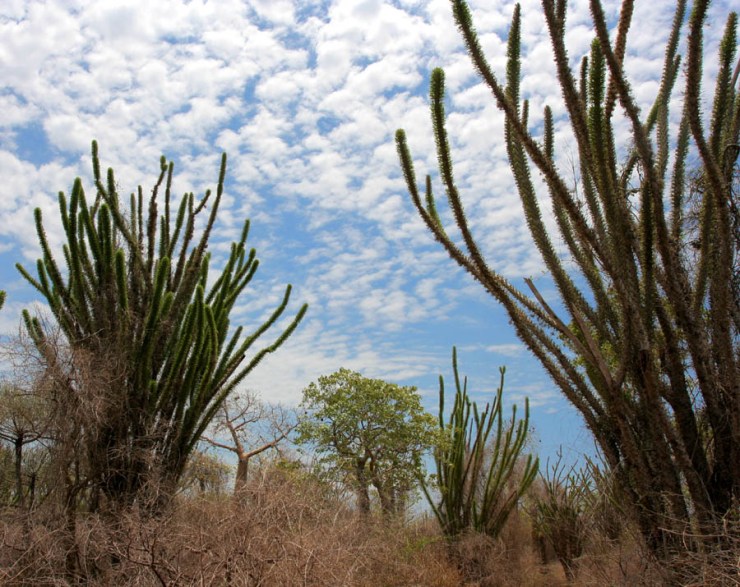
The precise composition of the vegetation of the Spiny Desert varies widely from one locality to another; it is composed generally of succulents, notably thorny, cactus-like plants. The result is a unique, in parts, type of dry, deciduous woodland dominated by thorny species, which gives the habitat its other name the Spiny Forest.
One of the survival techniques is enhanced water storage capacity in the pulpy tissue within large trunks and branches, as well as tubers, and extended root systems that help extract what little moisture there is in the soil. Other features are small needle-like leaves and waxy or hairy coating typical of plants that are adapted to life in arid zones.

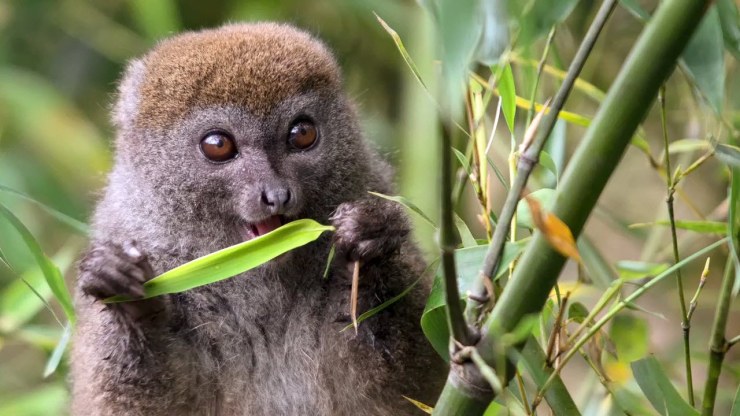
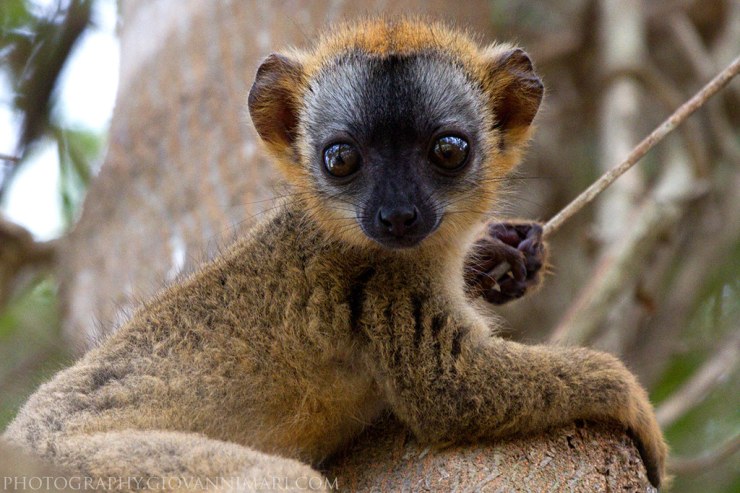
Madagascar is renowned for its lemurs, a unique group of primates that are endemic to the island. During their long history of isolation, lemurs have developed an impressive variety of adaptations, their evolution reflecting the diversity of ecological opportunities of Madagascar. The two most regularly seen lemur species are the Ring-tailed Lemur and Sifaka. Both are essentially diurnal, and often to be seen scrambling and jumping about in thickets of razor-sharp foliage, their soft, velvety hands coping with barbs and spines without any difficulty. They are equally impressive on the ground. Ring-tailed Lemurs are the most terrestrial of all lemurs, spending much of their time on the ground foraging for food and are capable of living in areas that are largely devoid of trees. Ring-tailed Lemurs are highly dextrous and seemingly impervious to the vicious thorns that are characteristic of Spiny Desert trees and plants. They live in a range of different habitats, from thick forest to rocky landscapes. This versatility has helped them to survive as Madagascar’s landscapes changed around them.
Courtesy of BBC Earth:
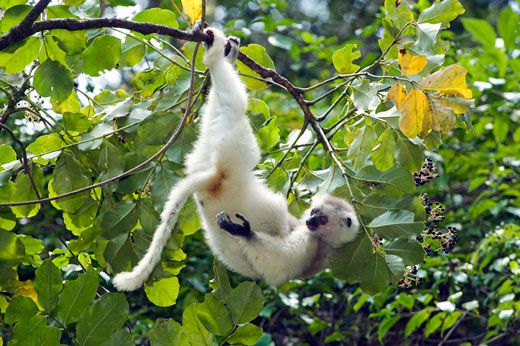
Sifakas mainly prefer to live among the tree canopies but when they do come down they have a distinct and engaging form of locomotion – to cover open ground they leap sideways in a series of extended jumps, holding their arms outstretched as a way of keeping balance. Sifakas usually rest during the hottest part of the day, foraging for food in the early morning and late afternoon. They feed primarily on leaves, moving acrobatically through the branches and using their long tails as balance when leaping from tree to tree or hanging upside down.

Both Sifakas and Ring-tailed Lemurs live in family groups, Sifakas in a small group of twelve, while Ring-tailed Lemurs can be seen in troops of up to twenty. Both societies are female-dominated, but with males having the responsibility to protect the family from predators. Among these are the Fossa, a civet-like creature and the lemur’s main predator. Endemic to Madagascar, the Fossa is the island’s largest carnivore and with a tail as long as the rest of the body, it can reach a total length of two metres. It can climb trees with ease and move on the ground at a good speed.
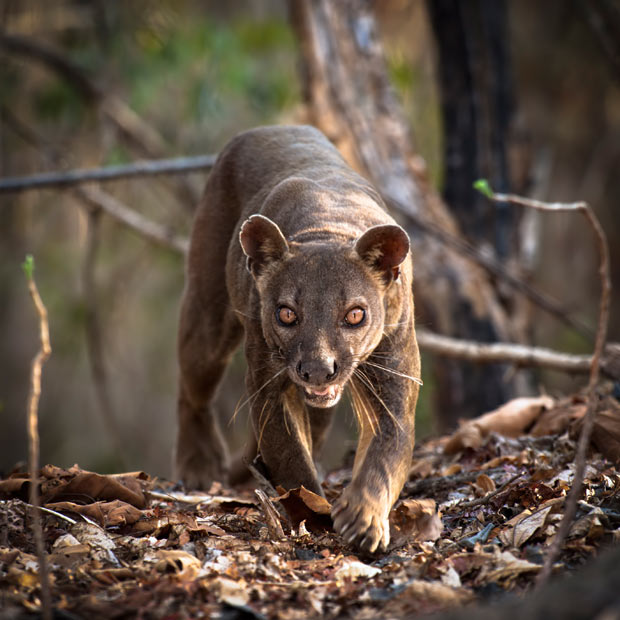
Fossas are among the most elusive and difficult to see of Madagascar’s mammals. One of the best opportunities is a chance encounter upon one of their ‘mating trees’. Their coupling ritual is extraordinary. A single female Fossa will position herself high in the tree canopy, attracting five or six male animals below. She will mate with some or all gathered, each of which will climb the tree to reach her and will then mate with her in a session lasting two or more hours. A female may occupy the mating tree for three or four days and then move on, some time to be replaced by another female and the process starts again. This usually takes place between September and November, with a female giving birth to two or four young three months later.

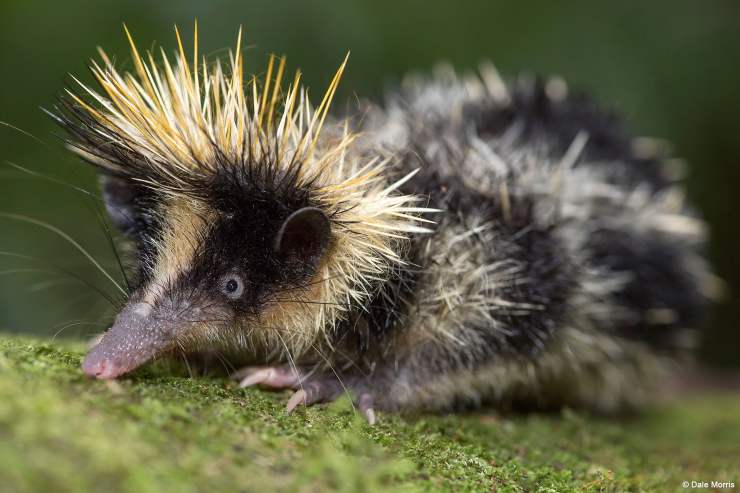
The other mammal living on Madagascar is related to moles and shrews: the nocturnal Lesser Hedgehog. They feed on insects and while usually foraging on the ground, they can climb trees and will scale quite large trees in search of insects. During the dry season, it becomes dormant and will emerge from its den only when it can be confident of finding enough food. Although still relatively common it is prized by the local people as a source of food and is under pressure from excessive hunting.
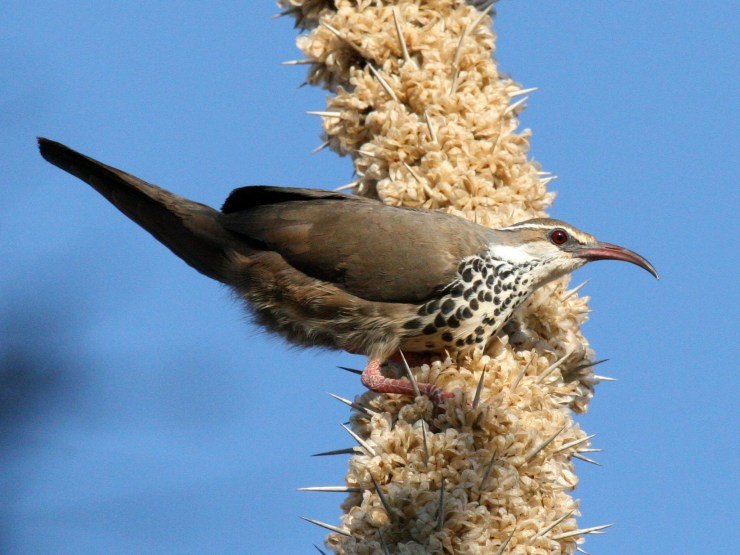
Below is shown the Sickle-billed Vanga

The majority of the 300 bird species in Madagascar are endemic. Many have adapted specially to local conditions such as the Sickle-billed Vanga. It uses its exaggerated curved beak to probe into crevices and under bark in search of insects. Some of the birds living in the Spiny Desert are very rare and vulnerable to disturbance and changes in their environment. Tracks on the desert sand are an important indicator of what wildlife is using a particular area. This is important for ground-dwelling birds such as two of the blue riband species here, the Long-tailed Ground Roller and Subdesert Mesite. They are found on a narrow coastal strip. The Long-tailed Ground Roller is highly territorial and nests in sandy banks, excavating a tunnel with a chamber at the end in which a female will lay her eggs. The Subdesert Mesite has a restricted range. It is known only in a few locations, where it forages for insects among the soil and leaf litter and builds its platform nest in thick shrubs up to 2 metres above the ground. Other notable Spiny Desert species include Lafresnaye’s Vanga and Madagascar Plover.
Below is shown the Long-tailed Ground Roller

Above is shown the Subdesert Mesite
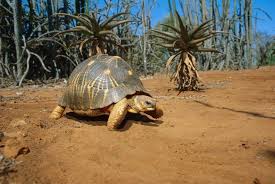
One of the most attractive species of the Spiny Desert is the Radiated Tortoise, which is endemic to the island. Historically it used to be safe from the local population because of the traditional beliefs that harming or killing them is a taboo and it will bring bad luck. In recent years these beliefs have broken down and taking the wildlife to a cooking pot becomes a necessity for many locals without means of support. Equally, the financial incentives offered by unscrupulous collectors of wildlife are hard for local people to resist.
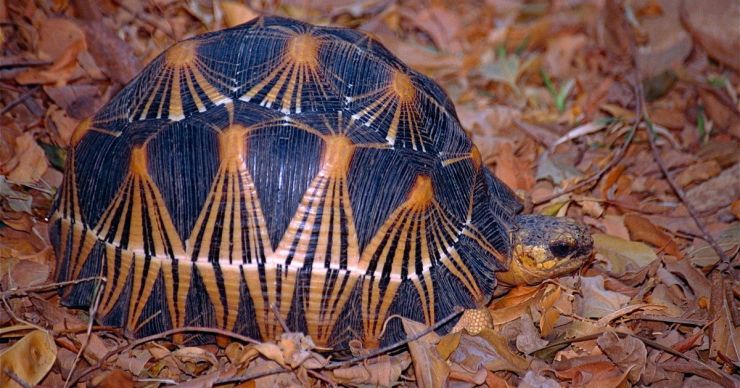
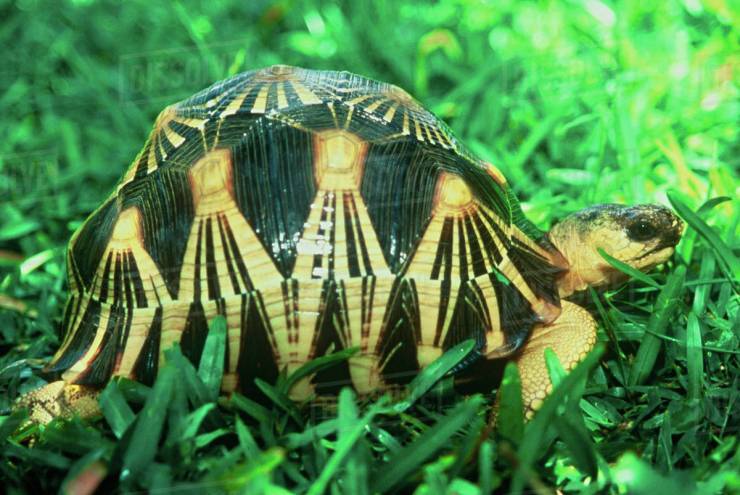
The illegal pet trade has helped put the Radiated Tortoise on the Critically Endangered list. Many areas have been stripped of all their tortoises, with armed bands of poachers moving in on a few surviving populations. Without action to stop them this species could become extinct within a short time. Meanwhile, human pressure on the Spiny Desert continues to intensify. The felling of trees for charcoal production is a major source of forest destruction and agriculture expansion. Deforestation to plant maize and provide new areas of pasture for cattle is having a serious effect on the quality and extent of wildlife habitat. Of paramount concern is the fact that despite the existence of some national parks, the vast majority of the Spiny Desert has very little statutory or practical protection. Quite recently a more than one-hundred-year-old giant tortoise of the Galapagos died. He was the last one. And do you remember the Dodo?

The wildlife of Madagascar doesn’t belong to the island only; it is the world’s heritage.

This beautiful bird is a Flufftail. Have we got enough time to save it?
Courtesy of James Wolfe:


Wow, what a collection of fascinating animals. And I agree with you. I am not a big fan of snakes. Thanks for an interesting read.
LikeLike
Thank you, Diana, for your lovely comments! Glad that you feel the same about the snakes! I realise that readers from the countries where snakes are worshiped will not agree!
Joanna
LikeLiked by 1 person
So amazing the beauty and the diversity of this fauna..I love the bird colors best and some very adorable mammals too:)
LikeLiked by 1 person
Thank you, Karima, for your lovely comments! Nothing can be better or more beautiful than the photos of animals! There will be more post about the wildlife to follow, I hope you will find them interesting too!
Joanna
LikeLiked by 1 person
Sorry to hear the baobabs in Madagascar are having trouble. Maybe the best known baobabs for many people are the ones in The Little Prince.
LikeLiked by 1 person
Hank you, Steve, for your erudite comments! I do hope that they can be saved!
Joanna
LikeLike
Fabulous article. Madagascar is immense in size and is endlessly fascinating. I am sorry to learn that baobob trees are under threat. And I’m with you on snakes. I do not like them at all.
LikeLike
Thank you, Neil, for your wonderful comments! You are the second person who feels the same about snakes, and it makes me feel good. It is terrible shame about the trees and I can only hope that it will be possible to save them.
I love that Madagascar is home to such a beautiful and unique wildlife.
Thank you again, Neil!
Joanna
LikeLiked by 1 person
Fascinating and masterful overview of these unique and wonderful survivors. Love this series of desert dwellers.
LikeLiked by 1 person
Thank you, Pat, for your wonderful comments! That is the reason I am writing about them; somehow it reminds me about the moon, my beloved celestial creation, as with a naked eye ( I have a perfect vision!), I can see the craters, valleys and a desert landscape in my mind.
Thank you again, Pat!
Joanna
LikeLiked by 1 person
You’re very welcome, Joanna. Keep up the good work.
LikeLike
Thank you, Pat, I will!
Joanna
LikeLiked by 1 person
Oh wow Joanna, these are truly some fascinating animals in Madagascar. It’s saddens me to learn that the monumental and majestic baobab trees may become extinct. 😥 You know, I was unaware of the fossas’ existence. Madagascar is truly a sight to behold. Of course I simply love those adorable lemurs!
Our respect and appreciation must be upheld when we are observing or dwelling with these inhabitants of these fascinating places to learn about and explore. Thanks so much for sharing your report of Madagascar my friend. Great job! 🥰👍🏼🤩💖🙏🏼
LikeLike
A naturalist’s paradise! They have the most extraordinary and beautiful collection of wildlife. I almost went there once but it became too complicated. I only had two weeks leave and it would be frustrating to have such a small sampling! Now you have taken all the complications out of it and brought it to me for which I thank you! This may be my favourite of the deserts. Maybe because the animals are such fun! I once got to hand feed some ring-tailed lemurs which was wonderful. I had never seen a picture of those tortoises. They are exquisite. So too the baobab trees and well, everything! Are those flying foxes in the film at the end? Thank you Joanna. You give me smiles.
LikeLiked by 1 person
Thank you, Carolyn, for such a wonderful comments! I love every word you have written, and it is my turn to thank you!
You made my day! Yes, you are right, the wildlife on Madagascar is special and fun. Shame about Dodo! I do hope that everyone and everything can be saved!
Thank you again, Carolyn!
Joanna
LikeLike
I look forward to them Joanna:) Thank you!
LikeLike
I must confess Joanna that I never realised that Madagascar had any desert areas. I’ve always imagined it with lush vegetation and diverse wildlife endemic to the island. It’s no wonder that lemurs are so acrobatic having to negotiate all that thorny vegetation.
I’m with you as regards the question “what are snakes for?”, but that question doesn’t arise where the Radiated Tortoise is concerned. What a handsome creature and such a shame that it’s being hunted for the pet trade. I had a tortoise as a pet when growing up but wouldn’t dream of having one now, nor any other exotic species for that matter. Importing rare and exotic species is one of my ‘pet’ hates and really wish it was banned completely.
The birdlife looks fantastic, especially that Flufftail, but why would anybody want to eat a hedgehog is my question of the day.
Madagascar was an unexpected destination in this series Joanna, but another eye-opener. Your knowledge of this subject is nothing short of amazing and brought to us in your most inimitable way. Thank you for enlightening us once again.
LikeLike
Thank you, Malc, for such wonderful comments! You are the third person not to love snakes, and I am glad! Perhaps, an exception would be the blind tiny snakes that are kept as pets by certain clever owl. She use them to keep her nest clean of bugs which they feed on. As they are blind, they don’t realise who is their master!
As this blog was created inspired by my unique friendship with a wild hedgehog, Gaby, whose life I saved, I could hardly type the words about eating them!
Every time I researched the wildlife of the deserts, I was astonished by the beauty and diversity of all of them. As I haven’t finished yet be prepared to be amazed too, Malc!
Thank you again, Malc, for your time and kind words, all deeply appreciated!
Joanna
LikeLiked by 2 people
Thank you!
Joanna
LikeLike
You’re welcome Joanna, and I’m looking forward to the next instalment
LikeLike
Thank you!
Joanna
LikeLiked by 1 person
Thank you, Joanna, for shedding light on Madagascar’s desert side. I knew it as a large island, also known as the Red or Rainbow Island, with dolomite, limestone, ilmenite, graphite, silica, mica etc.
Despite sparse rainfall, the spiny desert in Madagascar surprises with diverse flora and fauna, boasting an impressive 300 bird species. Nature’s adaptability is evident as plants compensate for low soil water retention with enhanced water storage. While octopus trees are fascinating, it’s disheartening to learn about the potential end of Baobab trees.
Lemurs are intriguing primates, resembling our langur or black-mouth monkeys. Despite the ferocious appearance of Fossa, their mating behavior is quite interesting. Vanga, Mesite, and Ground Roller showcase stunning beauty, with the Radiated Tortoise standing out as the most captivating. Unfortunately, beauty holds no meaning for poachers, be it the Radiated Tortoise or Hedgehog. Regarding your question, I think snakes are ecosystem engineers, and are used in magic potions and medicines.
As you rightly noted, many species are inevitably headed towards extinction sooner or later, like the Dodos of Mauritius, located east of Madagascar. With 95% of Madagascar’s species being endemic, the looming threats of deforestation and hunting pose a genuine risk to their existence like the Dodos.
Thanks for sharing another fascinating post about deserts, complete with amazing pictures and videos. Your research and efforts are appreciated. Thanks once more for everything.
LikeLiked by 1 person
Thank you, Kaushal, for your analytical comments! I love your additional snippets of knowledge, all very interesting!
I understand that snakes are revered in same countries, and therefore of importance. Thank you for your kind words of appreciation, Kaushal, and I will continue to publish more interesting facts about other deserts and their wildlife.
Joanna
LikeLiked by 1 person
Another amazing desert that holds so much life! We humans have so much to learn from these wonderful arid places! Thank you, Joanna, for sharing your research here! 🤗💌🌹💐🙋♂️
LikeLiked by 1 person
Thank you, Ashley, for your kind comments! Writing about nature is always the great pleasure, and I will work as long as I have readers willing to read.
Thank you again, Ashley, your time and comments are greatly appreciated!
Joanna
LikeLiked by 2 people
Snakes are reverred in India too. We offer them milk on Nag Panchami day, as they represent eternity, divinity and renewal.
You’re welcome, Joanna!
LikeLike
What a fascinating group of creatures and habitats Joanna. Thank you once again.
LikeLike
Joanna, such beautiful animals and those tortoise shells! A great post on this desert!!
LikeLike
Thank you so much for your kind comments, greatly appreciated!
Joanna
LikeLiked by 1 person
Yet another fascinating tale from the desert that ended hitting hard on the human pane. ‘Madagascar’ the name brings varied memories Joanna. Not that I have been there, but stories, movies- the happy, exotic and colourful ones have been a part for a long time.
And How strange is it to realise that we are at that curve in Earth’s lifetime that most things that we hear of now, either are endangered or already extinct. I, myself had a pet named Toto, a star tortoise that came in my life for a little while, i think thats the only one i could ever call a pet other than a cat who lived on the school’s roof garden for a couple of years.
As Kaushal ji remarked, Snakes are revered here and form a part of an extended rural and spiritual Indian Identity.
I like all have loved this series on Deserts Jonna, its like you doing your bit, your service to the animals of the world, along with Gaby who resides because of you, in our hearts too. Thank you, dear Joanna.
LikeLike
Thank you, Narayan, for your eloquently wonderful comments!
It is very satisfactory to read that my work is interesting, and even illuminating in a small way to my readers.
I think, there is now a worldwide determination among likeminded people to protect, and preserve everything in nature possible.
I must thank you, Narayan, especially for your beautiful words about Gaby being in my readers’ hearts too!
Of course, I know that snakes are revered in India, and I remember the highly imaginative story which you have written some time ago where snakes had a dramatic part.
Thank you again, Narayan, for your time and comments, all greatly appreciated!
Joanna
LikeLiked by 1 person
You are most welcome, Joanna.
LikeLike
Thank you!
Joanna
LikeLike
Such wonderful animals in this desert habitat, Joanna, and I’m not a fan of snakes either. 🙂 But the various species of birds are interesting, the colors are beautiful, and the Flufftail is cute. Thank you for sharing this beauty and information with us. ❤️
LikeLike
Thank you so much, Lauren, for your lovely comments!
The wildlife of all deserts is quite stunning!
As to snakes, I know that they are revere in some countries, such as India, and of course I respect the religious and cultural observances.
Thank you again, Lauren, for your kind words and your time, all greatly appreciated!
Joanna xx
LikeLiked by 1 person
You’re so welcome, Joanna, and of course, I respect other religious and cultural observances too. Without our differences, this world would be quite colorless. Thank you again for the time it takes you to compile the information for all of your fabulous posts. 🩷
LikeLike
Thank you, Lauren, you are very kind!
Joanna xx
LikeLiked by 1 person
Thanks for sharing these wild animals in Madagascar. I love all of these photos. Anita
LikeLike
Thank you, Anita, for your lovely comments, all greatly appreciated!
Joanna
LikeLiked by 1 person
Amazing photos dear Joanna. I need a tropical vacation. Maybe a year in Costa Rica to finish my last book.
LikeLike
Joanna, thank you for taking me back through time for a most pleasant memory of my grandfather. I first heard of Baobab trees when my Papa would read Rudyard Kipling tails to my siblings and I as we gathered round him in his library. My grandfather (who was a contemporary of Kipling) grew up in Brattleboro, VT which was only 15 minutes from Kipling’s historic home, Naulakha, in Dummerston. I suspect this familiarity was part of what made him a favorite author.
This tail began, “IN the High and Far-Off Times the Elephant, O Best Beloved, had no trunk.” It went on to relate how the Elephant’s Child’s satiable curiosity was rewarded with spankings each time he asked a question about everything around him. “One fine morning in the middle of the Precession of the Equinoxes this ‘satiable Elephant’s Child asked a new fine question that he had never asked before. He asked, ‘What does the Crocodile have for dinner?’ Then everybody said, ‘Hush!’ in a loud and dretful tone, and they spanked him immediately”. Later, “…he came upon Kolokolo Bird sitting in the middle of a wait-a-bit thorn-bush…” who sent him to the “…banks of the great grey-green, greasy Limpopo River, all set about with fever-trees, and find out.”
After some assistance from the “Bi-Coloured-Python-Rock-Snake”, he found the river but he didn’t know what a crocodile looked like and he stepped on what he thought was a log.
“But it was really the Crocodile, O Best Beloved, and the Crocodile winked one eye–like this!
”Scuse me,’ said the Elephant’s Child most politely, ‘but do you happen to have seen a Crocodile in these promiscuous parts?’
Then the Crocodile winked the other eye, and lifted half his tail out of the mud; and the Elephant’s Child stepped back most politely, because he did not wish to be spanked again.
‘Come hither, Little One,’ said the Crocodile. ‘Why do you ask such things?’
To abbreviate this story, I will tell you the Elephant Child was lured close enough that the crocodile said, “I think I will begin with the Elephant Child.” as he grasped his small nose and a tugging ensued wherein the small boot like nose was pulled into an elongated trunk. And that, O Best Beloved is why today elephants have a trunk which is ever so much more useful than the shorter version of long ago.
Stewart
PS: And this is not the first time you and I have visited Rudyard Kipling – viz. Great Books…#29
LikeLike
Thank you, Stewart, for your most enchanting comments! Your mention of Rudyard Kipling, one of my favourite writers, and my post dedicated to him and his work, is the icing on the cake as it means that you not only read my posts but your remember them! Thank your!
There will be a few more posts about the deserts and their wildlife.
Joanna
LikeLike
A most interesting post, Joanna. So many wonderful and unique animals live on Madagascar. The female Fossa is quite a promiscuous lady! :>) Very well done.
LikeLike
Thank you for your lovely comment, much appreciated!.
Yes, some habits of desert dwellers are amazing!
Joanna
LikeLiked by 1 person
You are welcome!
LikeLike
Tree shrews represent a fascinating component of the mammalian fauna within the Indian Subcontinent. Their unique physical adaptations, arboreal lifestyle, and distribution patterns underscore their ecological significance in forested ecosystems. Tree shrews are predominantly arboreal creatures, inhabiting various forested environments, ranging from tropical rainforests to subtropical woodlands. They exhibit a preference for dense vegetation with ample tree cover, providing them with both shelter and a readily accessible food supply. Within their chosen habitat, tree shrews establish territories marked by scent glands, engaging in solitary or monogamous lifestyles. They construct nests amidst the foliage or within tree hollows, employing leaves, twigs, and other plant materials for insulation and protection.
https://www.indianetzone.com/44/tree_shrew.htm
LikeLiked by 1 person
Thank you for your erudite addition to my post! Greatly appreciated!
Joanna
LikeLiked by 1 person