“The morning light has flooded my eyes – this
is Your message to my heart. Your face is bent
from above, Your eyes look down on my eyes, and
my heart has touched Your feet.”
Rabindranath Tagore
This post has originated a long time ago; a portrait of Gandhi hung on the wall of our living room when I was growing up, and the works of Rabindranath Tagore were on my desk. They came with me when I settled in England, and I often read his exquisitely beautiful prose and poetry, which gave him worldwide acclaim and the Nobel Prize for Literature. His spiritual writing filled me with deep respect and admiration for India and its people.

We live in an age of globalisation where identities built up over thousands of years will be lost in the not that distant future, all that what makes us who we are. But India is an exception because nowhere on Earth can you find all human stories, from the Stone Age to now, still thriving, as you can in rural India and its villages.
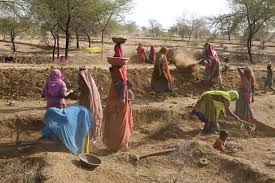

India is home to more than a fifth of the world’s population, has an over 10,000-year-old civilisation, four religions, and the world’s largest democracy. The name India comes from the word ‘Sindhu’, the Sanskrit name for the great river, the Indus, that flows for almost two thousand miles from the Himalayas to the Arabian Sea.

It became ‘Hindu’ and came to stand for not just the river but also for the people who lived beyond its eastern bank. It evolved into ‘Indu’ and later into the English name for the country ‘India’.

The River Indus not only gave the country its name but was also the birthplace of Indian civilisation and the culture that developed many millennia ago. There are 1.1 billion followers of Hinduism in the world. Hinduism is the only major religion of the world that can neither be traced to a specific founder nor has a holy book as the one and only scriptured authority. Its roots extend back to prehistoric times. The rituals and religious practices of the Indus Valley Civilisation originated a number of holy books including the Bhagwad Gita, part of the epic Mahabharata, the Ramayana, the Upanishads, and the Puranas. “The Song of God”, the Bhagwad Gita, often referred to as Gita, is a 700-verse Hindu scripture dated to the second century BCE. It is one of the most important texts of Hinduism as it helps with day-to-day activities and decisions. It is a practical guide based on the essential teachings of Hinduism.
A depiction of Indus Valley Civilisation
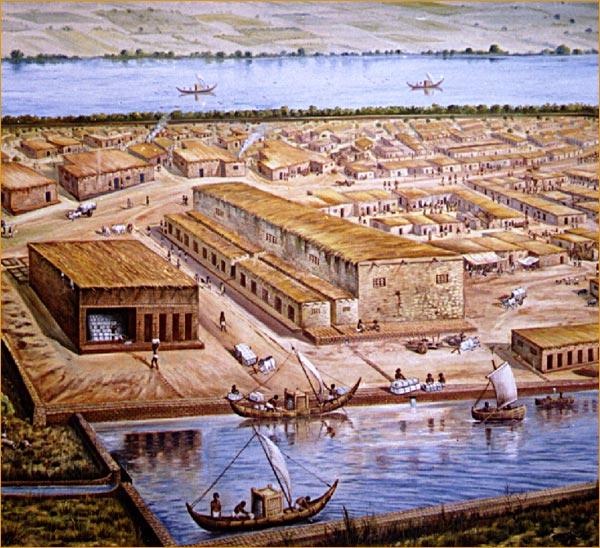
The core belief of Hinduism is that a person’s life is actually the journey of the soul. A life goes through a series of incarnations that eventually lead to ‘moksha’, or salvation, freeing the body from the cycle of rebirths after reaching spiritual perfection. The purity of mind and action is essential, as ‘karma’ or actions in life determine your reincarnation. ‘Dharma’ on the other hand controls the laws of the social, ethical, and spiritual.

The three manifestations of the omnipotent God are: Brahma, the creator of the Universe, Vishnu, the protector, and Shiva, the destroyer.
Trimurti, the Hindu Trinity

Not much is known of the very beginning of Hinduism, but what we do know is that when India’s vast history developed, it followed the sweep of tribes, small kingdoms, and large empires that came and went with the shifting sands of time.

Empires such as the Maurya whose most successful emperor, Ashoka – one of the most important figures in all Indian history – ruled almost the entire subcontinent in the middle of the third century BC. Following the decline of Ashoka’s empire, India suffered a series of invasions, all of whom left their mark on what was by then, a diverse collection of races and ethnicities populating the land.

Two images of Emperor Ashoka

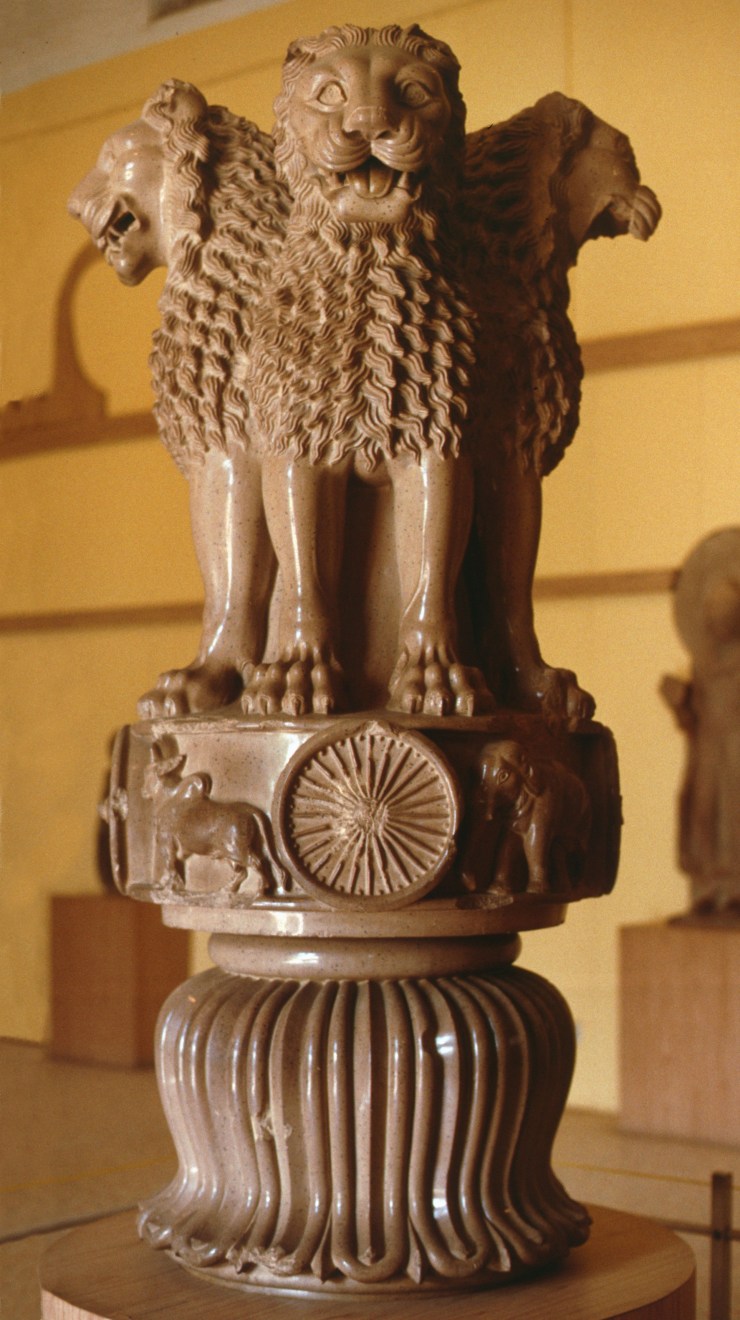
Ashoka’s influence has extended even to modern India. It resulted in India adopting some of his principles. After independence, the Lion Capital of Ashoka at Sarnath became the State Emblem of India. It consists of four Asiatic lions standing back to back on a circular abacus. The abacus has sculptures of an elephant, a horse, a bull, and a lion. These are separated by wheels in between. The emblem stands on a full-bloomed inverted lotus flower.
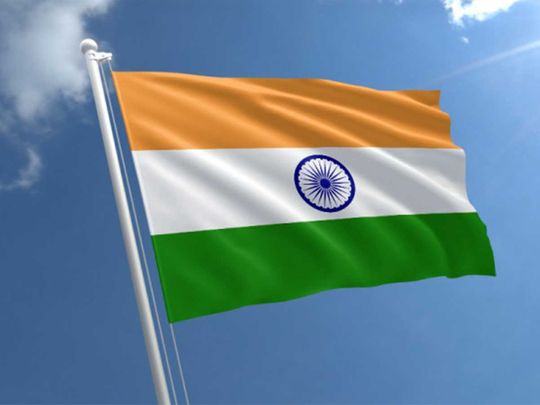
The national flag of India has three colours in horizontal stripes of deep saffron, white and green with Ashoka’s chakra (wheel of law) at its centre. It represents dharma or virtue which ought to be the controlling principle of those working and represents the dynamism of the Indian nation.
Another great empire, the Guptas, created something of a golden age in India, bringing a period of peace, prosperity, and achievement from the fourth to the middle of the sixth century AD. There were exciting discoveries in sciences, technology, engineering, art, literature, and mathematics, and developments in religious thought and philosophy contributed to the creation of Hindu culture. Other dynasties followed, all of which contributed to India’s rich and fascinating past.
Dashavatara Temple, Uttar Pradesh


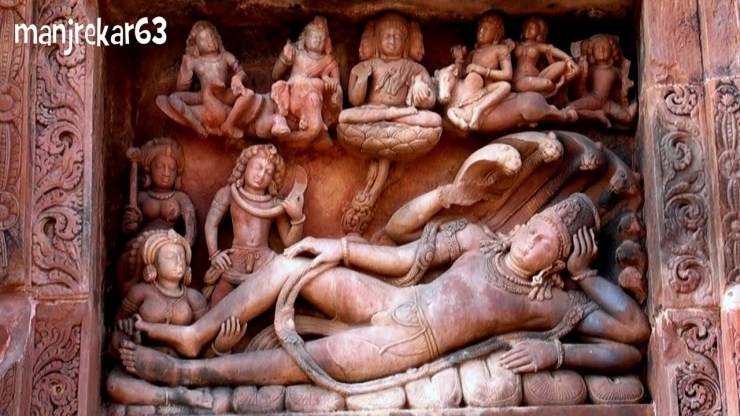
The body of text known as the Vedas is composed in Vedic Sanskrit and represents the oldest Sanskrit literature and oldest Hindu scriptures. Orthodox Indian theologians maintain that they are revelations experienced by ancient sages during intense meditations and that they are ‘apauruseya’, which means they were not composed by man. The Vedas are also the world’s oldest literature and are a collection of religious and philosophical poems and hymns, composed over several generations, beginning around 300 BC.

Some Vedic hymns and poems address philosophical themes, such as the henotheism that is the key to much of Hindu theology. Henotheism is the idea that one God takes many different forms, and that although an individual may worship several different gods and goddesses, they really revere but one Supreme Being.

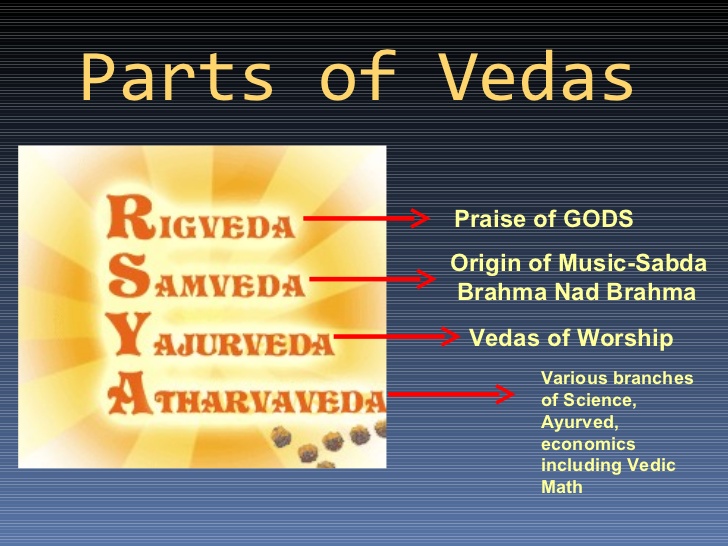
The great Indian epic, the Mahabharata, ascribes the authorship of the Vedas to the Hindu deity, Brahma. There are four Vedas – the Rigveda, the Yajurveda, the Samaveda, and the Atharvaveda.
The Rigveda (the wisdom of the verses) is nothing short of remarkable. It contains 1028 books (10,589 verses) which are divided into ten mandalas or book-sections dedicated to thirty-three gods. The most addressed were nature gods like Indra (king of heaven, rain god), and Agni (fire god).
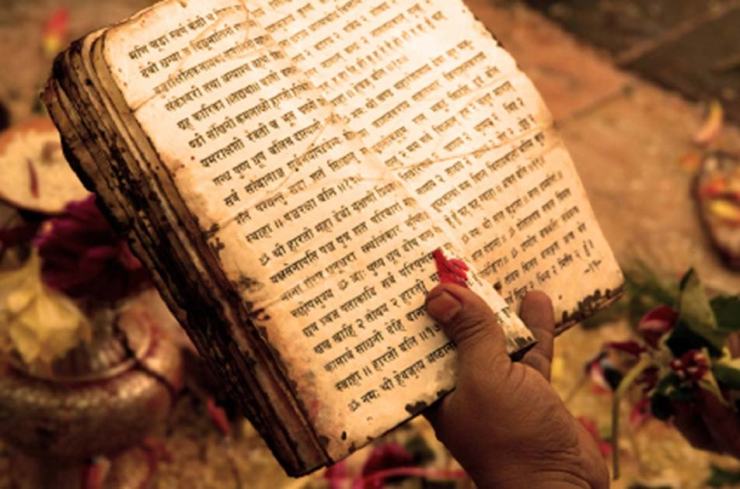
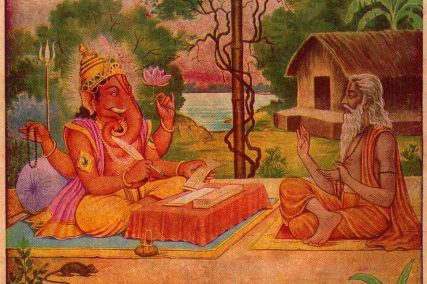

Initially, the priestly caste, the Brahmins, who alone memorised and performed the rituals in these texts, were unwilling to let them be seen and copied by non-Brahmins. Even in our own time, there have been extraordinary cases such as that of a Brahmin priest who appeared in Benares from nowhere and dictated a very long religious work in Sanskrit verse, until then unknown and unrecorded, which on internal evidence of style and language was medieval or even earlier, and which had been passed down orally through a certain line of priests.
Benares, India
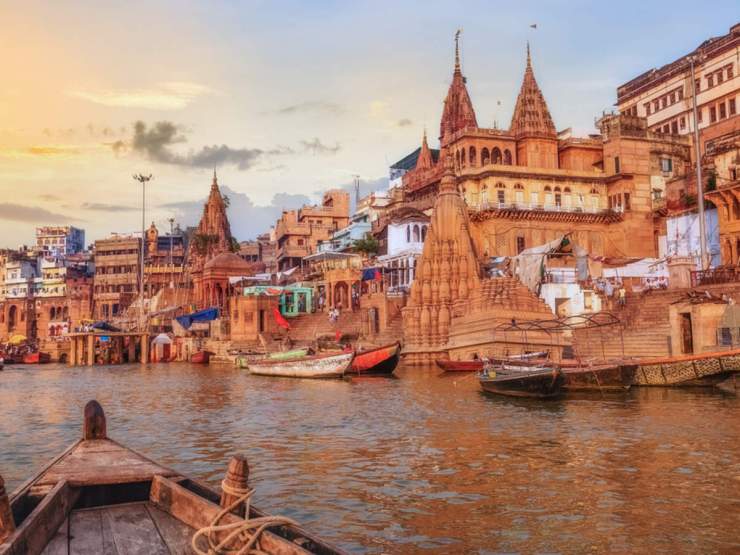

For thousands of years, these Brahminical rituals have been zealously guarded and never shared with the outside world; this is especially true of the mantra. These magical formulas can take days to recite, only Brahmins can utter them, and they have been passed down over a vast period of time. Mantras are a part of the archaic past of mankind, but no culture has assigned more importance to them than that in India. They work on emotions, physiology, and the nervous system; along with yoga, they are a way of achieving a heightened mental and physical state. Representations of figures on seals from the Bronze Age show men sitting in a yogic posture: it is probably one of the oldest rituals of Indian culture. How had they developed?
Understanding came only with the development of computer technology. Patterns of mantras from the twelve-day Agni ritual recorded in 1975 were put onto a computer, and analysis showed that the nearest analogue of these sound sequences was birdsong. An astonishing conclusion might follow: the possibility that the performance of such patterns of sounds is older than human language, a remnant of the pre-linguistic stage when sound was used in a purely syntactical or ritual manner.
Here a song thrush singing:
One of the rituals could date as far back as the Harappan Age. Once a year the image of the goddess of Madurai was taken to the banks of the sacred lake to celebrate her marriage to Shiva. This is a ritual as old as civilisation; recorded in the third millennium BC. At the lake, she and her consort were garlanded and serenaded with haunting hymns. “The great Goddess,” says an ancient Indian hymn “is the cause of all: she is peace, the intelligence in all things, all forms of faith: she is consciousness itself; ever in all things and pervading all creation.”
Meenakshi, the goddess of Madurai

Archaic in name and form, the great goddess of Madurai is at the heart of an ancient and irrepressible current of belief and experience in Indian life which was never lost and which despite the modernisation of our own age, will continue to be so, but then only time will tell. For a long time, pre-historic India wasn’t well documented. There were no written records detailing the chronology of early dynasties or events in a way useful to historians. There were epic poems like the Mahabharata and the Ramayana, which told of an apparently heroic age, and there were the sacred texts. These sacred books were held by Hindus to have been handed down orally from time immemorial. They were written down in the Middle Ages in the ‘sacred speech’, Sanskrit, whose demotic form is the ancestor of most of today’s North Indian dialects.
Ayodhya Kanda, one of seven volumes of an important illustrated manuscript of the Ramayana of Tulsi Das, signed by Ramcharan Kayasth, Jaipur school, dated VS 1853/1796-97 AD

The 106,000 verses of the great epic, the Mahabharata, are traditionally said to have been written by the revered sage Vyasa, who lived 3,800 years ago; the word Vyasa means “split, divide or differentiate.” He “split” the Vedas to allow people to understand the divine knowledge. He lived an ascetic life and is regarded as being the embodiment of wisdom.
Vyasa, full name Krishna Dvaipayana Veda Vyasa
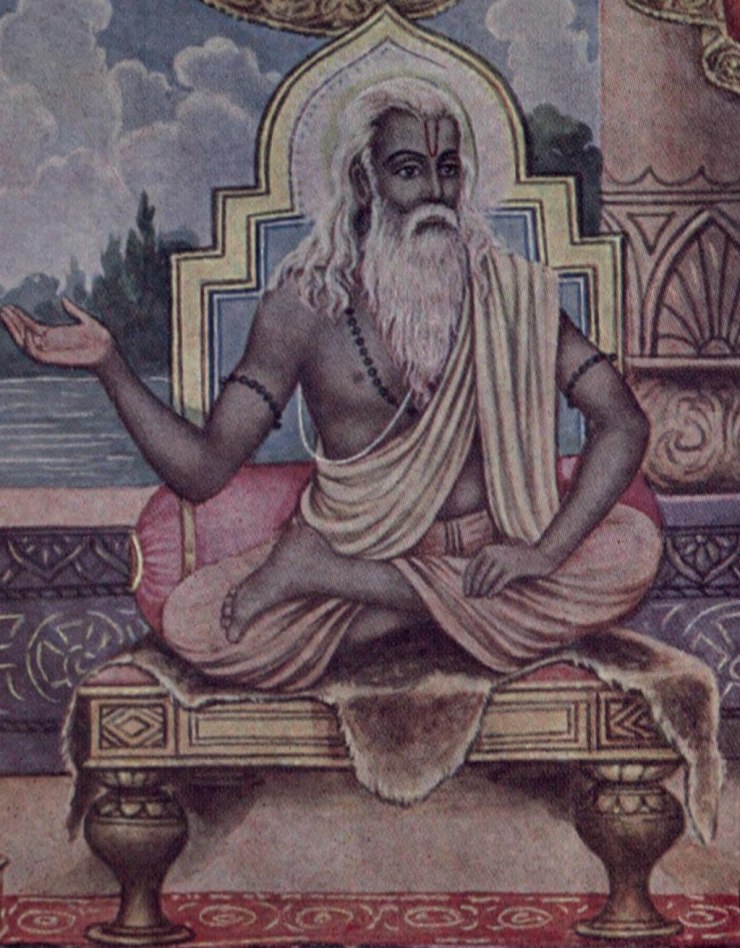
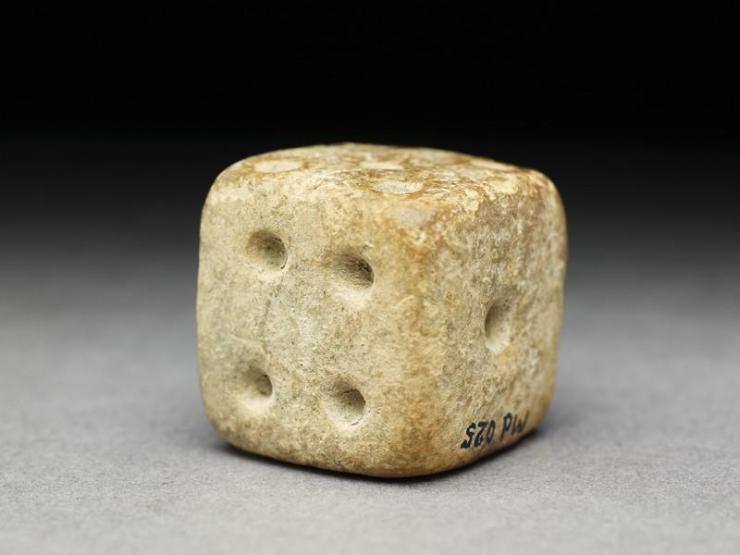
If anything, the Mahabharata is about dharma – the correct way to live. Archaeological finds of Painted Grey Ware, provided evidence that rather than being fictional, the events described in it may actually have taken place. Interestingly, the type of dice mentioned in the epic has also been found at some sites.

A scene from the many tales of the Mahabharata

The images below are divinely-inspired drawings of the Ramayana by Ramya Vivek who never before has drawn anything.


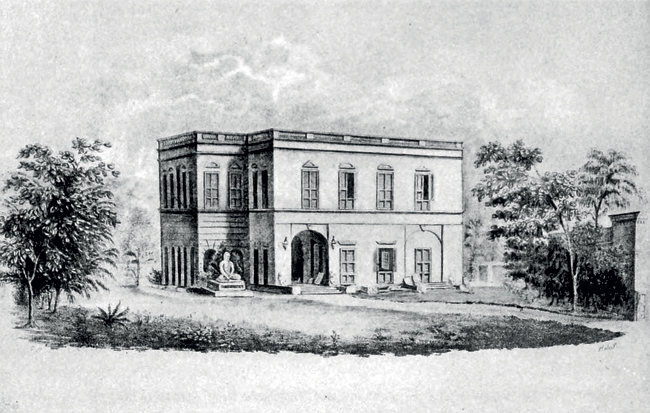
Sir William Jones

In 1786, a British judge and polymath, Sir William Jones, announced to the Asiatic Society in Calcutta his famous discovery that Sanskrit was related to Latin and Greek through some parent language:
“The Sanskrit language, whatever its antiquity, is more perfect than the Greek, more copious than the Latin and more exquisitely refined than either; yet bringing to both of them a stronger affinity than could have been produced by accident; so strong that no philologer could examine all three without believing them to have sprung from some common source, which perhaps no longer exists.”
The Asiatic Society building
Among the striking parallels Jones made was the identity of the word for father in Greek (pater), Latin (pater), and in Sanskrit (pitar), to which the Germanic (fadar) and English (father) were obviously related. He suggested that the Celtic and Germanic languages were another stem of this ‘Indo-European’ tree. In more obscure European tongues it was noted that the Sanskrit word for horse, asva, is closely matched in Lithuanian by aszva.
A memorial to Sir William Jones

The Rigveda is the earliest and largest of these texts. Rigveda translates as the ‘Veda of Adoration’ and it mostly contains verses in praise of deities, especially Agni (god of fire) and Indra (leader of gods). It is thought that the Rigveda was composed over a period of 500 years, around 1450 BC, or even between 1700 BC and 1100 BC.
Agni, the god of fire

Indra, leader of the gods, ruling the atmosphere, wind, rain, thunder and lightning, and able to stop rain which nourishes Mother Earth

Vedas’ poems deal with the curative properties of herbs and waters as well as diseases and deities that caused them. They also tell which herbs or amulets can drive out diseases. There are poems on the subject of atonement, political and philosophical matters, and a beautiful hymn to the goddess Prithvi, Mother Earth. The Rig Veda is still sung in Hindu temples today; although only committed to writing in the Middle Ages, it has been preserved with astonishing accuracy in the linguistic form from the Bronze Age.
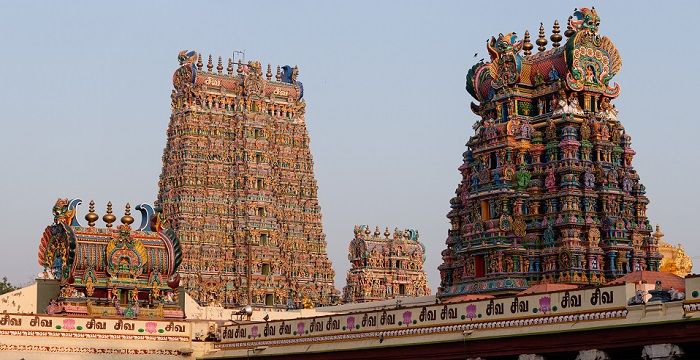
Meenakshi Amman temple in Madurai


The earlier verses described the Sanskrit speakers settled in north-west India, with no hint of migration from outside, so they had clearly been there for some time. They called themselves Aryans, literally ‘noble ones’. Their land stretched along the North-West frontier. Later hymns in the series suggest that by then they had spread into the ‘Seven Rivers’, today’s Punjab. Only in the last of the series is the scene set in the historical heartland of Indian civilisation, the valleys of the Ganges, and the Jumna. In 1921-22, it was discovered that the Aryan history, Indian history should be pushed back by several thousand years, over ancient Iraq and Egypt, making it the oldest known living civilisation.

Hymn 1 Agni
1 I Laud Agni, the chosen Priest, God, minister of sacrifice,
The hotar, lavishest of wealth.
2 Worthy is Agni to be praised by living as by ancient seers.
He shall bring hitherward the Gods.
3 Through Agni man obtaineth wealth, yea, plenty waxing day by day,
Most rich in heroes, glorious.
4 Agni, the perfect sacrifice which thou encompassest about
Verily goeth to the Gods.
5 May Agni, sapient-minded Priest, truthful, most gloriously great,
The God, come hither with the Gods.
6 Whatever blessing, Agni, thou wilt grant unto thy worshipper,
That, Aṅgiras, is indeed thy truth.
7 To thee, dispeller of the night, O Agni, day by day with prayer
Bringing thee reverence, we come
8 Ruler of sacrifices, guard of Law eternal, radiant One,
Increasing in thine own abode.
9 Be to us easy of approach, even as a father to his son:
Agni, be with us for our weal.
These texts reflect the development of Indo-Aryan culture from the time of their first migration into the northwest to their settlement of land in the Ganges valley and the creation of their first kingdom. They provide a good source of information about the daily life of the Vedic Aryans. They lived – when not on the move – in tribal settlements of several villages headed by a tribal chief. In time, they extended their territorial possessions from the mountain passes of the northwest to the western area of the Ganga – Yamuna Doab, ‘Ganga’ being another name for the Ganges and Yamuna being its second-largest tributary. For a period, the Saraswati River in Punjab appears to have been the Vedic base and it was in such river-filled land that they exchanged their nomadic lifestyle for a settled one, based on agriculture.
Illustration of the Creation Hymn of Rig Veda

Darkness was hidden by darkness in the beginning,
with no distinguishing sign, all this was water.
The life force that was covered with emptiness,
that One arose through the power of heat.
It was mentioned in the Rigveda, in texts dating back to 1100 BC; this was when metal was first used by Aryans to make weapons. Society developed, trade increased, and crafts such as carpentry, pottery, and blacksmithing established. Class structure emerged. Already there were priests and soldiers, with farmers employing indigenous people to work for them, the workers being of a different colour to Aryans. The Rigveda hymn deals with these distinctions:
“When gods prepared the sacrifice with Purusha as their offering
its oil was spring, the holy gift was autumn, summer was the wood
When they divided Purusha how many portions did they make?
What do they call his mouth, his arms? What do they call his thighs and feet?
The Brahman was his mouth, of both arms was the Rajanya (Kshatriya) made?
His thighs became the Vaishya, from his feet the Shudra was produced.”
Thus was the place of the Brahmin priests secured at the pinnacle of society. The first example of a type of democracy that was noted by historians, emerged with some tribes governed solely by a council of elders, without a king.
Today in the twenty-first century, The Rigveda remains one of the most important books for all humanity, providing not only glimpses of the origins of civilisation but a cosmic vision that transcends all time, connecting humanity to the power of universal creation. As perhaps humanity’s oldest book, The Rigveda remains its most mysterious and transformative.
Rigveda texts

The Upanishads were originally called Vedanta, which means the conclusion to Vedas. There are 18 principal Upanishads. Through episodes, commentaries, stories, traditions, and dialogue, the Upanishads unfold the fascinating tale of creation, life, the essence of life, and beyond to the seeker of truth.
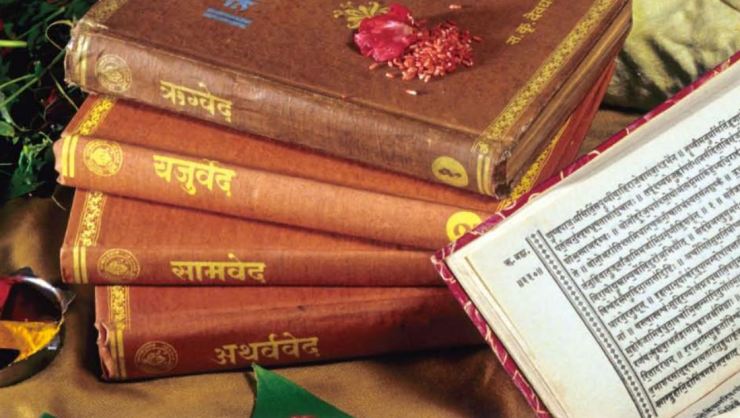
Upanishads ( ‘upa’ near, ‘ni’ down, ‘sad’ to sit ) means sitting down near; this implies the students sitting down near the guru to learn the big secret. The answers were however not open to all, but only for selected students. The reason for this was simple; not everyone can handle knowledge.
Out of 18 Upanishads, my favourite is Svetasvarata Upanishads, its name is after the teacher. It comments on the unity of the souls and the world in one all-encompassing reality. There is one beautiful verse in Upanishads Sanskrit – Vasudev Kutumbakam – that the world is one big family; by writing, and learning so much during my research for this post, I became part of that old tree, and now, I am family.
Parliament of India
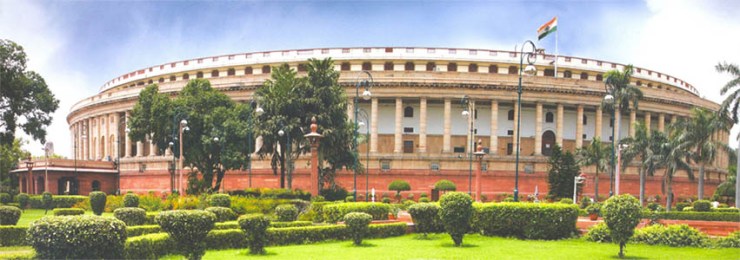
“The World is a Family” verse Vasudev Kutumbakam of Maha Upanishads is engraved in the entrance hall of the Parliament of India.
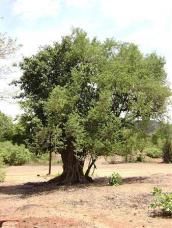
The Banyan Tree represents eternal life, because of its ever-expanding branches. The country’s unity is symbolised by the tree’s huge structure and its deep roots. The Banyan Tree is The National Tree of India.

The 18 Purana is a genre of important Hindu religious texts, consisting of narratives of the history of the Universe from creation to destruction, geologies of kings, heroes, sages, and descriptions of Hindu cosmology, philosophy, and geography.
Gita – it is said that Gita is nectar (shlokas) written in Vedas. After Vedas, Upanishads, and Puranas, Gita is Vedanta i.e. end of the Vedas’ beautiful philosophy – ADVAITA VEDANTA.
“All that one gives to others one gives to one’s self. If this truth is understood, who will not give to others? When one’s self arises, all arise; when one’s self becomes calm, all becomes calm. To the extent, we behave with humility, to that extent goodwill results.”
Bhagavad Gita is a battle for meaning in Earthly Existence. It is a magnificent religious poem; it comprehends in its short but intense unfolding both the human anxieties of life and death and the divine continuities that should shape our response to them. Reading it closely is a harrowing experience, for its shifting dimensions reveal how transient our individual perception must always be. Yet there is also comfort in the poem’s assurance of an eternal sincerity in the universe that offers fulfillment, if not reward. The poem possesses an epigrammatic eloquence that makes its guidance applicable cross-culturally.
“Set thy heart upon thy work, but never on its reward”, is a key precept of its teaching, as is “…..do thy duty, even of its humble, rather than another’s, even if it be great.”
Celebrations of Dussehra in Delhi
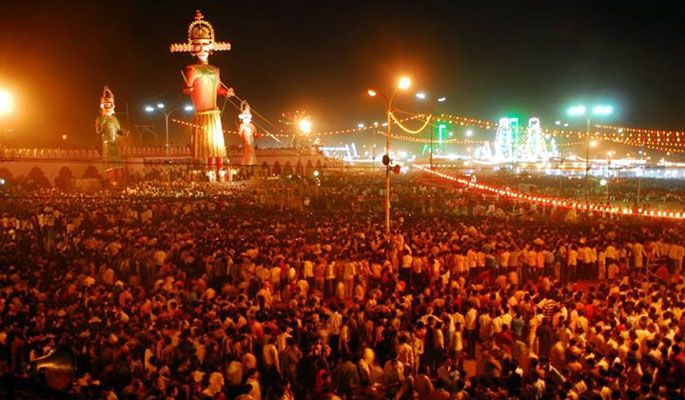
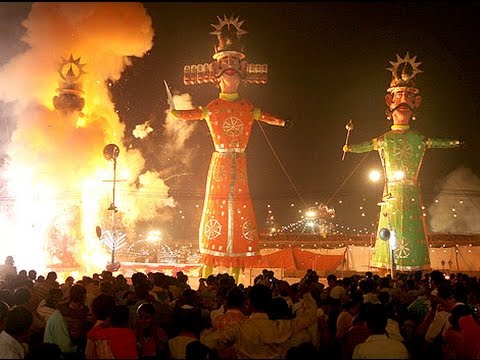
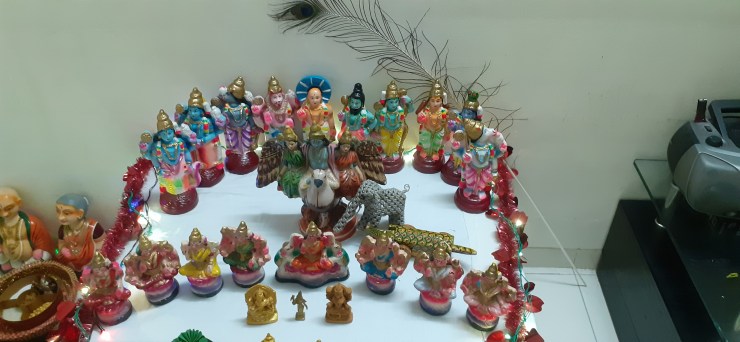
There are many Hindu festivals celebrating religious events all over India. The present one, Dussehra (25 October) is commemorating the victory of good over evil. It is celebrated on the tenth and final day of the festival of Navaratri. Also known as Vijayadashami and Durgatsav, it marks the day Lord Ram defeated the evil ten-headed King Ravana and rescued his wife Sita from him. Mammoth effigies of Ravana filled with firewood are burned to recreate the historical event. This is a time when young and old gather to listen to readings of stories from the Ramayanam known as Romleela. The exchange of apta leaves for good luck is an important custom too. The making of Golu dolls is also an old tradition. The festival is a public holiday and marks the beginning of the harvest season. Most businesses are closed on this day.

The Golu dolls below were created by Ramya Vivek and her daughters

The Mahabharata suggests that the sacred geography of India was well established during the first millennium BC, in a pattern that has remained ever since. The poem contains a list of 270 holy places which form a circuit of the entire country. The last and the most famous was Prayag, now Allahabad, at the junction of the Ganges and Jumma. It is a site of a great religious festival each year, and every twelfth year, at the Kumbh Mela, it sees the largest gathering of humanity anywhere on earth. In February 1989, fifteen million were present on the most auspicious night, many more over the whole month of the festival.
Kumbh Mela in 2019

Fascinating reaserch has shown why Prayag had pre-eminent sanctity as the ‘king of holy places’. Prayag was viewed as the navel of the earth, the mythical creation point of the universe; the site of the primordial mound which rose out of the waters (a phenomenon still to be seen at Allahabad at Mela time as the flood water of the Ganges subsides). Here there were an archaic pillar cult at the point where heaven and earth were first separated, and a sacred ‘undying’ tree, still alive in the seventeenth century, now a stump only. In the period of the epics, the first millennium BC, the chief cult shrine at Prayag stood on an island whose outline can still be seen although the Ganges has changed its course over centuries. On the north end of the island was a shrine to the primordial serpent who protected the eternal tree. It is still there today, the only one of its kind in India.
Prayag

There is a multitude of interesting places to see across India, but I can only (regrettably, shortness of space) suggest the astronomical observatories in five places – Jaipur, Mathura, Delhi, Ujjain, and Varanasi. They were commissioned by Maharaja Jai Singh II to be constructed between 1721 and 1736, each named Jantar Mantar.
Jantar Mantar, the astronomical observatory in Jaipur

The text of the ancient Sanskrit Vedas mentioned cosmology, astronomical terminology, and time measurements. These texts inspired Maharaja Jai Singh II to build the observatory complexes that included the largest in the world sundials and 18 other instruments. They are geometric forms constructed at such a large scale that they could measure time and track heavenly bodies with unprecedented precision. With each site at a different location. the astronomers could compare readings from different sites which enabled them to achieve greater accuracy.
A painting of the Maharaja Jai Singh II, in blue robes, inspecting one of his observatories

What is the meaning of Jantra in Jaipur? The archives of Jaipur State, such as accounts from 1735 and 1737-38, do not use this name as Jantra, which in spoken language was corrupted to Jantar. The word Jantar is derived from Yantra, instrument, while the suffix Mantar means consult or calculate. Sadly, the observatory in Mathura is now in ruins. The observatory Jantar Mantar is now a UNESCO World Heritage site.

Aryans, over time, migrated to the north, moving eastwards along the foothills of the Himalayas, but the most significant migration was the one to the east, and the period from the late seventh to the late fifth century BC was one of the most crucial points in the development of Indian culture.

In 1920 an Indian archaeologist, Daya Ram Sahni started excavation at Harappa. The very first trial digging produced seals like those found in 1850 by Alexander Cunningham. The upper level of the site showed occupation during the Mauryan Empire (fourth to third century BC). The deeper levels were obviously prehistoric, but from how far back? There was an answer soon.
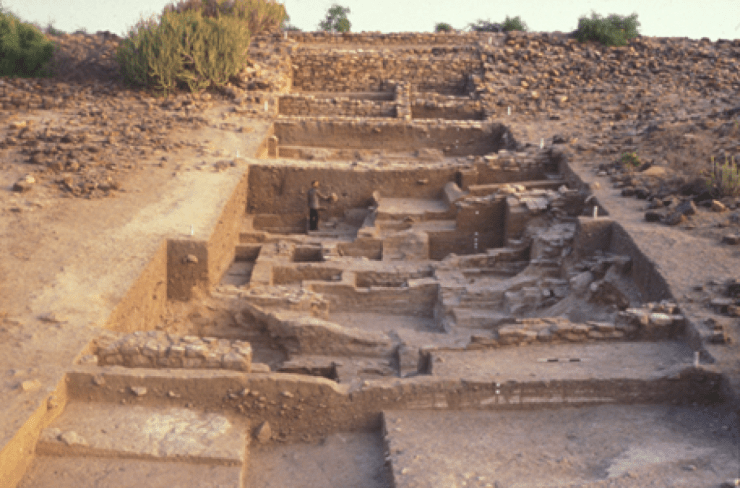
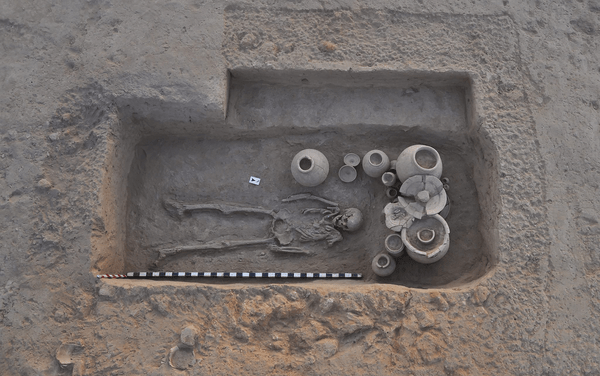
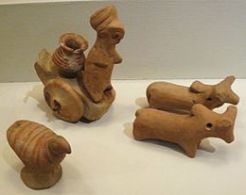

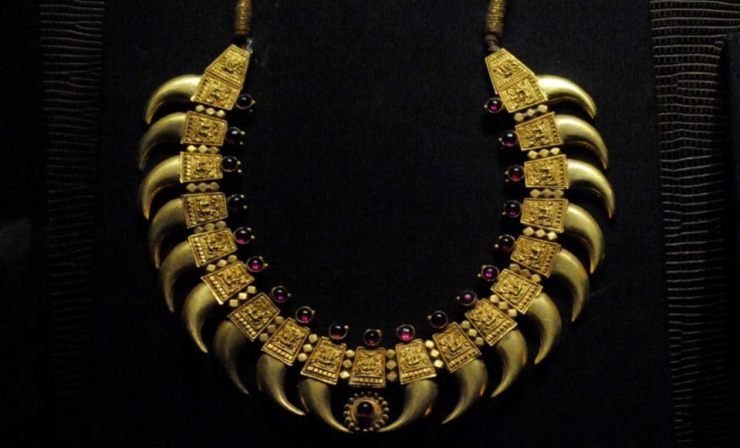

The next year, R.D.Banerjee began excavation at a huge site to the south in Sindh:

Built around 2500 BCE, it was one of the largest settlements of the ancient Indus Valley civilization, and one of the world’s earliest major urban settlements, contemporaneous with the civilizations of ancient Egypt, Mesopotamia, and Minoan Crete.
Mohenjo-Daro, the ‘Mound of the Dead’. Crowned by a brick stupa from the first-century AD, the archeologist found almost at once the evidence of the same prehistoric culture uncovered the previous year at Harappa. The citadel stood on a tract of land called locally ‘the Island’, and had been eroded by huge flood channels of the Indus which had gouged a path between it and the eastern suburbs of the ancient city which extended for about a square mile. The findings were among the most spectacular from the ancient world.
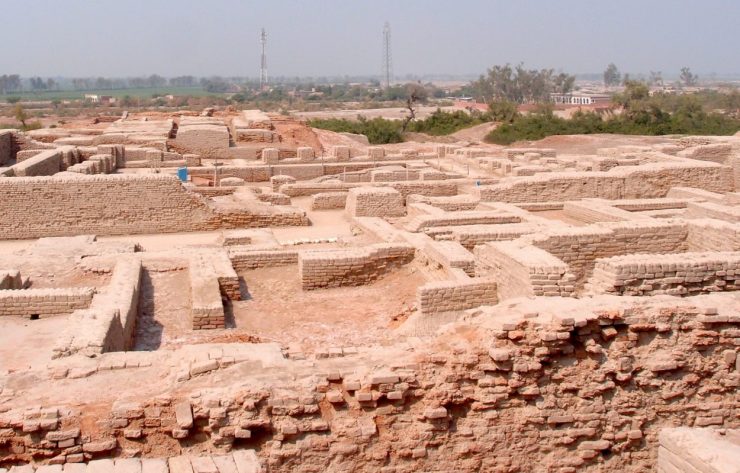
About 450 yards long, and probably fortified, the citadel contain an impressive series of ceremonial or governmental buildings including a large columned hall, a huge granary, and most strikingly of all, a colonnaded tank with a brick-lined bath 40 feet long, 23 feet broad and 8 feet deep which strongly recalled the ritual bathing tanks still seen all over India. The temple (if there was one) presumably lay under the Buddhist stupa on the summit of the hill, but this was not removed. In the suburbs were wide streets with grand mansions; there were wells and public latrines for every block; sewers large enough to walk in: this was in some respects a culture more advanced than other civilisations of the time – the mid-third Millenium BC.

India produced a great Bronze Age civilisation and had been literate. The biggest stumbling block was writing itself; the key to the identification of the Indus people. Examples of the script had survived engraved on hundreds of seals. But none of the inscriptions was more than a handful of characters, which made decipherment difficult. Indeed, the script remains undeciphered today: one of archaeology’s greatest mysteries.

In the last few decades, a much fuller picture has emerged of the civilisation of Mohenjo-Daro and Harappa. More than a thousand settlements are now known, extending from Afghanistan to Delhi, and from the Himalayan foothills down to Bombay; an area the size of Western Europe, and much larger than either early Iraq or Egypt. Most remarkable, though, is that over this huge area there seems to have been a unity of culture, art, script, and technology, including even of weights and measures.
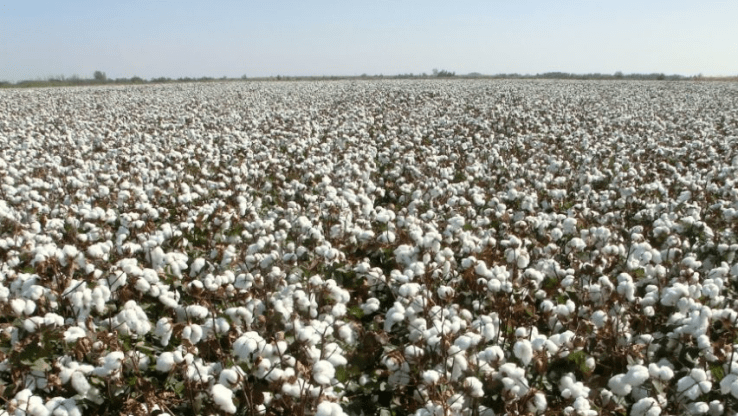
The largest city, Mohenjo-Daro, is now thought probably to have reached eighty thousand in population, with five million for the entire state. Like Iraq and Egypt, its civilisation depended on river irrigation. The Indus floods every year, inundating the plane, and on the fertilised soil they grew wheat, barley, rice, and cotton, which seems to have been cultivated in Sind for the first time in history, hence its Greek name – sindon. The marks on seals connect the trade with the Persian Gulf region and is one of the oldest international connections in Indian culture. A Greek merchant’s manual from around 60 AD describes sandalwood, ebony, cotton, spices, and pearls coming from Gujarat.

Chandragupta Maurya was the first emperor to unify most of India under one government. His capital at Pataliputra was a striking construction, fortified with palisades, huge in size, about nine miles by a mile and half; it had 570 towers and 64 gates and was around 21 miles in circumference, ie it was the largest city in the ancient world. The society there was clearly divided but not in any hierarchical order.
Chandragupta Maurya

Pataliputra – City of Dreams

Historians have acknowledged that India has been prodigiously gifted and creative in every field of human endeavor, and placed the spiritual quest at the center of life in a way that no other civilisation has.
From ancient times India defined the goals of civilisation very differently from the West. The West raised individualism, materialism, rationality, masculinity as its ideals. The great tradition of India also insisted on non-violence, renunciation, the inner life, the female, as pillars of civilisation. And through all the triumphs and disasters of her long history, she hung on to that ideal.
History is full of the empires of the sword.
India alone created EMPIRE OF THE SPIRIT.
I leave the last word to the fourteenth-century Indian poet Amir Khusro: he was a Muslim, wrote in Persian, and his ancestry was Turkic, but he counted himself the luckiest man alive to be born in India, and to have India as his motherland.
“How exhilarating is the atmosphere of India!
There cannot be a better teacher that the way
of life of its people.
If any foreigner comes by, he will have to ask
for nothing
because they treat him as their own.
Play an excellent host and win his heart,
And show him how to smile like a flower.”


 naturetails
Thank you so much for appreciating my words, Joanna! I truly feel blessed 🙏 Keep up the great work of sharing your educative posts as ever !
LikeLike
Thank you so much!
Joanna
LikeLiked by 1 person
Thank you, Kym!
Joanna x
LikeLiked by 1 person
🧡🤍💚
LikeLike
Thank you, Orededrum, I understand that you like the post!
Joanna
LikeLike
Wonderful essay. The breadth of your knowledge and interests always has impressed me, now more than ever.
LikeLike
Thank you, Neil, for your generous comments. I appreciate your words greatly, especially as they come from someone as talented as you are!
Joanna
LikeLiked by 1 person
My pleasure as always Joanna! 😍💖🥰
LikeLike
Thank you again, Kym!
Joanna x
LikeLiked by 1 person
🥰💖😍
LikeLike
i love this post & all that you say🙏🏼thank you so much❤️
LikeLike
Thank you, Swadharma9, for your very kind comments! Greatly appreciated!
Joanna
LikeLike
It took me a long time to take all this in Joanna. I realise it was originally written a while ago, but it needs to be published again and again so that people like me can get to read this masterpiece. Your experience in India has obviously left a lasting impression on you, and I can well understand why.
I said to somebody the other day that I don’t just like to see a place, but to get a ‘feel’ for it too, and I can tell that you have a real feel for India. The history, the religions, the people and all other aspects of Indian life hit me right from the very start. This is a fabulous post, and I can see that I’m not the only one who thinks so. Well done Joanna, and it’s good to see you back.
LikeLike
Thank you, Malc, for such wonderful comments! You are right, I have a deep attachment to India that started with Tagore’s poetry and Mahatma Gandhi’s work. Unfortunately, I have never been to India, and I don’t think I will have a chance to go there, with my obligations here. Perhaps, my intuitive feeling of empathy with India and its culture comes from the fact that Poland suffered terribly under Russian oppression, and India had suffered years of being subjugated too. Also, the heroes I am writing about are outstanding in the history of humanity, and not only in the realms of one country.
I have quite a few new readers and I think they will be interested to read the posts about great people, interesting places, and countries they might want to visit.
Thank you again, Malc, and your kindness is greatly appreciated.
Joanna
LikeLiked by 2 people
For some reason I thought you had lived in India, probably because you know so much about it 🙂
LikeLiked by 1 person
Thank you, Malc. You made my day!!
Joanna
LikeLiked by 1 person
🙂
LikeLike
My goodness Joanna, what a magnificent cornucopia of interesting information about India. It is such a fascinating place and there is so much history behind this populous subcontinent. Thank you, once again, for your efforts in bringing this to us.
LikeLike
Thank you, Peter, you are so generous in your comments!
It is a great pleasure to write for the readers who are so receptive!
Thank you again, Peter!
Joanna
LikeLiked by 1 person
Dear Joanna, I need to read this again (probably more than once) and am amazed at what you have written! Currently I’m reading Eknath Easwaran’s translation of the Bhagavad Gita and also learning to meditate (TM) which is difficult starting at the age of 73 (so much clutter). 💓🌹💌🤗🙋♂️
LikeLike
You’ve made amply clear in this post how long a history India has, and how great a literature.
The native language of over 3 billion people now alive belongs to the Indo-European family, including Hindi, Bengali, and Punjabi. The name of the ancient Indian fire god Agni is a cognate of the Latin and Russian words for fire, ignis and огонь (ogon).
(The phrase “a strong affinity” in the quotation from William Jones should be “a stronger affinity.”)
LikeLike
Thank you, Ashley, for your kind comments. I am glad that you find my post interesting, but then India is a very interesting place.
As to meditation, according to experts; find a quiet spot, shut your eyes, and breathe through your nose and focus.
Joanna
LikeLiked by 1 person
Thank you, Steve, for your comments
which I greatly appreciate.
Joanna
LikeLike
Wow.. Joanna! What a great post. I really appreciate your knowledge, work and art of writing!! Thank you so much for sharing!!
LikeLike
Thank you, Jyothi, for your kind comment! Greatly appreciated!
Joanna
LikeLiked by 1 person
Thank you, Joanna, for this complete treatise on India ranging from its pluralism to civilisation, dynasties, emblem, national flag, observatories and what not.
The way you have covered the main religion, Hinduism and its rituals, beliefs, practices, traditions, mantras, hymns, festivals, gods and goddesses, and scriptures like Ramayan, Mahabharat, Vedas, Puranas etc is incredible, especially when it has not been written by an Indian. You have also gone into minute features like Golu dolls, which are mainly made in Tamilnadu state during Navaratri.
It is not easy to cover India, where diversity in religion, language and social status is at its core. But then, you are also no less Indian, India has accepted you and vice versa. You have also indicated “Vasudhaiva Kutumbakam”.
Loved the way you talked about henotheism. I also liked the pictures, especially of rural India. I would like to add here that a new Parliament building has been inaugurated last month, and now sessions will be held there. Prayagraj was earlier named Allahabad, whose name has now been changed back to Prayagraj.
There would not have been a better beginning and ending with quotes of Gurudev Tagore and Amir Khusro respectively. Thanks a lot, Joanna, for such an incredible post!
There couldn’t have been a better beginning and end with quotes from Gurudev Tagore and Amir Khusro respectively. Thank you so much Joanna, for such an incredible post!
LikeLike
Sorry for repetition of the last paragraph.
LikeLike
Thank you, Kaushal, for the wonderful, and moving comments!
So many things changed since I wrote this post! The talented woman who made the dolls and was inspired by divinity to draw the pictures tragically died of Covid.
Your PM on his recent visit to the US
was treated with rightful respect.
And India will grow in stature beyond my imagination.
Tathastu!
Joanna
LikeLiked by 1 person
Fabulous article, Joanna! Lot of research has gone in, I’am sure. Very informative!!
LikeLike
A thought inspiring post… thank you…!
🇯🇲🏖️
LikeLike
Thank you, Indira, for your generous comment! Greatly appreciated!
Joanna
LikeLiked by 1 person
Thank you for your kind comment!
Greatly appreciated.
Joanna
LikeLiked by 1 person
It’s truly my pleasure, Joanna! Sorry to know about sad demise of that talented lady.
My PM is a down-to-earth person, but steals the show wherever he goes.
Thank you for your kind wishes for India! Namaste!!
LikeLike
Namaste.
Joanna
LikeLiked by 1 person
I was fascinated from the first word to the last, Joanna, but I’ll have to brush up on my list of adjectives because I’m at a loss for words to express my admiration 🌹
LikeLike
Thank you, Dear Luisa, for your wonderful comments! You know how to lift my spirit! I have a stressful time, and words like yours make a huge difference. Thank you!
Joanna
LikeLike
It was a real pleasure to try to express my views on your great post🌹🌹🌹
LikeLike
Thank you again!
Joanna
LikeLiked by 1 person
I have been to India as a guest of a diplomat/friend. I new so little until I read you post/article. A greater appreciation I have for this spiritual country! Thank you Joanna for your incredible account about these lovely people! ☸️
LikeLike
Thank you, Eva, for your wonderful comments! It makes me happy that you now know a little more about this fascinating and unique country.
Thank you again, Eva, greatly appreciated.
Joanna
LikeLike
Magnificent, Joanna. And I always thought the wheel in India’s flag was a spinning wheel. Still educable at least. 😟
LikeLike
Goodness, Pat, you are a quick reader! There are interesting bits there, although, the talented lady who made the dolls and drew the pictures died of Covid. Tragic!
Joanna
LikeLiked by 1 person
Very sad.
LikeLike
Yes, she was a talented writer too, with a great future, I thought.
LikeLike
Didn’t know that.
LikeLike
She had a blog and I read twice a day her tales, they were always excellent! She had two daughters and a loving husband. I don’t know what happened to them.
LikeLiked by 1 person
Wow, Joanna, what a wonderfully informative post! How much time you must put into researching & writing! The more I learn about India, the more I love her. The ancient philosophies of spirituality, health, & overall wellbeing is ideal. The Meenakshi Amman temple is exquisite! Thank you for sharing this well-written essay! 🌞
LikeLike
Thank you, Lisa, for your wonderful comments! When I write about the country or people I love, all the work involved is a pleasure.
Thank you again, Lisa, your words are greatly appreciated.
Joanna
LikeLiked by 1 person
interesting, well written, & fascinating! thank you so much! i love it🙏🏼❤️🙏🏼
LikeLike
Thank you so much for your wonderful comment! All greatly appreciated!
Joanna
LikeLiked by 1 person