

“When the imagination sleeps, words are emptied of their meaning.”
Albert Camus
Courtesy of The Modern Samurai:
“I guess there are never enough books.”
John Steinbeck
“Natural Blues” (Reprise Version) by Moby, featuring Gregory Porter and Amythyst Kiah (courtesy of Moby):
I caught the reading bug as a child, probably as a means of escape. I once became so engrossed in a book that I was found in the late afternoon, still in my nightdress, sitting on the floor, oblivious of the time or the fact that I hadn’t gone to school. Needless to say, I was punished and books were locked away. In my house, I surround myself with books. They are in every room, everywhere I look, and beautifully arranged, as according to Seneca, ‘if you have a library and a garden, you have everything.’ I have both. In my library, there are no books that one can find at the airports – holiday romances, cheap thrillers, and ‘action’ adventures without any real actions.

A good book makes us more thoughtful, more alert to the world’s wonders, more knowledgeable, it extends our vocabulary. and makes us more interesting as company, gives, often life-changing, inspiration The books that I am presenting here are on all lists of essential reading. Today, I am writing about the works of one of the greatest writers, whose books remain immediately appealing and deeply affecting – John Steinbeck.
“What good is the warmth of summer,
without the cold of winter to give it sweetness?”
John Steinbeck
“Summertime” from “Porgy and Bess” by George Gershwin, performed by Ray Chen:
JOHN STEINBECK
27 February 1902 – 20 December 1968

Courtesy of Biography:
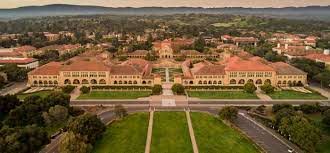
John Steinbeck was born in Salinas, California, and grew up in a fertile agricultural valley about twenty-five miles from the Pacific Coast. Both the valley and the coast would serve as a setting for some of his best fiction. In 1919 he went to Stanford University, where he enrolled in literature and writing courses until he left in 1925 without taking a degree.
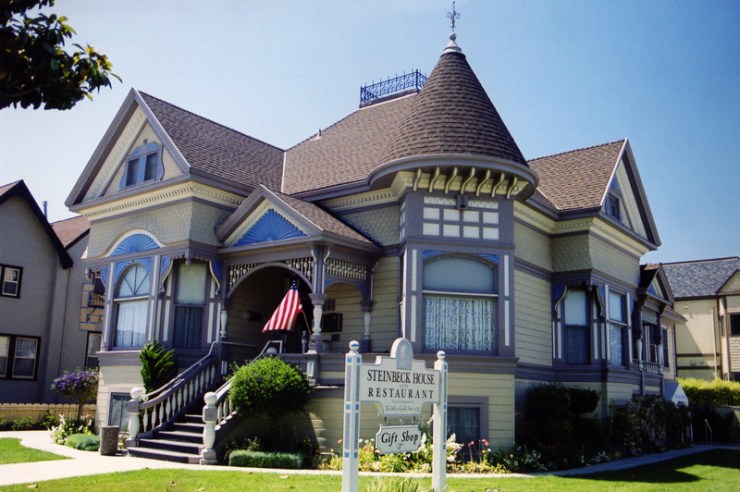
Salinas, California

Courtesy of Matthew Sollid:
Stanford University
Steinbeck’s house in Salinas
During the next five years, Steinbeck supported himself as a labourer and a journalist in New York City, working at the same time on his first novel, Cup of Gold (1929). After moving to Pacific Grove, he published a few titles but his wider success and financial security came with Tortilla Flat (1935), stories about Monterey’s peasants. The powerful novels of the late 1930s focused on the Californian working-class, Of Mice and Men (1937), and the book considered his finest, The Grapes of Wrath (1939). After many career experimentations, the next monumental publication was an ambitious saga of the Salinas Valley and his own family’s history – East of Eden. Steinbeck was a prodigious writer but his Travels with Charley in search of America deserves a mention.
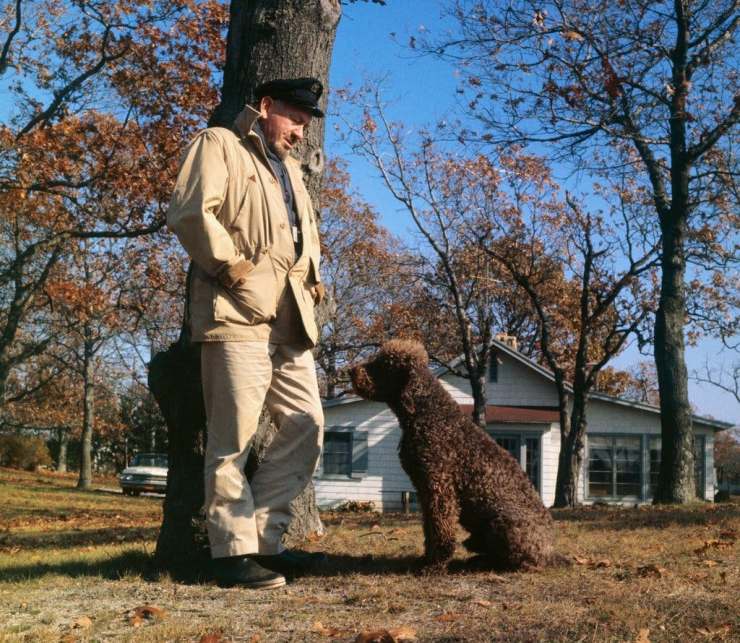
John Steinbeck and Charley
The place The Grapes of Wrath has assumed in American culture remains unique; it is probably the most read great novel. When the book was published in 1939, on account of its occasional obscene language and general themes, it was banned in Illinois and reviled as ‘filthy’ in Washington, DC, although the First Lady Roosevelt and her husband read and publicly spoke about it. Steinbeck received regular threats following the book’s publication and took to carrying a gun in public, just in case. It quickly rose on the bestseller lists, sold nearly half a million copies in the first year, and received in 1940 both the National Book Award and the Pulitzer Prize. A movie based on the book went on to dominate the Academy Awards. By the fiftieth anniversary of its publication, nearly fifteen million copies of the novel had been printed, with another 150,000 added annually. It has been translated into dozens of languages and is analysed at schools and universities. In 1962, The Grapes of Wrath received The Nobel Prize for Literature.
“Tumbleweed” performed by Joan Baez:
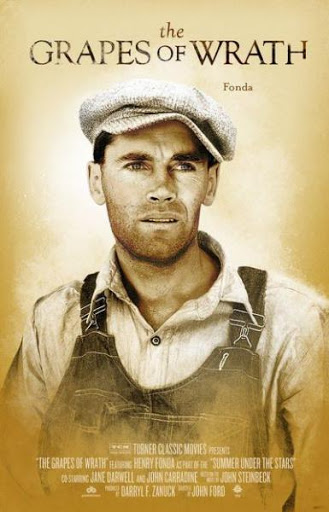
Henry Fonda in the film The Grapes of Wrath
Woody Guthrie’s “The Ballad of Tom Joad” recorded in 1940, was directly inspired by The Grapes of Wrath and the successful John Ford film adaptation, released in 1940 (courtesy of Ronald Blonk):
Escaping from the Dust Bowl county in the film

More recently, also inspired by the book and film adaptation, as well as by Woody Guthrie’s ballad, Bruce Springsteen wrote “The Ghost Of Tom Joad”, a modern-day version of the same Great Depression-era concerns, during the early 90s (courtesy of Springsteen & Rock Music):
Courtesy of Reading Through History:
Despite Steinbeck’s doubts, which were constant during its tumultuous process of composition, The Grapes of Wrath turned out to be not only a ‘fine’ book but the greatest of his seventeen novels. Steinbeck’s mixture of native philosophy, common-sense politics, folk wisdom, working-class characters, and a bold, rhythmic style of writing and raw dialogue – qualified the novel as the ‘American Book’, he had set out to write. The novel’s title came from Julia Ward Howe’s “Battle Hymn of the Republic” – and was clearly in the American grain. The song’s opening lines are as follows:
“Mine eyes have seen the glory of the coming of the Lord
He is trampling out the vintage where the grapes of wrath are stored
He hath loosed the fateful lightning of his terrible swift sword
His truth is marching on.”

“I Heard It Through The Grapevine”, performed by New York Jazz Quartet:
Although many people were shocked by the poverty and hopelessness of the migrant labour situation in California, Steinbeck refused to write a popular book or to court commercial success. It was ironic, then, that shortly after its official publication date on 14 April 1939, fuelled by the nearly ninety reviews in the media, The Grapes of Wrath climbed to the top of the bestseller lists for most of the year, selling 428,000 copies in hardcover at $2.75 each. It proved itself to be among the most enduring works of fiction by an American writer, past or present. The Grapes of Wrath entered both the American consciousness and its conscience. If a literary classic can be defined as a book that speaks directly to readers, then The Grapes of Wrath is such a book.

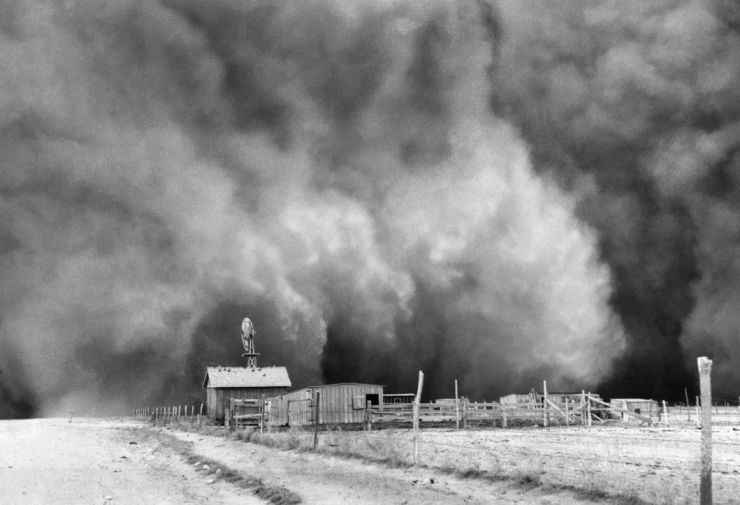
Courtesy of Decades TV Network, the story of Black Sunday:
Here is an extract from THE GRAPES OF WRATH:
“In the middle of that night, the wind passed on and left the land quiet. The dust-filled air muffled sound more completely than fog does. The people, lying in their beds, heard the wind stop. They awakened when the rushing wind was gone. They lay quietly and listened deep into the stillness. Then roosters crowed, and their voices were muffled, and the people stirred restlessly in their beds and wanted morning. They knew it would take a long time for the dust to settle out of the air. In the morning the dust hung like fog, and the sun was as red as ripe new blood. All day the dust sifted down from the sky, and the next day it sifted down. An even blanket covered the earth. It settled on the corn, piled up on the tops of the fence posts, piled up on wires, it settled on roofs, blanketed the weeds and trees.
The people came out of their houses and smelled the hot stinging air and covered their noses from it. And the children came out of the houses, but they did not run or shout as they would have done after a rain. Men stood by their fences and looked at the ruined corn, drying fast now, only a little green showing through the film of dust. The men were silent and they did not move often. And the women came out of the houses to stand beside their men – to feel whether this time the men would break. The women studied the men’s faces secretly, for the corn could go, as long as something else remained. The children stood near by, drawing figures in the dust with bare toes, and the children sent exploring senses out to see whether men and women would break.”
“Dust Bowl Dance” by Mumford & Sons (courtesy of Mac Dvorak):
OF MICE AND MEN
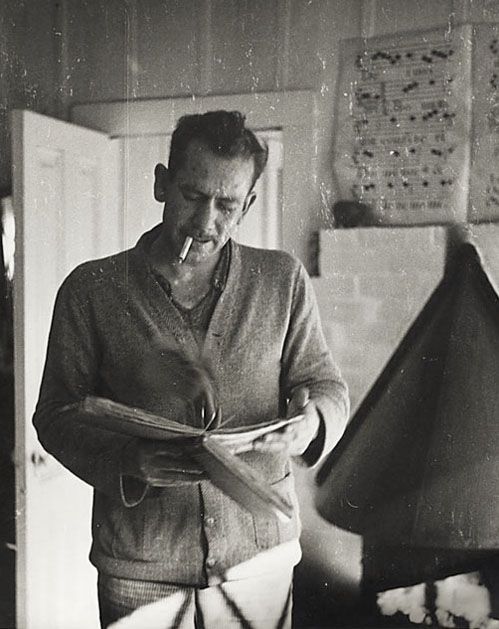
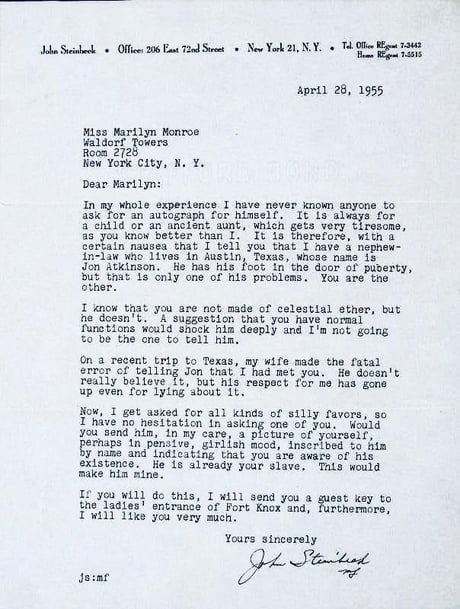
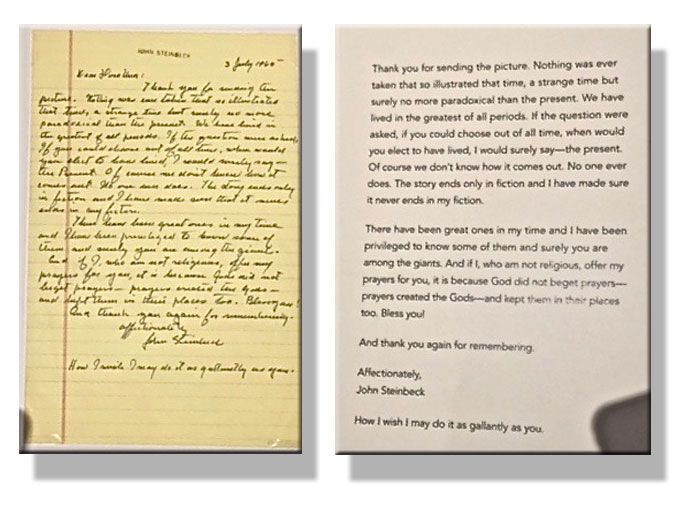
John Steinbeck celebrated friendship, both in his life and in his fiction. Before he began to write each morning, he frequently scrawled letters to friends, and these pages, many unpublished, map the contours of his life and art. Friendship is the most enduring relationship in his best work, a fact that places him solidly in a long tradition of American writers. This had shaped his long career, indeed echoed in his acceptance speech for the 1962 Nobel Prize in Literature.
Courtesy of guyjohn59:
Steinbeck’s greatness as a writer lies in his empathy for common people – their loneliness, joy, anger, and strength, their connection to places, and their craving for land. Of Mice and Men, arguably the best of his short novels, owes much of this appeal to Steinbeck’s ability to create this thematic complexity within the context of the abiding commitment between friends that is love at its highest pitch.
Courtesy of Whiteboard Literature:
John Steinbeck’s letters to Marilyn Monroe and Dorothea Lange
Of Mice and Men is a compelling story of two friends, outsiders striving to find their places in an unforgiving world.
The New York Times wrote:
“A thriller, a gripping tale that you will not set down until it is finished. Steinbeck has touched the quick.”
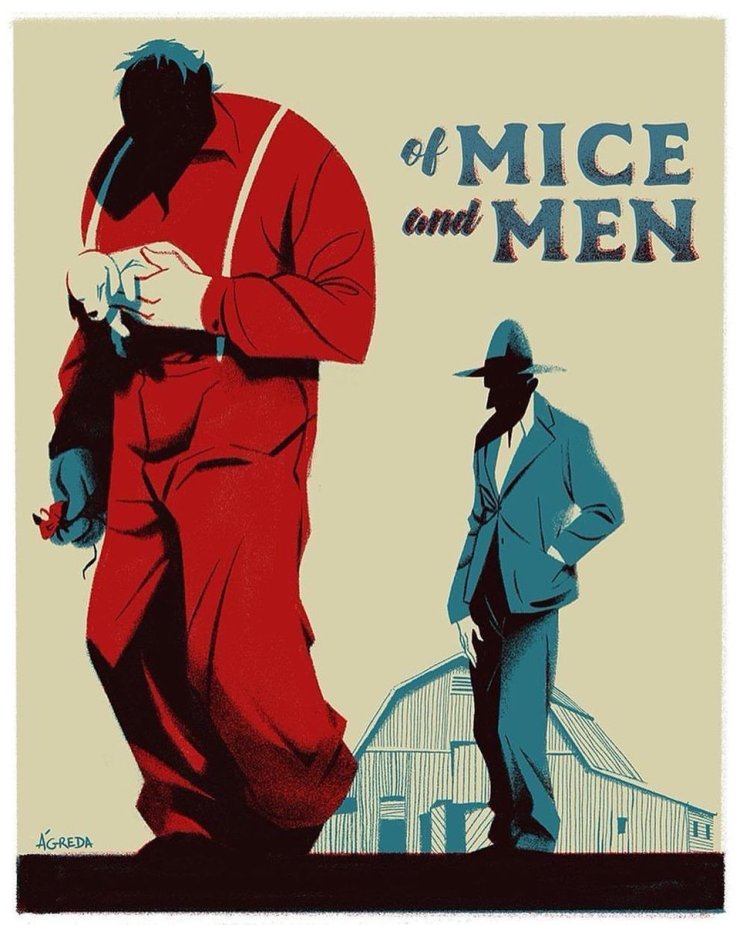
Steinbeck chose the title Of Mice and Men after reading a poem called “To a Mouse” by Robert Burns, in which the poet regrets accidentally destroying a mouse’s nest. The poem resonates with several of Of Mice and Men’s central themes: the impermanence of home and the harshness of life for the most vulnerable. The relevant verse is:
“But Mousie, thou art no thy lane,
In proving foresight may be vain:
The best laid schemes o’ mice an’ men
Gang aft agley,
An’ lea’e us nought but grief and pain,
For promis’d joy!”
or in standard English:
“But, Mouse, you are not alone,
In proving foresight may be vain:
The best laid schemes of mice and men
Go often askew,
And leaves us nothing but grief and pain,
For promised joy!”

The book tells the story of two drifters in search of work, George and his simple-minded friend Lennie, who have nothing in the world except each other and a dream – a dream that one day they will have some land of their own. Eventually, they find work on a ranch in California’s Salinas Valley, but their hopes are doomed as Lennie, struggling against extreme cruelty, misunderstanding, and feelings of jealousy, becomes a victim of his own strength. Tackling universal themes; friendship and shared vision, and giving voice to America’s lonely and dispossessed, Of Mice and Men has proved one of Steinbeck’s most popular works, achieving success as a novel, a Broadway play and three acclaimed films.
“Hallelujah” by Leonard Cohen, performed by Sheku Kanneh-Mason:
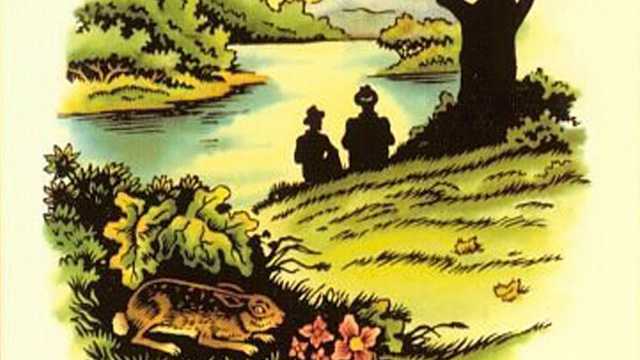
A fragment from Of Mice and Men:
“A few miles south of south of Soledad, the Salinas River drops in close to the hillside bank and runs deep and green. The water is warm too, for it has slipped twinkling over the yellow sands in the sunlight before reaching the narrow pool. On one side of the river, the slopes of the golden foothills curve up to the strong and rocky Gabilan mountains, but on the valley side, the water is lined with trees – willows fresh and green with every spring, carrying in their lower leaf junctures the debris of the winter’s flooding; and sycamores with mottled, white, recumbent limbs and branches that arch over the pool. On the sandy bank under the trees, the leaves lie deep and so crisp that a lizard makes a great skittering if he runs among them. Rabbits come out of the brush to sit on the sand in the evening, and the damp flats are covered with the night tracks of coons, and with the spread pads of dogs from the ranches, and with the split-wedge tracks of deer that comes to drink in the dark.”

“And then from the direction of the state highway came the sound of footsteps on crisp sycamore leaves. The rabbits hurried noiselessly for cover. A stilted heron labored up into the air and pounded down river. For a moment the place was lifeless, and then two men emerged from the path and came into the opening by the green pool. They walked in single file down the path, and even in the open one stayed behind the other. Both were dressed in denim trousers and in denim coats with brass buttons. Both wore black shapeless hats and carried tight blankets rolls slung over their shoulders. The first man was small and quick, dark of face, with restless eyes and sharp, strong features. Every part of him was defined: small, strong hands, slender arms, a thin and bony nose. Behind him walked his opposite, a huge man, shapeless of face, with large, pale eyes, with wide, sloping shoulders; and he walked heavily, dragging his feet a little, the way a bear drags his paws. His arms did not swing at his sides but hung loosely.
The first man stopped short in the clearing, and the follower nearly ran over him. He took off his hat and wiped the sweat-band with his forefinger and snapped the moisture off. His huge companion dropped his blankets and flung himself down and drank from the surface of the green pool; he drank with long gulps, snorting into water like a horse. The small man stepped nervously beside him.
“Lennie!” he said sharply. “Lennie, for God’s sakes don’t drink so much.”
Lennie continued to snort into the pool. The small man leaned over and shook him by the shoulder.
“Lennie. You gonner be sick like you was last night.”
Lennie dipped his whole head under, hat and all, and then he sat up on the bank and his hat dropped down on his blue coat and ran down his back. “Tha’s good”, he said. “You drink some, George. You take a good big drink”.
He smiled happily.”

“Come, Sweet Death” (Arr. for 5 Cellos) by J.S. Bach, performed by Sheku Kanneh-Mason:
A speech given by Marcus Mumford on John Steinbeck, upon Mumford & Sons collectively receiving the Steinbeck Award (courtesy of Martha Heasley Cox Center for Steinbeck Studies):

 naturetails
Thank you, Allan, for your lovely comments, all much appreciated!
Joanna
LikeLiked by 1 person